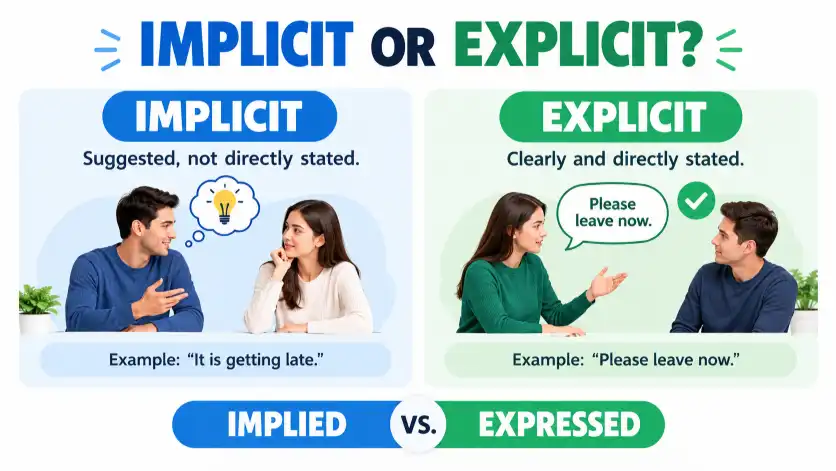
Implicit and explicit describe two different ways of communicating information. Implicit means suggested or understood without being stated directly, while explicit means clearly and directly expressed. Both words are correct, but they have different meanings and uses.
People often search for implicit or explicit because these words appear in English grammar, school assignments, academic writing, business communication, and everyday conversations. Their similar appearance can make them confusing, especially for students and English learners.
For example, if someone says, “It is getting late,” they may be indirectly suggesting that it is time to leave. This is an implicit message because the speaker does not directly ask anyone to leave. However, if the person says, “Please leave now,” the message is explicit because the request is clear.
Understanding the difference helps you communicate more effectively, improve your writing, and recognize implied meanings in conversations and texts. It also helps you choose the right word when explaining ideas, giving instructions, or describing someone’s message.
In this guide, you will learn the meanings, origins, differences, common mistakes, and practical examples of implicit and explicit.
What Is the Difference Between Implicit and Explicit?
Implicit means something is suggested or understood without being stated directly, while explicit means something is expressed clearly and directly. For example, an implicit message hints at an idea, whereas an explicit message explains it openly so there is little room for confusion.
Quick Answer
Use implicit when a meaning or message is suggested rather than directly stated. Use explicit when information is expressed clearly and directly.
Examples:
- Implicit: “The room is getting cold.” This may suggest that someone should close the window.
- Explicit: “Please close the window.” This directly states the request.
- Implicit: A teacher hints that students should improve their work.
- Explicit: A teacher says, “Revise your work before Friday.”
The main difference is simple:
- Implicit = implied or indirect.
- Explicit = expressed or direct.
Both words are correct in English. Choose the one that matches the meaning you want to communicate.
What Does Implicit or Explicit Mean?
What Does Implicit Mean?
Implicit means suggested, implied, or understood without being directly stated. It describes information that people understand through context, actions, tone, or clues rather than clear words.
An implicit message does not always mean someone is hiding information. People often communicate implicitly to sound polite, express feelings subtly, or allow others to understand their intentions.
Examples of implicit meaning include:
- “Your desk is still messy.” This may suggest that someone should clean it.
- “Everyone else has submitted the assignment.” This may hint that a student should submit theirs.
- “She looked disappointed when he arrived late.” Her expression may imply how she felt.
In each example, the intended meaning goes beyond the exact words. The reader or listener must use the situation to understand the possible message.
What Does Explicit Mean?
Explicit means clearly, directly, and openly stated. It describes information that does not depend on hints or indirect suggestions.
People use explicit language when they want others to understand instructions, expectations, facts, or requirements without guessing.
Examples include:
- “Please clean your desk before leaving.”
- “Submit your assignment by Friday.”
- “She told him directly that she felt disappointed.”
These statements communicate their meaning openly. The reader does not need to search for a hidden suggestion to understand the main point.
Explicit language is especially helpful in academic work, business communication, safety instructions, and situations where accuracy matters.
Main Difference Between Implicit and Explicit
The main difference is how a person communicates the meaning.
| Feature | Implicit | Explicit |
| Meaning | Suggested or implied | Clearly stated |
| Communication | Indirect | Direct |
| Understanding | Often depends on context | Usually clear from the words |
| Instructions | May use hints | States what to do |
| Common use | Subtle messages and assumptions | Rules, facts, and directions |
| Example | “It is getting late.” | “Let’s leave now.” |
For example, a manager who says, “The report is missing some details,” may implicitly suggest that an employee should revise it. If the manager says, “Add the missing details before noon,” the instruction is explicit.
Neither style is always better. Implicit communication can sound natural and subtle, while explicit communication helps prevent misunderstandings.
The Origin of Implicit and Explicit
Origin of Implicit
The word implicit comes from Latin implicitus, related to the idea of something being folded or involved within something else. Its meaning developed to describe ideas or messages that are contained within a statement without being directly expressed.
Today, implicit commonly describes meanings, assumptions, expectations, and messages that people understand from context.
For example, an implicit agreement is an understanding that may exist without every detail being directly stated.
Origin of Explicit
The word explicit comes from Latin explicitus, associated with unfolding or making something clear. Its modern meaning reflects the idea of expressing information openly and directly.
Today, explicit is commonly used for clear statements, detailed instructions, openly expressed ideas, and clearly defined conditions.
For example, explicit instructions tell someone exactly what steps to follow.
Why Are Implicit and Explicit Often Confused?
These words look and sound similar, and both describe how information is communicated. However, their meanings differ in an important way.
Implicit refers to what is implied, while explicit refers to what is expressed directly.
A simple memory tip can help you remember the difference:
- Implicit = Implied
- Explicit = Expressed
When you see either word in a sentence, ask yourself if the meaning is suggested or directly stated. This will usually help you choose the correct word.
British English vs American English
There is no major difference between British and American English in the spelling or meaning of implicit and explicit. Both words are standard in both varieties of English.
| British English | American English | Example |
| Implicit | Implicit | The message was implicit. |
| Explicit | Explicit | The instructions were explicit. |
| Implicit meaning | Implicit meaning | The writer suggested an idea indirectly. |
| Explicit instructions | Explicit instructions | The teacher explained every step clearly. |
Regional Differences
British and American writers use these words in much the same way. Neither word belongs exclusively to one region.
The choice depends on the intended meaning, not the country. For example, a British writer and an American writer can both describe an indirect suggestion as implicit and a clear instruction as explicit.
Style Guides and Publishing Preferences
Different publishers and workplaces may have their own rules for tone and clarity. However, these preferences do not change the meanings of implicit and explicit.
- Academic writing: Use explicit wording when presenting important arguments, methods, and conclusions.
- Business writing: Make deadlines, responsibilities, and requirements explicit.
- Creative writing: Use implicit meaning to suggest emotions, themes, or character intentions.
- General writing: Choose the word that accurately describes how the information is communicated.
Which Version Should You Use?
Choose implicit or explicit according to the situation. Neither word is always better, and neither is restricted to a particular country.
United States
American English uses both words regularly.
- Use implicit for an indirect suggestion or unstated assumption.
- Use explicit for a clear statement or direct instruction.
Example: The manager gave explicit instructions for completing the report.
United Kingdom
British English follows the same distinction. Both words are suitable for everyday, professional, and academic writing.
Example: His criticism was implicit rather than direct.
Canada
Canadian English also uses both words with the same meanings.
Example: The contract contains explicit conditions that both parties must follow.
Australia
Australian English uses implicit for indirect meaning and explicit for directly expressed information.
Example: The teacher gave explicit directions for the assignment.
International Writing
For international readers, choose clear wording that people with different levels of English can understand.
Use explicit when you need to remove doubt. Use implicit when the meaning depends on context or an unstated suggestion.
Academic Writing
Academic writing often uses both words to explain ideas and arguments.
- An implicit assumption is an assumption that the writer does not state directly.
- An explicit argument is an argument the writer presents clearly.
- An implicit meaning is an idea readers infer from a text.
- An explicit definition directly explains a term.
When writing an academic paper, make important claims and research methods explicit whenever possible. This helps readers understand your work without guessing.
Business Writing
In business communication, explicit language is often useful for deadlines, responsibilities, policies, and instructions.
Implicit: “Our team gets better results when reports arrive earlier.”
Explicit: “Submit all weekly reports by Wednesday at noon.”
The first sentence suggests a preferred behavior. The second states exactly what employees should do.
Implicit communication can still be useful for gentle suggestions and understanding workplace expectations. However, important tasks should not depend on guesses.
Common Mistakes With Implicit and Explicit
Mistake 1: Treating Both Words as Synonyms
Incorrect: The manager gave an implicit instruction by stating exactly what everyone needed to do.
Correct: The manager gave an explicit instruction by stating exactly what everyone needed to do.
Explanation: The instruction was stated directly, so explicit is the better choice.
Mistake 2: Assuming Implicit Means Secret
Incorrect: An implicit message is always a secret message.
Correct: An implicit message is suggested rather than directly stated.
Explanation: An implicit message may be easy to understand from context. It does not have to be secret or intentionally hidden.
Mistake 3: Assuming Explicit Means Rude
Incorrect: Explicit communication is always rude or aggressive.
Correct: Explicit communication can be polite, firm, or neutral.
Explanation: Being direct does not mean being impolite. For example, “Please arrive by 9 a.m.” is both explicit and courteous.
Mistake 4: Confusing Implicit With Unclear
Incorrect: Every implicit message is meaningless because it is unclear.
Correct: An implicit message can be understandable when the context provides enough clues.
Explanation: Writers often use indirect meaning on purpose. However, different readers may interpret the same message differently.
An Easy Memory Tip
Remember these two associations:
- Implicit = Implied. The meaning is suggested.
- Explicit = Expressed. The meaning is stated directly.
If the speaker gives a direct instruction, think explicit. If the speaker hints at something and expects the listener to understand, think implicit.
Everyday Examples of Implicit and Explicit
These examples show how the two words work in emails, business writing, news, blogs, social media, academic writing, and daily conversations.
1. Emails
Implicit: “I noticed the proposal has not been updated yet.”
The sender may be hinting that the recipient should update it.
Explicit: “Please update the proposal before 2 p.m. today.”
The sender states the task and deadline directly.
2. Business Writing
Implicit: “Our team has had better results when reports arrive earlier.”
This statement may suggest that employees should submit reports sooner.
Explicit: “Submit all weekly reports by Wednesday at noon.”
This instruction clearly states the expected action and deadline.
3. News Headlines

Implicit: “Residents Face Another Long Wait for Repairs.”
The headline may suggest frustration without directly accusing anyone of wrongdoing.
Explicit: “City Officials Delay Repairs Until Next Month.”
The headline directly states who delayed the repairs and when.
4. Blogs
Implicit: “A cluttered desk can make it harder to focus.”
This sentence suggests that tidying the desk may improve concentration.
Explicit: “Clear your desk before starting your next task.”
This sentence directly tells the reader what to do.
5. Social Media
Implicit: “Some people remember birthdays better than others.”
Depending on the situation, this post may hint that someone forgot a birthday.
Explicit: “You forgot my birthday, and that hurt my feelings.”
The writer openly states the problem and its emotional effect.
6. Academic Writing
Implicit: “The study’s results raise questions about the effectiveness of the treatment.”
The sentence suggests that the treatment may not work as expected.
Explicit: “The study found that the treatment did not improve the measured outcome.”
The second sentence directly reports the finding, assuming it accurately reflects the study.
7. Daily Conversation
Implicit: “It is getting late.”
The speaker may be suggesting that it is time to go home.
Explicit: “Let’s leave now so we can get home before midnight.”
The speaker directly explains the proposed action and reason.
8. Rules and Instructions
Implicit: “Visitors usually remove their shoes before entering this room.”
This describes a custom that may suggest what visitors should do.
Explicit: “Please remove your shoes before entering this room.”
The instruction clearly states what visitors are expected to do.
Google Trends and Modern Usage
Implicit and explicit remain useful English words in education, professional communication, literature, psychology, technology, and everyday writing.
People may search for implicit or explicit when they encounter these terms in school assignments, reading comprehension exercises, workplace documents, or discussions about communication.
Why Do People Search for These Words?
Common reasons include:
- Understanding the difference between implicit and explicit meaning.
- Learning how to identify an implied message in a story.
- Understanding explicit instructions in a policy or contract.
- Improving academic and professional writing.
- Finding examples of implicit and explicit communication.
Modern Usage Patterns
Implicit often appears in phrases such as:
- Implicit meaning
- Implicit bias
- Implicit assumption
- Implicit agreement
Explicit commonly appears in phrases such as:
- Explicit instructions
- Explicit consent
- Explicit details
- Explicit statement
These phrases show how the words work in different contexts. The exact meaning still depends on the sentence.
What About Google Trends Data?
No verified, current Google Trends figures are included here, so exact search volumes and regional rankings should not be assumed.
General usage patterns show that both words are relevant across education, writing, business, and communication. Search interest may vary by topic and region, but that does not establish which word is more popular in a particular country.
For Wordslit, the most useful approach is to explain the difference with clear examples rather than relying on unsupported popularity claims.
Quick Comparison Table: Implicit vs Explicit
| Version | Meaning | Correct? | Region | Example |
| Implicit | Suggested but not directly stated | Yes | International | Her reply contained an implicit warning. |
| Explicit | Clearly and directly stated | Yes | International | He gave explicit directions. |
| Implicit meaning | Meaning inferred from context | Yes | International | The story has an implicit message. |
| Explicit meaning | Meaning expressed directly | Yes | International | The author gave an explicit explanation. |
Key Takeaways
- Implicit means suggested or understood without being directly stated.
- Explicit means clearly and directly expressed.
- Both words are correct in British and American English.
- Implicit messages often depend on context, tone, or clues.
- Explicit communication helps reduce confusion about tasks and expectations.
- Implicit does not automatically mean secret, and explicit does not mean rude.
- Use implicit for implied ideas and explicit for directly stated information.
- Remember: implicit is implied, while explicit is expressed.
Frequently Asked Questions
Q1: What is the main difference between implicit and explicit?
Implicit means a message is suggested without being directly stated. Explicit means the message is expressed clearly and directly. For example, “The room is cold” may implicitly suggest closing a window, while “Please close the window” explicitly states the request. The key difference is if the reader must infer the meaning or can understand it directly.
Q2: Is implicit the opposite of explicit?
Yes, implicit and explicit are opposites in many contexts. Implicit describes something implied or understood indirectly, while explicit describes something openly stated. For example, an implicit expectation may be understood from workplace behavior, whereas an explicit expectation appears in written instructions. Both words are correct, but they describe different ways of communicating information.
Q3: What is an example of implicit meaning?
An example of implicit meaning is the sentence, “Your clothes are still wet.” Depending on the situation, the speaker may be suggesting that you should wait before wearing them. The sentence does not directly tell you to wait, so the suggestion is implicit. Context helps the listener understand the possible intention behind the statement.
Q4: What is an example of explicit meaning?
An example of explicit meaning is, “Wait until your clothes are dry before wearing them.” The speaker directly explains what the listener should do and when. The instruction does not depend on interpreting a hint. Explicit language is especially useful for safety instructions, school assignments, workplace policies, and situations where people need to understand exactly what is expected.
Q5: What is the difference between implicit and explicit in literature?
In literature, implicit meaning is an idea readers infer from a character’s actions, dialogue, symbols, or events. Explicit meaning is directly stated by the narrator or a character. For example, a character who avoids eye contact may implicitly show discomfort. If the narrator says, “She felt uncomfortable,” the feeling is expressed explicitly.
Q6: What does implicit mean in simple words?
Implicit means understood without being said directly. It often involves a hint, an assumption, or a meaning that readers work out from context. For example, if someone says, “Everyone else has finished the task,” they may be indirectly encouraging you to finish yours. The sentence itself does not directly tell you to hurry.
Q7: What does explicit mean in simple words?
Explicit means clear, direct, and stated openly. For example, “Finish the task before lunch” is explicit because it tells someone exactly what to do and gives a deadline. Explicit language helps people understand instructions without relying on hints. It is commonly used in schoolwork, contracts, workplace communication, and explanations that require precision.
Q8: Are implicit and explicit used differently in British and American English?
No significant difference exists between British and American English in the spelling or meaning of these words. Both varieties use implicit for implied information and explicit for directly stated information. Writers in both countries can use these words in academic, professional, and everyday settings. The choice depends on the intended meaning rather than regional spelling rules.
Q9: How can I remember the difference between implicit and explicit?
Use the memory tip implicit = implied and explicit = expressed. An implicit message requires you to interpret a suggestion or clue. An explicit message states the information directly. When you are unsure which word to use, ask yourself if the meaning is suggested or clearly written or spoken. This simple question will usually help you choose correctly.
Q10: Should I use implicit or explicit in academic writing?
Use both words when they accurately describe your point. Choose implicit when discussing an unstated assumption, implied meaning, or indirect suggestion. Choose explicit when discussing a clearly stated claim, definition, instruction, or conclusion. In academic writing, make important arguments and methods explicit whenever possible so readers do not have to guess what you mean.
Conclusion
The difference between implicit and explicit comes down to how information is communicated. Implicit means suggested or understood indirectly, while explicit means clearly and directly stated. Both words are correct, and both play important roles in English grammar, reading, writing, and communication.
Use implicit when describing a hint, an unstated assumption, or a meaning that readers must infer from context. Use explicit when describing a direct instruction, a clear statement, or information that leaves little room for doubt.
For academic and business writing, explicit language is often the safer choice when you need to communicate important facts, expectations, or instructions. In creative writing and everyday conversations, implicit language can make communication more subtle and natural.
Remember that implicit does not always mean hidden, and explicit does not always mean blunt. Context determines how each word works in a sentence.
The easiest rule to remember is this: implicit is implied, while explicit is expressed. Keep this distinction in mind when reading, writing, or speaking, and you will be better prepared to use both words accurately. If this guide helped you understand the difference, use the examples to practice writing your own sentences.
Read More About !

“I’m Charlotte Vans, and I enjoy making grammar and word usage easier to understand. Through my writing, I help readers understand confusing words, improve spelling, and write with greater confidence.”






1 thought on “Implicit or Explicit: Meaning, Differences, and Examples”