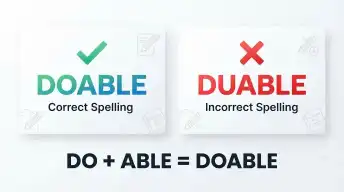
If you are unsure if “duable or doable” is correct, the answer is simple: doable is the correct standard English spelling. It means that something can be done, completed, or achieved. Duable is generally considered a misspelling and should be avoided in standard English writing.
This confusion is common because doable is formed from the verb do plus the suffix ,able, while its pronunciation may make the spelling less obvious. Students, ESL learners, writers, and even native English speakers may sometimes wonder if duable could be an alternative spelling.
In this guide, we will explain the meaning of doable, its correct spelling, origin, British and American English usage, common mistakes, practical examples, and an easy memory trick. You will also see a quick comparison between duable and doable so you can confidently choose the right word.
Duable or Doable: What’s the Correct Spelling?
Doable is the correct standard English spelling, while duable is generally a misspelling. Doable means that something is possible, practical, or capable of being done. For example, “The project is doable within a week” means the project can realistically be completed within a week. The word is used in both British and American English, so doable is the spelling you should use in standard writing.
Duable or Doable: Quick Answer
The correct spelling is doable.
- ✅ Doable = possible, manageable, or capable of being done
- ❌ Duable = nonstandard spelling or spelling mistake
Examples
- The task is doable in one day.
- Is this plan doable with our current budget?
- She believes the goal is completely doable.
The easiest way to understand the spelling is:
do + able = doable
The base word is do, not du. When ,able is added, the standard form becomes doable.
Duable vs Doable
If you are writing an email, article, school assignment, business report, or social media post, choose:
Doable
Avoid:
Duable
What Does Doable Mean?
Doable is an adjective that means possible, manageable, or capable of being done.
It is used when someone wants to say that a task, plan, goal, project, or activity can realistically be completed.
Simple Meaning of Doable

In simple English:
Doable means “something that can be done.”
For example:
The assignment is doable before Friday.
This means the assignment can realistically be completed before Friday.
Another example:
The journey is long, but it is doable.
Here, doable means the journey is possible or manageable.
Definition of Doable
Doable means capable of being done successfully or reasonably accomplished.
The word can describe many different things, including:
- Tasks
- Projects
- Goals
- Plans
- Deadlines
- Activities
- Challenges
- Changes
- Workloads
For example:
Finishing the report today is doable.
The speaker believes finishing the report today is realistic.
Doable Can Mean “Manageable”
Sometimes doable does not simply mean technically possible. It can also suggest that something is manageable or realistic under the circumstances.
Compare these sentences:
The project is possible.
The project is doable.
Both sentences suggest that the project can be completed. However, doable often sounds more practical and conversational.
For example:
Working eight hours today is possible.
This only states that it can happen.
Working eight hours today is doable.
This suggests that the workload is manageable.
The Origin of Doable
The word doable is formed from the verb do and the suffix ,able.
The suffix ,able is used in English to create adjectives that describe something capable of being done, used, understood, or experienced.
Consider these examples:
- read → readable
- understand → understandable
- enjoy → enjoyable
- wash → washable
- do → doable
The same basic word,building idea applies to doable.
Why Is It Doable and Not Duable?
The spelling can seem confusing because the pronunciation may not make the connection to do immediately obvious.
However, the standard spelling keeps the original form of the verb:
DO + ABLE → DOABLE
The spelling duable does not represent the standard formation of this word.
This is why dictionaries and standard English usage use doable when the intended meaning is “capable of being done.”
Is Duable Ever a Standard Alternative?
For ordinary English writing, no.
You may occasionally see duable written online, especially in user,generated content, but its appearance does not make it an accepted standard alternative spelling.
If your goal is correct English, use doable.
British English vs American English
One useful thing about this word is that there is no standard British,American spelling difference.
Both British and American English use:
doable
| British English | American English | Example |
| doable | doable | The task is doable. |
| doable | doable | The deadline is doable. |
| doable | doable | The plan seems doable. |
| duable ❌ | duable ❌ | Not the standard spelling |
British English
British writers use doable when they mean that something can be done.
The work is difficult, but it is doable.
American English
American writers also use doable.
The project is doable within the current budget.
So you do not need to change the spelling depending on if your audience is in the UK or US.
What About Canada and Australia?
The same standard spelling is used in Canadian and Australian English:
doable
Therefore, doable is the appropriate choice for most international English writing as well.
Which Version Should You Use?
The simple rule is:
Use “doable” in standard English.
United States
Use doable in:
- Emails
- School assignments
- Articles
- Business communication
- Reports
- Websites
- Everyday conversations
Example:
The new deadline is doable.
United Kingdom
Use doable in British English as well.
Example:
The project is challenging, but it is doable.
Canada
Canadian English also uses doable.
Australia
Australian English uses doable as the standard form.
International Writing
If your content is intended for an international audience, doable is the safest and clearest choice.
Academic Writing
Doable is grammatically correct, but it can sound somewhat conversational.
For example:
The experiment is doable within six months.
This is understandable and correct.
A more formal version might be:
The experiment is feasible within six months.
The words are similar, but feasible often fits formal academic or technical writing better.
Business Writing
Doable is common in workplace communication:
The proposed schedule is doable if we add another employee.
For a formal report, you could use:
The proposed schedule is feasible with additional resources.
Common Mistakes
1. Writing “Duable”
❌ The project is duable.
✅ The project is doable.
The standard spelling is doable.
2. Thinking “Duable” Is the British Version
❌ Duable is British English.
✅ Doable is used in both British and American English.
There is no standard British spelling duable for this meaning.
3. Adding the Suffix Incorrectly
Some writers may think that because do sounds unusual when combined with able, the spelling should change.
But the standard form is:
do + able = doable
4. Using “Doable” When a More Formal Word Is Better
This is not a spelling error, but it can be a style issue.
Informal:
The deadline is doable.
More formal:
The deadline is feasible.
Both communicate a similar idea, but the second may suit a formal report better.
Common Mistakes
Understanding the correct spelling is easier when you look at the mistakes people commonly make.
Mistake 1: Writing “Duable”
❌ The task is duable.
✅ The task is doable.
Doable is the standard English spelling. The word is connected to the verb do, so the correct form is doable.
Mistake 2: Assuming “Duable” Is an Alternative Spelling
❌ Both duable and doable are correct.
✅ Doable is the standard spelling.
Although duable may appear in online writing, it should not be treated as a standard alternative.
Mistake 3: Confusing Spelling With Pronunciation
The pronunciation of doable can make the spelling seem less obvious.
You might hear the word and think it begins with a sound closer to du,. However, spelling should follow the established written form:
DO + ABLE = DOABLE
Mistake 4: Using the Wrong Word in Formal Writing
Doable is correct, but it can have a conversational tone.
For example:
The plan is doable.
In a formal report, you might instead write:
The plan is feasible.
This is a matter of style, not correctness.
Easy Memory Tip
Remember this simple formula:
DO + ABLE = DOABLE
If you can DO something, it is DOABLE.
Everyday Examples of Doable
Doable is a flexible word. It can appear in conversations, emails, business writing, blogs, social media, and many other types of communication.
1. Doable in Emails
You might use doable when discussing deadlines or tasks.
I think the revisions are doable by Friday.
This means the revisions can realistically be completed by Friday.
Another example:
The requested changes are doable, but we may need another day.
2. Doable in Business Writing
In workplace communication, doable can describe a realistic schedule or plan.
The proposed timeline is doable with the current team.
Another example:
Is the new deadline doable for everyone?
Here, the word asks if the deadline is practical and manageable.
3. Doable in News Headlines
News writing may use doable when discussing goals, plans, targets, or proposed changes.
For example:
New Climate Target Considered Doable
The word tells readers that the target is viewed as possible or achievable.
4. Doable in Blog Writing
Bloggers often use doable when giving practical advice.
These five steps make healthy eating more doable.
Here, doable means easier to manage in everyday life.
5. Doable on Social Media
The word is also common in casual online communication.
A 30,day writing challenge sounds difficult, but it’s doable!
This sounds natural and encouraging.
6. Doable in Academic Writing
You can use doable in academic writing, especially when the tone is not highly formal.
The research project is doable within the available time.
For a formal academic paper, however, feasible may sometimes be a better choice:
The research project is feasible within the available time.
7. Doable in Daily Conversation
This is one of the most natural uses.
Can we finish this today?
Yes, it’s doable.
Here, doable simply means possible or manageable.
Doable vs Possible vs Feasible
These words can be similar, but they are not always interchangeable in tone.
| Word | Basic Meaning | Typical Tone | Example |
| Doable | Can be done | Everyday / conversational | The task is doable. |
| Possible | Can happen or exist | Neutral | The plan is possible. |
| Feasible | Practical and realistically achievable | Formal | The proposal is feasible. |
| Achievable | Can be successfully reached | Neutral / formal | The goal is achievable. |
| Manageable | Not too difficult to handle | Practical | The workload is manageable. |
Doable
Use doable when you want a simple, natural way to say something can be done.
The assignment is doable.
Possible
Use possible when you simply want to state that something can happen.
It is possible to finish today.
Feasible
Use feasible when discussing if something is practical, especially in professional, technical, or academic contexts.
The proposed solution is feasible.
Achievable
Use achievable when talking about goals or targets.
The sales target is achievable.
Google Trends & Modern Usage
People search for “duable or doable” because the two spellings can be confused when the word is heard rather than seen.
The main reason for the confusion is that English spelling does not always match pronunciation perfectly. The word doable can therefore cause uncertainty, especially for learners who are still building their English vocabulary.
Modern standard English uses doable.
Searches for spelling comparisons like this commonly come from:
- Students checking their writing
- ESL learners
- Writers and bloggers
- Editors and proofreaders
- Professionals writing emails
- People checking unfamiliar words
- Users correcting spelling mistakes
There is no need to treat duable and doable as two competing standard spellings. For standard English, doable is the form to use.
Regional Usage
Unlike words such as colour/color or centre/center, doable does not have a standard British,American spelling difference.
The same spelling is used in:
- American English
- British English
- Canadian English
- Australian English
- International English
So the choice is simple:
Use doable.
Quick Comparison Table
| Version | Meaning | Correct? | Region | Example |
| Doable | Possible or manageable | ✅ Yes | English worldwide | The project is doable. |
| Duable | Intended to mean “possible” | ❌ No, not standard | None as a standard spelling | Avoid this spelling. |
Doable vs Duable
| Feature | Doable | Duable |
| Standard spelling | ✅ Yes | ❌ No |
| Means “capable of being done” | ✅ | Intended meaning |
| British English | ✅ | ❌ |
| American English | ✅ | ❌ |
| Canadian English | ✅ | ❌ |
| Australian English | ✅ | ❌ |
| Suitable for general writing | ✅ | ❌ |
| Suitable for professional writing | ✅ | ❌ |
| Correct spelling for Wordslit content | ✅ | ❌ |
Key Takeaways
- Doable is the correct standard English spelling.
- Duable is generally a misspelling.
- Doable means possible, practical, or manageable.
- The word comes from do + ,able.
- Both British and American English use doable.
- The spelling does not change based on region.
- Doable works well in everyday and general professional writing.
- Feasible may be a more formal alternative in academic or technical contexts.
- Remember: DO + ABLE = DOABLE.
FAQs About Duable or Doable
Q1: Is “duable” or “doable” correct?
Doable is the correct standard English spelling. It means something is possible, manageable, or capable of being done. Duable is generally considered a spelling mistake. If you are writing an article, email, assignment, report, or social media post, doable is the form you should use.
Q2: What does doable mean?
Doable means that something can be done, completed, or achieved. It can also suggest that something is practical or manageable. For example, “The assignment is doable” means the assignment can realistically be completed. The word can describe tasks, plans, goals, deadlines, projects, and other activities.
Q3: Is duable a real word?
Duable may appear in some online content, but it is not the standard spelling for the meaning “capable of being done.” Its appearance in user,generated content does not make it an accepted alternative to doable. In standard English writing, doable is the appropriate form.
Q4: Is doable one word?
Yes. Doable is one word. It is formed from the verb do and the suffix ,able. The correct form is written as doable, not do able. For example, you should write, “The project is doable,” rather than separating the two parts.
Q5: Is doable formal English?
Doable is standard English, but it often has a conversational or everyday tone. It is perfectly suitable for general communication, emails, blogs, and informal business writing. In highly formal academic or technical writing, feasible, practicable, or achievable may sometimes be more appropriate.
Q6: Is doable British English?
Yes. Doable is used in British English. It is also used in American, Canadian, Australian, and international English. There is no standard British spelling duable. Therefore, British writers should also use doable when they mean something is possible or manageable.
Q7: What is another word for doable?
Depending on the sentence, alternatives include possible, feasible, achievable, manageable, practical, realistic, and attainable. These words have slightly different shades of meaning. Feasible often suits formal contexts, while manageable focuses more on if something is reasonably easy to handle.
Q8: How can I remember the spelling of doable?
Use the simple memory formula DO + ABLE = DOABLE. Start with the complete verb do, then add ,able. This gives you doable. Remembering the base word prevents the common mistake of changing the spelling to duable.
Q9: Can doable be used in academic writing?
Yes, but the context matters. Doable is grammatically correct, although it may sound less formal than words such as feasible or achievable. For example, “The experiment is doable” is understandable, while “The experiment is feasible” may sound more appropriate in a formal research paper.
Q10: Why is doable sometimes spelled duable?
The confusion usually comes from pronunciation. When people hear doable, they may not immediately connect the first part of the word with do. However, the standard spelling retains the base verb: do + able = doable. That is why doable, not duable, is the correct form.
Conclusion
When deciding between duable or doable, the correct choice is doable. It is the standard English spelling for something that can be done, completed, or achieved. The word can also suggest that a task or plan is practical and manageable.
The spelling becomes easier to remember when you connect it to the original verb do. Simply think of it as:
DO + ABLE = DOABLE
There is no standard British,American spelling difference here. British, American, Canadian, Australian, and international English all use doable. The spelling duable may appear online, but it should not be used as the standard form in your writing.
For everyday communication, doable is natural and useful. In very formal academic, technical, or professional writing, alternatives such as feasible or achievable may sometimes fit better depending on the context.
The simple rule to remember: If you can DO it, it is DOABLE.
Read More About !

“I’m Charlotte Vans, and I enjoy making grammar and word usage easier to understand. Through my writing, I help readers understand confusing words, improve spelling, and write with greater confidence.”