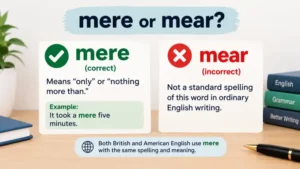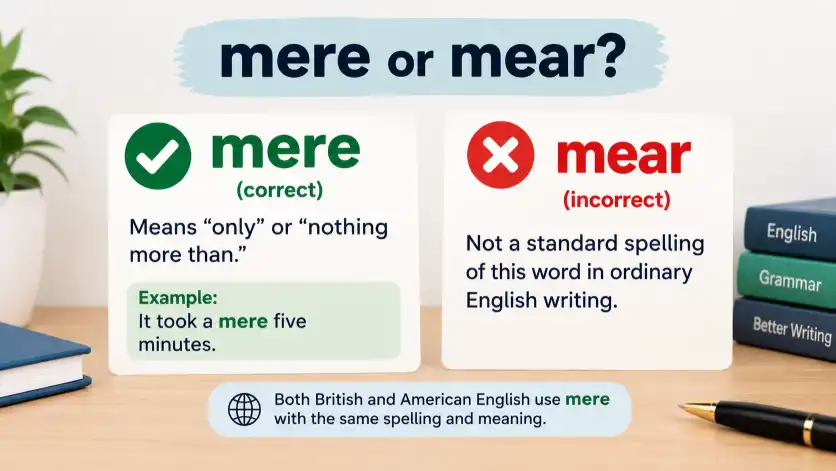
The correct spelling is mere or mear: “mere” is correct when you mean “only,” “nothing more than,” or something small in amount or importance. For example, you can say, “It took a mere five minutes to finish the task.” The word “mear” is not a standard alternative spelling in this context.
Many people search for mere or mear because the words look and sound similar. This can cause confusion when writing emails, school assignments, blog posts, or professional documents. Choosing the right spelling helps you communicate clearly and avoid common English mistakes.
In this guide, you will learn the meaning of mere, understand why mear is usually incorrect, and explore practical examples of how to use the correct word. You will also discover whether British and American English use different spellings and how to remember the difference.
Whether you are an English learner, student, writer, or editor, this comparison will help you use the word with confidence.
What Is the Difference Between Mere and Mear?
Mere or mear: Mere is the correct standard English word meaning “only” or “nothing more than.” For example, “It took a mere five minutes.” Mear is not a standard spelling of this word in ordinary English writing. Both British and American English use mere with the same spelling and meaning.
Mere or Mear: Quick Answer
Use mere when you mean “only,” “nothing more than,” or something limited in amount or importance. Avoid mear when you intend this meaning because it is not the standard spelling.
Examples:
- Correct: It was a mere misunderstanding.
- Incorrect: It was a mear misunderstanding.
- Correct: She won by a mere point.
Easy rule: Remember that mere is the standard spelling in both British and American English.
What Does Mere Mean?
The word mere is an adjective that means “only,” “nothing more than,” or something limited in amount, size, or importance. It often emphasizes that something is smaller or less significant than people might expect.
Definition of Mere:mere or mear
Mere describes something that is only what is stated, without anything extra or more important.
Examples:
- A mere child: Someone who is only a child.
- A mere suggestion: An idea that is not a final decision.
- A mere five minutes: Only five minutes.
- A mere coincidence: An event that happens by chance.
How to Use Mere in a Sentence:mere or mear
You will usually see mere before a noun.
- It took a mere minute to solve the problem.
- Her comment was a mere suggestion.
- A mere promise cannot guarantee success.
- The team won by a mere two points.
- Mere words cannot always express our feelings.
In each example, mere emphasizes a limited amount, action, or quality.
Is Mere Always Negative?
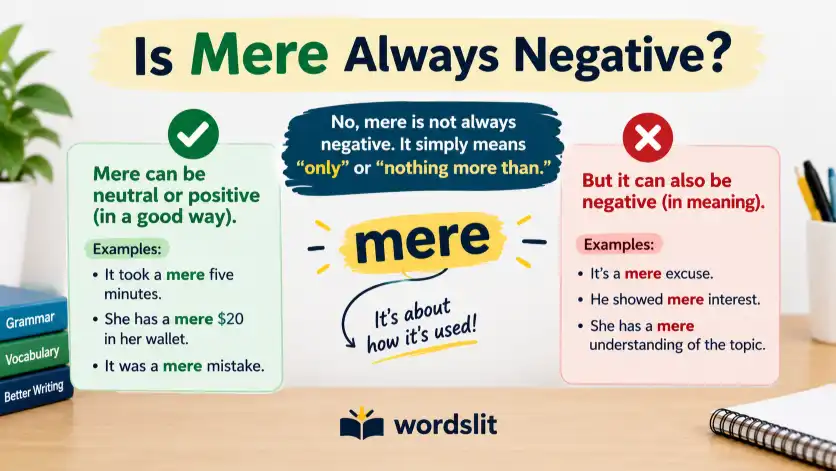
No. The meaning depends on the context.
- Neutral: The journey took a mere hour.
- Positive: A mere smile brightened her day.
- Dismissive: He treated the warning as a mere rumor.
The word can highlight something small without suggesting that it has no value.
The Origin of Mere and Mear
Where Does the Word Mere Come From?
The word mere, meaning “only” or “nothing more than,” developed through Middle English and Old French and is ultimately linked to the Latin word merus, meaning “pure” or “unmixed.” Over time, mere developed its modern sense of describing something as only what is stated.
The spelling mere became established in standard English. There is no standard spelling change that makes mear an accepted alternative for this meaning.
Why Do People Write Mear Instead of Mere?
People may confuse mere and mear for several reasons:
- Similar sounds: The words look similar, and pronunciation can make spelling harder to remember.
- Typing errors: Writers may accidentally type mear instead of mere.
- English spelling rules: English words do not always follow predictable sound-to-letter patterns.
- Online confusion: Seeing an unfamiliar spelling online may lead readers to question which form is correct.
The key point is that a similar sound does not make mear a standard replacement for mere.
British English vs American English:mere or mear
British and American English use mere with the same spelling and meaning. Unlike words such as colour and color, this word does not have separate standard British and American spellings.
| British English | American English | Example |
| Mere | Mere | It was a mere mistake. |
| A mere five minutes | A mere five minutes | The meeting lasted a mere five minutes. |
| Mere words | Mere words | Mere words cannot solve the problem. |
| Mear is not standard for this meaning | Mear is not standard for this meaning | Use mere, not mear. |
Do British and American Dictionaries Accept Mear?
Standard English dictionaries recognize mere as a word with established meanings. Mear is not the usual standard spelling for those meanings.
You should not choose between these spellings based on your audience’s location. Both British and American readers expect mere when you mean “only” or “nothing more than.”
What About Style Guides?
For school assignments, business documents, journalism, and academic writing, use mere when it accurately expresses your intended meaning.
If you encounter Mear as a proper name or specialized term, check its context. That use does not make it a standard alternative to mere in ordinary English.
Which Version Should You Use?:Mere or Mear
In almost all everyday writing, choose mere. Your location and intended audience do not change this recommendation.
United States
American English uses mere in formal and informal writing.
Example: The repair cost a mere $20.
United Kingdom
British English uses the same spelling.
Example: The journey took a mere ten minutes.
Canada
Canadian English also uses mere in this context.
Example: It was a mere suggestion, not a final decision.
Australia
Australian English follows the same standard spelling.
Example: The team won by a mere point.
International Writing
Use mere when writing for an international audience. It is the standard choice and avoids unnecessary spelling confusion.
Academic Writing
In academic work, use mere when it clearly expresses your meaning. However, consider whether it sounds too dismissive for your argument.
- Neutral: The study included a small sample.
- Emphatic: The study included a mere ten participants.
The second example stresses how limited the sample was.
Business Writing
Use mere when you want to emphasize a limited amount or show that something is not enough on its own.
Example: A mere verbal promise cannot guarantee success.
Avoid mear in professional documents because it is not the standard spelling for this meaning.
Common Mistakes:Mere or Mear
Mistake 1: Using Mear Instead of Mere
Incorrect: The task took a mear five minutes.
Correct: The task took a mere five minutes.
Explanation: Mere means “only” in this sentence. Mear is not the standard spelling.
Mistake 2: Treating Mear as a British Spelling
Incorrect: British writers use mear, while American writers use mere.
Correct: Both British and American writers use mere.
Explanation: There is no standard regional spelling difference between these forms.
Mistake 3: Confusing Mere With More
Incorrect, if you mean an additional cup: I need a mere cup of coffee.
Correct: I need one more cup of coffee.
Explanation: Mere means “only” or “nothing more than.” More means an additional amount or a greater quantity.
Mistake 4: Assuming Mere Always Means Unimportant
Incorrect assumption: A mere smile cannot make a difference.
Better understanding: A mere smile can have a meaningful effect.
Explanation: Mere can emphasize the small size of an action without proving that the action has little value.
Easy Memory Tip
Remember this sentence:
“A mere mistake is still a mistake.”
The word mere ends in e. Use this spelling when you mean “only” or “nothing more than.”
Everyday Examples of Mere and Mear
Understanding mere becomes easier when you see it in different types of writing. In the following examples, mere is the correct spelling, while mear would be incorrect if used with the same meaning.
1. Emails
“Please remember that this is a mere suggestion, and the final decision is yours.”
Here, mere shows that the suggestion is not a final decision or a demand.
2. Business Writing
“The company achieved its target with a mere 5% increase in costs.”
The word mere emphasizes that the increase was small.
3. News Headlines
Examples:
- A Mere Two Points Separate the Teams
- The Project Was Delayed by a Mere Day
- Mere Words Cannot Explain the Impact
In headlines, mere can highlight a small amount or create emphasis.
4. Blogs
“A mere change in your daily routine can help you build better habits.”
This sentence suggests that even a small change may make a difference.
5. Social Media
Examples:
- A mere coffee break made my day!
- It took a mere ten minutes to finish.
- A mere smile can brighten someone’s day.
These examples show how mere can fit naturally into informal writing.
6. Academic Writing
“The findings were based on a mere twelve participants, so further research is needed.”
Here, mere emphasizes the limited number of participants. In formal research, use it only when that emphasis suits your intended meaning.
7. Daily Conversation
Examples:
- It was a mere misunderstanding.
- We waited for a mere five minutes.
- That is a mere excuse.
You can use mere in conversation, although only may sound more natural in some situations.
Google Trends and Modern Usage:Mere or Mear
Is Mere More Common Than Mear?
In standard English writing, mere is the established spelling for the meaning discussed in this article. Mear is not a standard alternative for that meaning.
This describes general English usage, not a measured Google Trends result. Exact search-volume figures should not be assumed without checking current data.
Why Do People Search for Mere or Mear?
Readers may search for this comparison because they:
- Want to confirm the correct spelling.
- Have heard the word but are unsure how to write it.
- Need to check a sentence before publishing it.
- Are learning English as a second language.
- Want to know whether British and American English use different spellings.
What Does Modern English Usage Show?
Mere remains useful in everyday and formal writing. Common expressions include a mere suggestion, a mere coincidence, and a mere five minutes.
Mear may appear in names, specialized contexts, or spelling mistakes. These appearances do not establish it as a standard spelling of mere.
To compare search interest over time, you would need to examine both terms in Google Trends and select the regions and dates you want to study.
Quick Comparison Table:Mere or Mear
| Version | Meaning | Correct? | Region | Example |
| Mere | Only; nothing more than | Yes | US, UK, Canada, Australia, international English | It took a mere minute. |
| Mear | Not the standard spelling for this meaning | No, in this context | No standard regional preference | Write mere, not mear. |
| More | An additional amount or a greater quantity | Yes, when intended | Standard English worldwide | I need more time. |
The main difference is simple: mere is the correct spelling for the intended meaning, while more is a separate word with a different meaning.
Key Takeaways
- Mere is the correct standard spelling for the meaning discussed here.
- Mear is not a standard alternative to mere in ordinary English writing.
- Mere can mean “only,” “nothing more than,” or something limited in amount or importance.
- British and American English both use mere.
- You can use mere in emails, blogs, academic work, and everyday conversation.
- Do not confuse mere with more, which refers to an additional or greater amount.
- Remember this example: “It took a mere five minutes.”
Frequently Asked Questions
Q1: Is mere or mear the correct spelling?
Mere is the correct standard spelling when you mean “only,” “nothing more than,” or something small in amount or importance. Mear is not a standard alternative for this meaning. For example, write “It took a mere five minutes,” not “It took a mear five minutes.”
Q2: What does the word mere mean?
Mere is an adjective that emphasizes a limited amount, fact, or quality. It can mean “only” or “nothing more than.” For example, “It was a mere suggestion” means it was only a suggestion, not a firm decision or promise.
Q3: Is mear ever a correct English word?
Mear is not the standard spelling of mere in ordinary English usage. It may appear in proper names or specialized contexts, so its meaning depends on the context. However, when you want to express “only” or “nothing more than,” use mere.
Q4: Do British people spell mere as mear?
No. British English uses mere, just as American English does. The spelling mear is not a recognized regional alternative for this common word. If you are writing for a British audience, use mere in sentences such as “It was a mere coincidence.”
Q5: What is an example of mere in a sentence?
Here is a simple example: “The repair took a mere ten minutes.” In this sentence, mere emphasizes that the repair took only a short amount of time. Another example is “A mere apology was not enough to solve the problem.”
Q6: What is the difference between mere and more?
Mere means “only” or “nothing more than,” while more refers to an additional amount or a greater quantity. For example, “It took a mere hour” emphasizes a limited amount of time. “It took more than an hour” means the time exceeded one hour.
Q7: Can I use mere in formal writing?
Yes. Mere is suitable for academic writing, business documents, essays, and professional communication. Use it when you want to emphasize that something is limited or insufficient. For example, “Mere promises cannot replace a clear agreement.” Make sure the emphasis fits your intended meaning.
Q8: Is mere an adjective?
Yes. Mere is generally used as an adjective before a noun. Examples include a mere child, a mere suggestion, and a mere coincidence. It describes something as only what is stated or emphasizes its limited amount or significance.
Q9: Why do people confuse mere and mear?
People may confuse these spellings because they look similar and pronunciation can make spelling harder to remember. Typing mistakes and uncertainty about English spelling can also cause confusion. The easiest solution is to remember that mere is the standard spelling for the meaning “only” or “nothing more than.”
Q10: How can I remember the spelling of mere?
Remember this example: “A mere mistake can teach you something.” The word mere ends in e, and that is the spelling you should use for its standard meaning. Reading and writing a few example sentences can help you remember it more easily.
Conclusion
When choosing between mere and mear, the correct spelling for ordinary English writing is mere. It means “only,” “nothing more than,” or something limited in amount or importance. You can use it in everyday conversations, emails, academic assignments, blog posts, and professional documents.
The spelling does not change between British and American English. Both use mere, so you do not need a different version for readers in another country.
Although mear may appear in names or specialized contexts, it is not the standard replacement for mere. You should also remember the difference between mere and more, because these words have different meanings.
If you are unsure, try replacing mere with only. If the sentence keeps its intended meaning, mere may be the right choice.
The easiest rule to remember is this: use “mere” for “only,” and avoid “mear” when writing standard English.
Keep exploring word comparisons to improve your spelling, grammar, and everyday writing skills.
Read More About !

“I’m Charlotte Vans, and I enjoy making grammar and word usage easier to understand. Through my writing, I help readers understand confusing words, improve spelling, and write with greater confidence.”