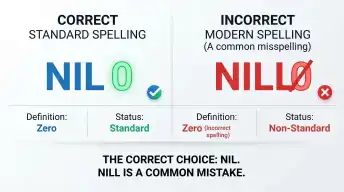
Nil is the correct and standard spelling when you mean zero, nothing, or no amount. Nill is not normally used as the modern spelling of this word. For example, you can say, “The final score was two nil,” meaning one side scored two and the other scored zero.
People often search for nill or nil because the words sound similar when spoken. This can make the spelling confusing, especially for ESL learners, students, writers, and anyone who is unsure if the word should have one l or two.
The word nil is common in British English, especially in sports scores, but it is also understood in American and international English. It can describe zero in sports, business, finance, and everyday expressions.
In this article, we will explain the meaning of nil, its origin, regional usage, common mistakes, and the difference between nil and zero. We will also look at practical examples so you can confidently choose the correct word.
Nill or Nil: Featured Snippet Answer
Nil is the correct standard spelling when you mean zero, nothing, or no amount. For example, “The score was three nil” means the first team scored three while the other team scored zero. Nill is not normally used for this meaning in modern standard English.
Nill or Nil: Quick Answer
If you are choosing between nill or nil, use nil when you mean zero or nothing.
Examples
- The final score was two nil.
- The risk is nil.
- The company reported nil income from the project.
Quick Rule
- Nil = zero or nothing.
- Nill = not the standard modern spelling for this meaning.
- Use nil when referring to zero in contexts where the word fits naturally.
What Does Nil Mean?
Nil is a noun that means zero, nothing, or no amount.
It is often used when talking about scores, quantities, results, or the absence of something.
For example:
The football match ended three nil.
This means one team scored three goals and the other team scored none.
The word can also describe something that is considered nonexistent or equal to zero.
The chance of success is nil.
Here, nil means that there is no chance or that the chance is considered zero.
Simple Definition
Nil means zero, nothing, or no amount.
Common Uses of Nil
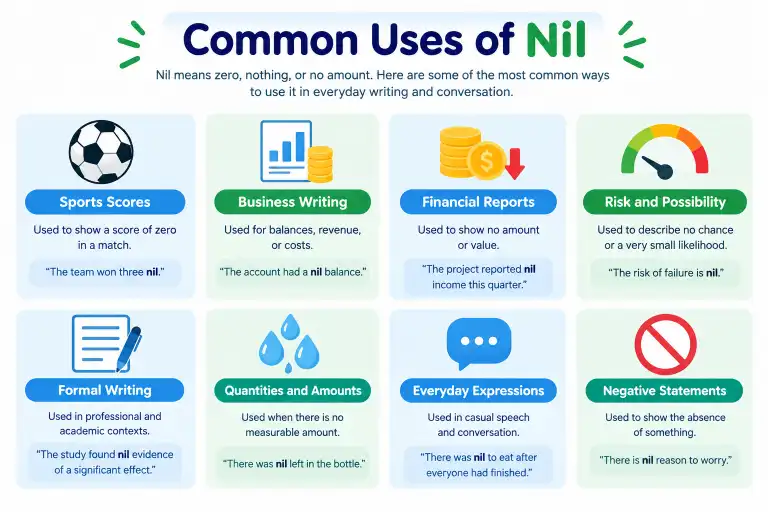
You may see nil in:
- Sports scores
- Business writing
- Financial reports
- Formal writing
- Discussions of risk
- Descriptions of quantities
- Everyday expressions
The Origin of Nil
The word nil is connected to the Latin word nihil, meaning nothing. Over time, nil became established in English as a short word referring to zero or an absence of something.
Its connection with the idea of “nothing” is also reflected in other English words derived from Latin nihil.
Today, nil has a clear and practical meaning. It is often used when a writer wants to express zero without simply using the numeral 0 or the word zero.
One of its most familiar uses is in sports:
The team won four nil.
In this sentence, nil represents the score of zero.
Why Is Nill Confusing?
The main reason for the confusion is pronunciation. When people hear nil, they may wonder if the final sound should be represented by one l or two.
English spelling does not always tell you exactly how a word should look from its pronunciation. In this case, however, the standard spelling is straightforward:
N,I,L = nil
So, when you mean zero or nothing, use nil, not nill.
British English vs American English
The word nil is used in both British and American English, but it is more noticeable in some contexts in British English. The biggest difference appears in sports, where British speakers commonly use nil to describe a score of zero.
For example:
The team won three nil.
In American English, people are more likely to say:
The team won three to zero.
Both expressions communicate the same score.
| British English | American English | Example |
| nil | nil | The risk is nil. |
| nil is common in sports | zero is often preferred in sports | They won two nil / two to zero. |
| nil means zero or nothing | nil means zero or nothing | The balance was nil. |
| nill is not the standard spelling | nill is not the standard spelling | Use nil instead. |
Regional Usage
British English:
Nil is very common when reporting sports scores.
Chelsea won the match five nil.
American English:
American speakers commonly use zero when describing sports scores.
The team won five to zero.
However, American English does recognize nil, particularly in formal expressions or contexts involving a zero amount.
Publishing Preferences
If you are writing for a specific audience, follow the language style that your readers expect.
- UK sports content often uses nil.
- US sports content often uses zero.
- International content can use either when the meaning is clear.
- Academic and technical writing often prefers zero for numerical precision.
Which Version Should You Use?
The choice between nil and zero depends on your audience and context. If you are specifically deciding between nill and nil, however, the answer is simple: use nil when you mean zero or nothing.
United States
Use nil when it sounds natural, but zero is often more familiar in American sports writing.
Example:
The score was three to zero.
United Kingdom
Nil is widely used, especially for sports.
Example:
The score was three nil.
Canada
Both nil and zero are understood. Choose the word that fits your context and follows the style of the publication you are writing for.
Australia
Nil is familiar, especially in sports and situations where it means nothing or no amount.
International Writing
For an international audience, zero may be easier to understand in numerical contexts. Nil is also correct when the context makes its meaning clear.
Academic Writing
Academic writing usually values precise numerical language.
For example:
The value was zero.
This is often clearer than:
The value was nil.
Business Writing
Nil can be appropriate in business and financial contexts.
The account had a nil balance.
However, zero balance may be more direct for a general audience.
Common Mistakes
Mistake 1: Writing “nill” for zero
❌ The final score was two nill.
✅ The final score was two nil.
Explanation: When the word means zero in a score, the standard spelling is nil.
Mistake 2: Adding an Extra “L”
❌ The risk is nill.
✅ The risk is nil.
Explanation: The standard spelling contains only one l.
Mistake 3: Thinking “nill” and “nil” are interchangeable
❌ The balance was nill.
✅ The balance was nil.
Explanation: Modern standard English uses nil for the meaning of zero or nothing.
Mistake 4: Using “nil” when “zero” is clearer
Sometimes nil is grammatically possible but zero is more precise.
❌ The temperature was nil degrees.
✅ The temperature was zero degrees.
Explanation: When discussing a specific numerical measurement, zero is normally the clearer choice.
Easy Memory Tip
Remember:
Nil has one L and means zero.
If you are talking about a score, amount, or result of nothing, think:
0 = nil
Everyday Examples
The word nil can appear in several types of writing. Its meaning stays closely connected to zero or nothing, but the context can change how natural it sounds.
1. Emails
In a professional email, nil can describe an amount that is zero.
There is currently a nil balance on the account.
The additional cost to the customer is nil.
For a general audience, zero may sometimes sound more natural.
2. Business Writing
Businesses may use nil when describing financial results, balances, or changes.
The company recorded nil revenue from this product during the period.
The additional charge was nil.
The word gives the sentence a concise and formal tone.
3. News Headlines
Sports headlines frequently use nil, especially in British English.
United Win Four Nil
Visitors Defeat Hosts Three Nil
The short form works well in headlines because it communicates the score quickly.
4. Blogs
In a blog post, nil can describe a very small or nonexistent possibility.
The chance of finding a solution was almost nil.
This usage is common when discussing possibility, risk, or likelihood.
5. Social Media
People may use nil in sports,related posts.
What a match! We won three nil!
Three nil at full time!
The exact style depends on the audience and region.
6. Academic Writing
Academic writers may use nil when discussing an absence or lack of a measurable amount.
The study found nil evidence of a significant effect.
However, zero may be preferable when reporting an exact numerical result.
7. Daily Conversation
Nil can appear in ordinary speech, although nothing or zero may be more common in some situations.
There was nil left after everyone had eaten.
The chance of getting a ticket was nil.
8. Sports Commentary
This is one of the clearest contexts for nil.
The final score was two nil.
Here, nil simply means that one side scored zero.
Google Trends & Modern Usage
People searching “nill or nil” are usually trying to confirm the correct spelling of a word they have heard or encountered in writing.
The confusion often comes from the pronunciation of nil. Because the word ends with an l sound, some writers may incorrectly add a second l.
Modern standard English strongly favors nil when the intended meaning is zero, nothing, or no amount.
Usage can vary by region and context. British English has a particularly strong association between nil and sports scores, while American English often uses zero for the same purpose.
There is no need to add another l simply because of pronunciation.
The standard spelling is: nil.
Quick Comparison Table
| Version | Meaning | Correct? | Region | Example |
| nil | Zero or nothing | Yes | International English | The score was three nil. |
| nill | Not the standard modern form for zero | No for this meaning | Rare/older usage | Avoid it when you mean zero. |
| zero | The number 0 | Yes | International English | The score was three to zero. |
Nil vs Zero
Although nil and zero can have the same basic meaning, they are not always used in exactly the same situations.
| Word | Meaning | Common Context | Example |
| Nil | Zero or nothing | Sports, formal expressions | The team won two nil. |
| Zero | The number 0 | Mathematics, measurements, general use | The temperature was zero. |
Nil is therefore not simply a different spelling of zero. It is a separate word that can represent zero in certain contexts.
Key Takeaways
- Nil is the correct standard spelling when you mean zero or nothing.
- Nill is not the normal modern spelling for this meaning.
- Nil is especially common when describing sports scores.
- British English frequently uses nil in sports, such as “three nil.”
- American English often uses zero in sports, such as “three to zero.”
- Zero is often clearer in mathematics, measurements, and technical writing.
- Nil can also describe no amount, no result, or an absence of something.
- When you are unsure if to write nill or nil, choose nil.
FAQs
Q1: Is “nill” a correct word?
Nill is not the standard modern spelling when you mean zero or nothing. If you want to describe a score of zero or an amount of nothing, use nil. For example, “The team won two nil” is correct, while “The team won two nill” is not standard usage.
Q2: Is it nil or nill?
The correct spelling is nil when the word means zero, nothing, or no amount. It contains only one l. For example, you can write, “The final score was three nil.” The spelling nill should not be used for this meaning in normal modern English.
Q3: What does nil mean?
Nil means zero, nothing, or no amount. It is commonly used in sports scores, formal expressions, business writing, and discussions about risk or quantity. For example, “The chance of success is nil” means that there is no chance of success or that the chance is considered zero.
Q4: Is nil British English?
Nil is particularly common in British English, especially when reporting sports scores. A British speaker may say “The team won four nil.” The word is also understood outside Britain, although other varieties of English may prefer zero in some situations.
Q5: Is nil used in American English?
Yes. Nil is a valid English word in American English. However, American speakers commonly use zero when describing sports scores. For example, “They won four to zero” is generally more natural in American sports language than “They won four nil.”
Q6: What is the difference between nil and zero?
Both nil and zero can refer to an amount of nothing. Zero is the standard mathematical term, while nil is often used in sports, formal expressions, and contexts where something has no amount or value. The best choice depends on the context and audience.
Q7: Can nil be used in formal writing?
Yes. Nil can be used in formal writing when it means zero or nothing. For example, “The additional cost was nil.” However, zero may be preferable in technical, mathematical, or highly numerical writing because it states the numerical value more directly.
Q8: Is “two nil” correct?
Yes. “Two nil” is a correct way to describe a sports score, particularly in British English. It means that one team scored two while the other team scored zero. In American English, “two to zero” is more commonly used for the same score.
Q9: Why do people spell nil as nill?
The confusion is mainly related to pronunciation. When people hear nil, they may think the final l sound should be written twice. English spelling does not always match pronunciation perfectly, but the standard spelling for this word is nil, with one l.
Q10: What is an easy way to remember nil?
A simple memory trick is: “Nil has one L and means zero.” Whenever you need a word meaning zero or nothing, remember N,I,L. For example, “The score was one nil” and “The risk is nil.”
Conclusion
When deciding between nill or nil, choose nil when you mean zero, nothing, or no amount. The spelling nil is the standard modern form and is widely understood across different varieties of English.
The word is especially common in British English sports reporting. Expressions such as “two nil” and “four nil” are familiar ways to describe scores. In American English, zero is often preferred in sports, so you may hear “two to zero” instead.
The choice can also depend on the type of writing. Zero is usually more direct in mathematics, measurements, and technical contexts, while nil can sound natural in sports, business, and expressions about absence or lack.
Most importantly, do not add a second l when you mean zero. Write nil, not nill.
Easy rule to remember: If you mean zero, spell it with one L: nil.
Read More About !

“I’m Charlotte Vans, and I enjoy making grammar and word usage easier to understand. Through my writing, I help readers understand confusing words, improve spelling, and write with greater confidence.”






2 thoughts on “Nill or Nil: Which Spelling Is Correct?”