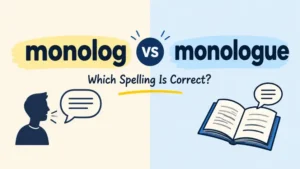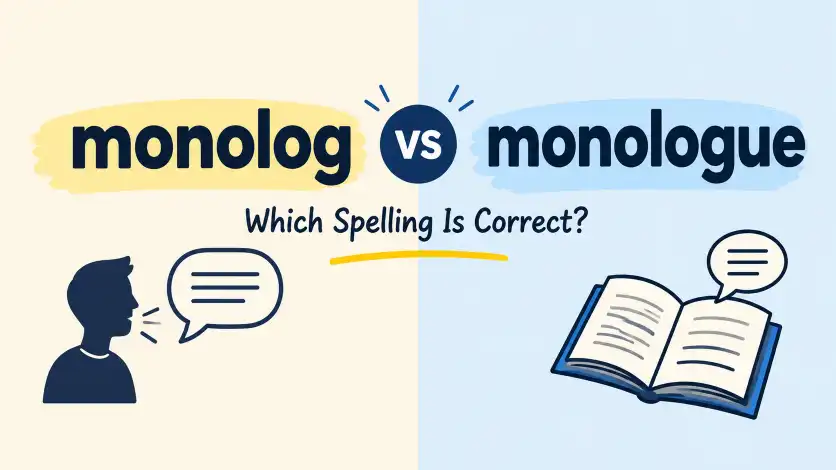
A monologue is a long speech delivered by one person without interruption from others.
The correct and most widely used spelling is monologue, while monolog is an accepted but less common variant. Both words refer to a speech or extended talk by one person. The difference between them is small, but it can confuse students, writers, actors, and English learners.
People often search for “monolog or monologue” because they want to know if the final ,ue is necessary. Some also wonder if monolog is the American spelling and monologue is the British spelling. In reality, both forms are recognized, but monologue is common in both American and British English.
Choosing the right spelling is important when writing school assignments, preparing acting scripts, creating website content, or discussing films and plays. Using the more familiar form helps readers understand your writing without confusion.
In this guide, you will learn the meaning and origin of both spellings, their differences, and how to use them in everyday English. You will also discover common spelling mistakes, practical examples, regional usage, and helpful answers to frequently asked questions.
Monolog or Monologue : Quick Answer
Monologue is the standard and preferred spelling in most situations. Monolog is also accepted, but it is less common.
Examples:
- The actor performed a powerful monologue on stage.
- She prepared a short monologue for her acting audition.
- The comedian opened the show with a funny monologue.
Both spellings describe a speech by one person. However, monologue is the safer choice for schoolwork, professional documents, articles, and everyday communication.
Easy tip: When you are unsure, always choose monologue.
Definition and Meaning of Monolog or Monologue
Clear Definition of Monologue
A monologue is a long speech delivered by one person without another person taking part in the speech itself. It is often used in plays, films, television programs, and other forms of storytelling.
A monologue may express a character’s thoughts, feelings, memories, or plans. It can also describe a person speaking for a long time without giving others much chance to respond.
For example, an actor may stand alone on a stage and talk about a painful experience. This speech is a monologue because one person delivers it.
The spelling monolog has the same basic meaning. The main difference between the two words is their spelling, not their definition.
Simple Meaning of Monologue
In simple English, a monologue means one person speaking for an extended time.
Imagine a student standing in front of a class and talking about friendship. If the student delivers the speech alone, it may be called a monologue.
The word can also describe everyday conversations. If someone talks continuously about a subject while other people listen, their speech may be described as a monologue.
Examples:
- My brother gave a long monologue about football.
- The teacher asked us to write a dramatic monologue.
- Her monologue made the audience laugh.
Context and Usage
The word monologue has several common uses.
1. In theatre and drama
Actors use monologues to express a character’s feelings, thoughts, or personal struggles.
Example: The main character delivered an emotional monologue before leaving the stage.
2. In films and television
Writers use monologues to explain a character’s past or reveal important information.
Example: The film begins with a monologue about the hero’s childhood.
3. In comedy
Comedians and television hosts often perform monologues to entertain their audiences.
Example: The host opened the show with a funny monologue about daily life.
4. In everyday conversations
People may use the word when someone talks for too long without allowing others to speak.
Example: Our short meeting turned into a long monologue about his new project.
5. In literature
Authors use monologues to reveal a character’s thoughts, fears, hopes, or intentions.
Example: The novel includes a monologue that reveals the main character’s hidden feelings.
Are Monolog and Monologue Different in Meaning?
No. Monolog and monologue generally have the same meaning. Both refer to a speech or extended talk by one person.
The main difference is spelling and frequency of use. Monologue is more common and widely recognized, while monolog is a less common alternative.
For example:
- The actor performed a monologue.
- The actor performed a monolog.
Both sentences express the same idea, but the first is the better choice for most readers.
The Origin of Monolog or Monologue
The word monologue entered English through French monologue, which came from Greek word elements connected with speaking and speech.
The prefix mono, means “one” or “single.” The second part is linked to the Greek word logos, which can mean “word,” “speech,” or “discourse.” Together, these elements express the idea of one person speaking.
The word became common in English literature and theatre. Today, it is also used when discussing films, television, comedy, and everyday communication.
Why Do Two Spellings Exist?
English has many words with alternative spellings. These differences may develop as words pass through other languages or as spelling conventions change.
The spelling monologue keeps the familiar ,logue ending, while monolog uses a shorter ending. Both forms are recognized, but monologue remains the more common choice.
Other words with a similar ending include:
- Dialogue: A conversation between two or more people.
- Prologue: An opening section of a book or play.
- Epilogue: A concluding section of a story.
- Catalogue: A list of items or information.
These words can help you remember the spelling of monologue.
Monolog or Monologue : Google Trends and Usage Data
People search for “monolog or monologue” because they want to know which spelling is correct, if the words have different meanings, and which version is suitable for formal writing. Understanding their usage can help students, writers, editors, and English learners make better spelling choices.
Which Spelling Is More Popular?
Monologue is the more widely used spelling in general English. The shorter form, monolog, is also recognized, but it is less common in everyday writing.
Both forms refer to a speech by one person. The difference is mainly spelling preference rather than meaning.
For example, someone searching for a monologue for an acting audition will usually encounter the longer spelling in educational materials, theatre resources, and general writing.
Usage by Country
The following table gives general spelling guidance. It does not represent live search statistics or exact search volumes.
| Country or Region | Recommended Spelling | Usage Guidance |
| United States | Monologue | Monolog is also recognized |
| United Kingdom | Monologue | The usual spelling |
| Canada | Monologue | Widely understood |
| Australia | Monologue | Suitable for general writing |
| New Zealand | Monologue | Recommended for everyday use |
| International audiences | Monologue | The safest general choice |
These recommendations help writers choose a familiar spelling for different audiences. They should not be treated as proof that every country follows exactly the same usage patterns.
How to Compare Google Trends Results
Google Trends can help you compare interest in monolog and monologue over time and across different locations. It shows relative search interest rather than exact numbers of searches.
To compare the two terms:
- Open Google Trends.
- Enter monolog as one search term.
- Add monologue as the second search term.
- Choose a time range, such as the past 12 months or past five years.
- Select a country or choose worldwide results.
- Compare interest over time and by region.
Use the same date range and location for both terms to make the comparison meaningful.
What Can Search Trends Tell You?
Search trends may help you understand which spelling attracts more attention from online users. They can also reveal changes in interest over time.
However, search interest does not determine if a word is correct. A spelling can receive fewer searches and still be accepted by dictionaries.
For this reason, use dictionaries and established spelling conventions to decide which form to use. Treat Google Trends as a way to explore search behavior rather than as the final authority on spelling.
Why Do People Search for This Keyword?
Readers may search for “monolog or monologue” for several reasons:
- School assignments: Students want to spell the word correctly in essays and drama projects.
- Acting auditions: Actors search for monologues to practice before performances.
- English learning: Learners want to understand the meaning and spelling difference.
- Professional writing: Editors and writers need a consistent spelling.
- Online content: Bloggers want to answer common spelling questions.
- Regional spelling: Readers wonder if American and British English use different forms.
A useful spelling guide should answer the main question first, then explain the definitions, regional usage, and common mistakes. This helps readers find a quick answer while also learning how to use the word correctly.
Monolog vs. Monologue: Side,by,Side Comparison
The following comparison summarizes the main similarities and differences between monolog and monologue.
| Feature | Monolog | Monologue |
| Spelling | Shorter form | Longer form |
| Meaning | Speech by one person | Speech by one person |
| Correctness | Accepted variant | Standard, widely preferred |
| American English | Recognized alternative | Commonly used |
| British English | Less common | Usual spelling |
| Academic writing | Less common choice | Recommended |
| Professional documents | Depends on style guide | Recommended |
| Theatre and film | Understood | Widely used |
| Plural form | Monologs | Monologues |
| Best choice for learners | Alternative form | Learn this form first |
What Is the Main Difference?
The main difference is spelling frequency, not meaning. Both words describe an extended speech by one person.
For example:
- The actor delivered a powerful monologue.
- The actor delivered a powerful monolog.
Both sentences communicate the same idea, but the first uses the more familiar spelling.
Which Form Should You Remember?
If you want one simple rule, remember monologue. It is suitable for schoolwork, articles, emails, creative writing, and professional documents.
You can recognize monolog as an alternative without needing to use it in your own writing.
Frequently Asked Questions
Q1: Is monolog or monologue correct?
Both spellings are recognized, but monologue is the standard and more widely preferred form. Use it in most types of writing.
Q2: Is monolog an American spelling?
Yes, monolog is recognized as an alternative spelling, particularly in American English. However, monologue is also widely used in the United States and remains the safer choice for general writing.
Q3: Do monolog and monologue mean the same thing?
Yes. Both words refer to a speech or extended talk by one person. Neither spelling has a separate meaning in ordinary usage.
Q4: Which spelling should I use in an essay?
Use monologue. It is widely recognized in both American and British English and is suitable for school assignments, academic essays, and professional documents.
Q5: What is the plural of monologue?
The plural of monologue is monologues.
Example: The actors performed three monologues during the school event.
The plural of monolog is monologs, although that form is less common.
Q6: What is the difference between a monologue and a dialogue?
A monologue is a speech delivered by one person, while a dialogue is a conversation between two or more people.
Example: The play begins with a monologue and later includes a dialogue between two characters.
Q7: Is a monologue the same as a soliloquy?
Not exactly. A monologue is an extended speech by one person. A soliloquy is a speech in which a character expresses their thoughts aloud, traditionally while alone on stage. A soliloquy is a specific type of dramatic speech.
Q8: How do you pronounce monologue?
In many English accents, monologue is pronounced approximately MON,uh,log. The exact vowel sounds can vary between accents.
Q9: Can I use monolog in professional writing?
Yes, if your publication or style guide accepts it. However, monologue is generally the safer choice for reports, articles, business documents, and academic writing.
Q10: What is an example of a monologue?
An actor standing on stage and describing a character’s feelings in a long speech is performing a monologue.
Example: The main character delivered a monologue about the importance of family.
Q11: Is monologue used only in theatre?
No. The word also appears in films, comedy shows, books, television programs, and everyday conversations. It can describe a person who talks for a long time without allowing others to speak.
Q12: How can I remember the spelling of monologue?
Connect the word with dialogue, prologue, and epilogue. These words share the familiar ,logue ending, which can help you remember the spelling.
Conclusion
Choosing between monolog and monologue is simple once you understand that both spellings refer to the same basic idea: a speech by one person. The difference is mainly in spelling preference and how commonly each form appears in general writing.
Monologue is the best choice for most writers. It is widely recognized in both American and British English and works well in essays, emails, news articles, school assignments, scripts, and professional documents. The shorter form, monolog, is also accepted as a variant, but it is less common in everyday use.
If you are learning English, focus on remembering monologue first. You can use it confidently when writing about theatre, acting, comedy, literature, films, or someone who speaks at length without allowing others to respond.
Before publishing an article or submitting an assignment, check your spelling and keep it consistent throughout the document. If your teacher, editor, or publisher follows a specific style guide, follow its instructions.
In short, both forms are recognized, but monologue is the most reliable spelling for everyday and formal use. When you are unsure which version to choose, use the longer form to keep your writing clear, consistent, and familiar to a wide range of readers.
Read More About !

“I’m Charlotte Vans, and I enjoy making grammar and word usage easier to understand. Through my writing, I help readers understand confusing words, improve spelling, and write with greater confidence.”