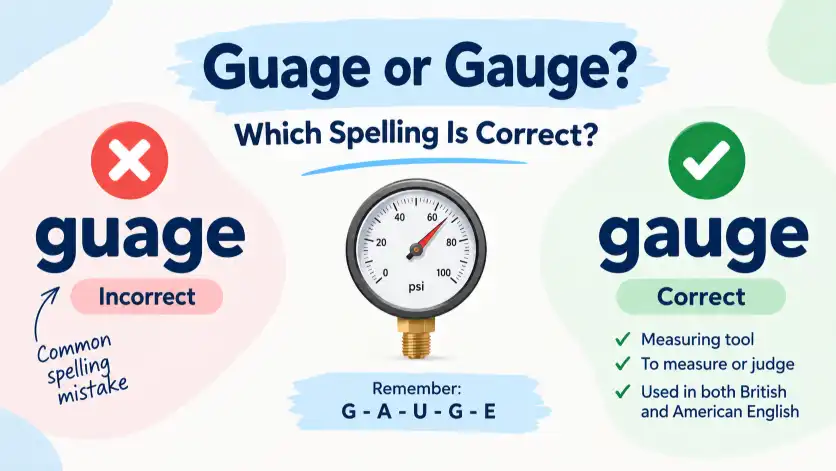
The correct spelling is gauge, not guage, in standard English. Gauge refers to a tool used to measure something or the act of measuring or judging it. For example, a fuel gauge shows how much fuel remains in a car.
Many people search for “guage or gauge” because the word has an unusual letter order. This can make it hard to spell correctly, especially when writing quickly. The mistake may appear in school assignments, emails, work reports, and online posts.
The good news is that the rule is simple. Both American and British English use gauge. The spelling does not change between these forms of English.
In this guide, you will learn the meaning of gauge, its origin, and the correct way to use it. You will also see common spelling mistakes and simple examples to help you remember the word. if you are a student, an English learner, or a professional writer, this guide will help you choose the correct spelling with confidence.
Guage or Gauge : Quick Answer
Gauge is the correct spelling, while guage is a common misspelling. Both British and American English use gauge.
Examples:
- Correct: Check the fuel gauge before driving.
- Incorrect: Check the fuel guage before driving.
- Correct: The pressure gauge needs repair.
- Incorrect: The pressure guage needs repair.
Remember to write the letters in this order: G,A,U,G,E.
Definition and Meaning of Gauge
Gauge has several meanings. It can refer to a tool that measures something or the act of judging the size, level, amount, or quality of something.
What Does Gauge Mean?
Gauge means a tool used to measure something or a way to measure or judge its size, level, amount, or quality.
For example, a fuel gauge shows the amount of fuel in a car. You can also gauge someone’s reaction to understand how they feel.
Simple Meaning of Gauge
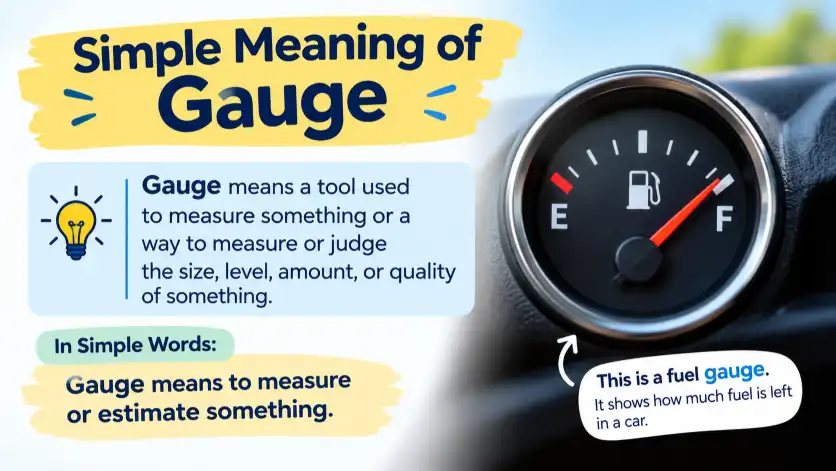
In simple words, gauge means to measure or estimate something.
Gauge can work as both a noun and a verb.
- Noun: The fuel gauge is almost empty.
- Verb: We need to gauge the cost before starting the project.
Different Uses of Gauge
1. Gauge as a measuring tool
A gauge can measure or show pressure, temperature, fuel level, or other quantities.
Example: The mechanic checked the pressure gauge.
2. Gauge as a way to judge something
Gauge can mean to understand or estimate a situation, feeling, or result.
Example: She watched the audience to gauge their reaction.
3. Gauge as a measure of size
The word can describe the thickness of wire, the size of a needle, or the distance between railway tracks.
Example: The worker checked the wire gauge.
4. Gauge in everyday speech
People also use gauge when they want to understand something before making a decision.
Example: We asked the team to gauge their interest in the project.
The Origin of Gauge
The word gauge has a long history in English. It came through Old French from a word associated with measuring and standards. Over time, its meaning expanded to include measuring tools, standards, and the act of judging something.
English contains many words borrowed from other languages. Their spellings do not always match the patterns that modern readers expect. Gauge is one such word.
Why Is Gauge Spelled This Way?
The spelling of gauge may look unusual because the letters do not appear in the order some readers expect. The correct form is g,a,u,g,e, not g,u,a,g,e.
This difference often causes confusion when people write the word from memory. However, gauge is the standard spelling used in everyday and professional English.
Is Guage an Older Spelling?
Guage is not the standard alternative spelling of gauge in modern English. In ordinary writing, it should be treated as a spelling error.
Always use gauge in essays, emails, reports, and website articles.
British English vs American English Spelling
Both British and American English use gauge as the correct standard spelling. The word does not change based on the country or type of English you use.
Some writers may see gage in certain American technical contexts. However, gauge is the safer choice for everyday writing. Guage is a misspelling, not a standard British or American spelling.
British English vs American English Comparison
| Word or Phrase | British English | American English |
| Gauge | Correct | Correct |
| Guage | Incorrect | Incorrect |
| Pressure gauge | Correct | Correct |
| Fuel gauge | Correct | Correct |
| Gauge a reaction | Correct | Correct |
| Gage | Limited or specialized use | Used in some contexts |
Examples in British English
- The engineer checked the pressure gauge.
- It is hard to gauge public opinion.
- The fuel gauge shows that the tank is nearly empty.
Examples in American English
- The mechanic replaced the fuel gauge.
- We need to gauge customer interest.
- The pressure gauge needs repair.
These examples show that gauge is correct in both varieties of English. You do not need to change its spelling when writing for readers in the United States or the United Kingdom.
Which Spelling Should You Use?
The best choice is gauge for almost all everyday, academic, and professional writing. The spelling guage should be avoided.
For American Readers
Use gauge in school assignments, emails, business reports, and articles. You may encounter gage in certain technical documents, but follow the spelling required by the relevant industry or style guide.
For British and Commonwealth Readers
Use gauge when writing for readers in the United Kingdom, Pakistan, Australia, Canada, and other Commonwealth countries. It is widely understood and does not require a spelling change.
For International Readers
Choose gauge when writing for a global audience. It is the standard spelling and works well in general and technical writing.
For Students and English Learners
Remember the correct letter order:
G – A – U – G – E
Practise these common phrases:
- Fuel gauge
- Pressure gauge
- Wire gauge
- Gauge public opinion
Writing these phrases several times can help you remember the spelling.
For Professional Writers
Always proofread technical terms before publishing an article, report, or email. A spelling checker may help you identify guage and replace it with gauge.
Common Mistakes with Guage or Gauge
Writers often misspell gauge because they remember the sound but forget the correct letter order. Understanding common errors can help you avoid them.
Mistake 1: Writing Guage Instead of Gauge
Incorrect: The car’s guage is not working.
Correct: The car’s gauge is not working.
Tip: Remember that the letter “a” comes before “u” in gauge.
Mistake 2: Using Guage in Formal Writing
Incorrect: We used a guage to measure the pressure.
Correct: We used a gauge to measure the pressure.
Correct spelling helps make your writing clear and professional.
Mistake 3: Misspelling the Word in Emails
Incorrect: Please check the water guage today.
Correct: Please check the water gauge today.
Always review important words before sending a work email.
Mistake 4: Confusing Gauge with Other Measurement Terms
Gauge can describe a measuring tool, but it does not replace every measurement term.
For example, a ruler measures length, while a pressure gauge measures or indicates pressure.
Choose the word that best describes the tool or action.
Mistake 5: Assuming British and American English Use Different Spellings
Some English words have different spellings in the United States and the United Kingdom. For example, American English uses color, while British English uses colour.
However, gauge is spelled the same way in both.
Gauge in Everyday Examples
Gauge appears in emails, news reports, social media posts, and formal documents. It can refer to a measuring tool or the act of judging a situation.
1. Gauge in Emails
- Please check the fuel gauge before the next trip.
- We need to gauge customer interest before launching the product.
- Could you confirm the pressure gauge reading?
2. Gauge in News
- The survey helped researchers gauge public opinion.
- Officials are trying to gauge the impact of the new policy.
- The report provides a useful gauge of economic activity.
3. Gauge on Social Media
- I want to gauge interest before planning the event.
- It is hard to gauge the mood from online comments.
- We asked a few questions to gauge people’s views.
4. Gauge in Formal Writing
- The study aimed to gauge student satisfaction.
- Engineers used a pressure gauge to check the system.
- The survey helped the team gauge customer needs.
5. Gauge in Everyday Conversation
- I cannot gauge how much time we need.
- It is difficult to gauge his reaction.
- She tried to gauge the size of the room.
In all these examples, use gauge, not guage.
Part 2 complete.
Guage or Gauge : Google Trends and Usage Data
People search for “guage or gauge” when they want to check the correct spelling or understand the word’s meaning. The unusual letter order makes it easy to type the wrong form.
Which Spelling Is More Common?
Gauge is the correct standard spelling in modern English. It appears in everyday writing and technical terms, including fuel gauge, pressure gauge, and wire gauge.
Guage is a common spelling mistake. It should not be used as an alternative spelling in ordinary English writing.
Search Interest by Country
Readers in different countries may search for this word for several reasons:
- United States: To check spelling or learn about measuring tools.
- United Kingdom: To understand the word’s meaning and correct usage.
- Canada and Australia: To check spelling in general or technical writing.
- Pakistan and other countries: English learners may search for the correct spelling and examples.
These are possible search contexts, not verified rankings of search volume. Google Trends can compare interest by country and over time, but specific data is needed to identify the most popular locations.
Why Do People Search for Guage or Gauge?
Common reasons include:
- Checking spelling before writing an email or report.
- Learning the meaning of gauge.
- Understanding British and American English.
- Finding examples of the word in sentences.
- Avoiding spelling mistakes in schoolwork or professional writing.
For all these purposes, gauge is the correct choice.
Comparison Table: Guage vs Gauge
| Feature | Gauge | Guage |
| Spelling status | Correct | Misspelling |
| Standard English word | Yes | No, not for the intended meaning |
| British English | Correct | Incorrect |
| American English | Correct | Incorrect |
| Meaning | To measure or judge; a measuring tool | No standard meaning intended here |
| Example | Check the pressure gauge. | Check the pressure guage. |
| Recommended use | General and professional writing | Avoid |
The main difference is the letter order. Write gauge, with “a” before “u,” whenever you mean a measuring tool or the act of measuring or judging something.
FAQs:
Q1: Is it guage or gauge?
Gauge is correct. Guage is a common misspelling. Use gauge when referring to a measuring tool or the act of measuring or judging something.
Q2: Why is gauge spelled with “au”?
Gauge has a historical spelling that may look unusual to modern readers. The correct letter order is G,A,U,G,E, and the spelling has remained in standard English.
Q3: Is gauge correct in both British and American English?
Yes. Gauge is the standard spelling in both British and American English. The word has the same spelling and meaning in both varieties.
Q4: What does gauge mean in simple words?
Gauge means to measure or estimate something. It can also mean a tool that measures pressure, temperature, fuel level, or another quantity.
Q5: Is guage ever correct?
Guage is not the standard spelling of gauge. In ordinary English writing, treat it as a spelling error and replace it with gauge.
Q6: How do you remember the spelling of gauge?
Remember the letter order G,A,U,G,E. Practise familiar phrases such as “fuel gauge,” “pressure gauge,” and “gauge public opinion.”
Q7: What is the plural of gauge?
The plural of gauge is gauges.
Example: The mechanic checked all the pressure gauges.
Q8: Can gauge be used as a verb?
Yes. Gauge can mean to measure, estimate, or judge something.
Example: The teacher asked questions to gauge the students’ understanding.
Conclusion
The correct spelling is gauge, while guage is a common spelling mistake. Gauge is the standard choice in both British and American English, so you do not need to change its spelling for different audiences.
The word has several useful meanings. It can describe a tool that measures pressure, temperature, or fuel level. It can also mean to measure, estimate, or judge something. For example, you can check a fuel gauge or gauge someone’s reaction to an idea.
If you are writing an email, school assignment, business report, or website article, choose gauge. It is the clearest and most reliable spelling for general use. You may also encounter gage in some American and technical contexts, but gauge remains a safe choice for most readers.
The easiest way to avoid this mistake is to remember the correct letter order: G,A,U,G,E. Practise common phrases such as “pressure gauge,” “fuel gauge,” and “gauge public opinion.” With regular use, the spelling will become easier to remember.
When in doubt, choose gauge for clear, correct, and professional English writing.
Read More About !

“I’m Charlotte Vans, and I enjoy making grammar and word usage easier to understand. Through my writing, I help readers understand confusing words, improve spelling, and write with greater confidence.”







2 thoughts on “Guage or Gauge: Which Spelling Is Correct?”