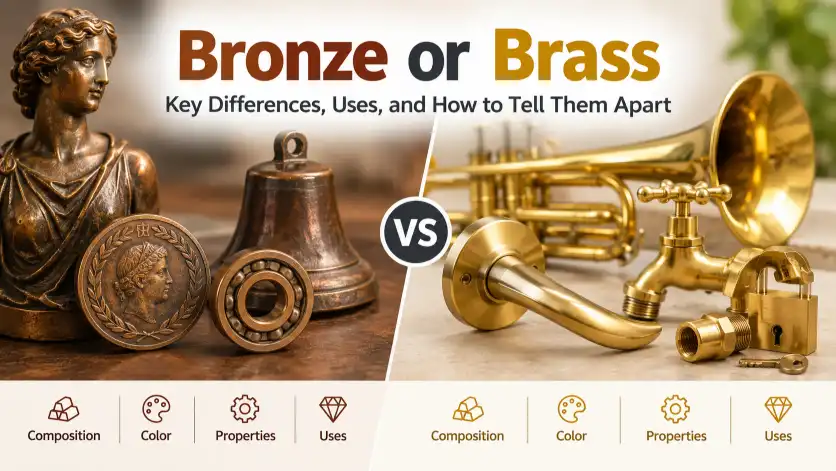
Choosing between bronze and brass depends on the intended application, as each metal offers distinct qualities. Bronze typically combines copper with tin, whereas brass consists mainly of copper and zinc.
Despite their similar appearance, the two alloys differ in color, strength, corrosion resistance, and suitability for various uses.
People often search for bronze or brass when choosing jewelry, buying home decorations, selecting plumbing fittings, or comparing materials for construction and manufacturing. The confusion is understandable because both metals can have a golden, yellow, or brown appearance. However, looking at their color alone is not always enough to identify them correctly.
Manufacturers use bronze to produce statues, bells, bearings, and selected marine parts because of its durability and wear resistance. Brass serves a different range of purposes, including plumbing fixtures, locks, door hardware, musical instruments, and ornamental accessories, where its golden color and workability make it a practical choice. The best choice depends on the specific alloy, the working environment, and the purpose of the finished product.
Knowing how bronze differs from brass makes it easier to compare materials, understand product descriptions, and choose the right metal for a particular task. This guide explores their meanings, compositions, major differences, practical applications, and historical origins. It also examines their use in British and American English, highlights common misconceptions, and answers frequently asked questions to help you understand these two copper-based alloys.
Bronze vs. Brass: Key Differences and Common Uses
Bronze and brass are copper-based alloys with different compositions, appearances, and practical applications. With its reddish-brown or darker finish, bronze is often used to manufacture statues, bells, medals, bearings, and marine components.
Brass, which usually has a yellow or golden appearance, is popular for faucets, cabinet handles, keys, musical instruments, fasteners, and decorative accessories. Both materials offer useful properties, but the right choice depends on the intended purpose and required performance.
Brass usually has a yellow or golden appearance and is commonly used for faucets, cabinet handles, keys, musical instruments, fasteners, and decorative accessories. Although both materials offer durability and versatility, the best choice depends on the intended application, environmental conditions, and required properties.
Definition and Meaning of Bronze or Brass
Clear Definition of Bronze
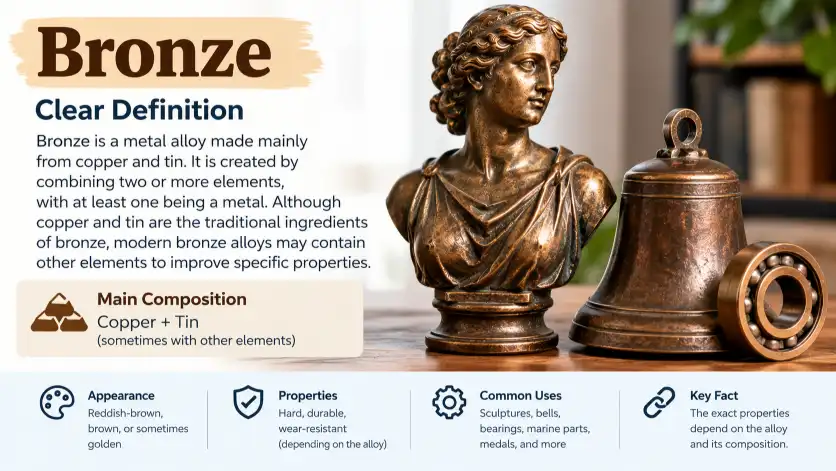
Bronze is a metal mixture made mainly from copper and tin. It is classified as an alloy because it combines two or more elements, including at least one metal, to create a material with distinct properties. Traditional bronze contains copper and tin, but manufacturers can add other elements to enhance specific characteristics.
Different bronze alloys serve different purposes. Aluminum bronze, for instance, contains aluminum to improve certain mechanical and corrosion-resistant properties.
Phosphor bronze contains phosphorus and is often used to manufacture springs, electrical connectors, and other parts that require durability, flexibility, and resistance to wear.
Throughout history, bronze has played an important role in manufacturing tools, sculptures, weapons, and decorative objects. Its ability to form detailed shapes through casting, along with its strength and wear resistance, makes it valuable for many applications. However, its performance against corrosion and other forms of wear varies according to the alloy’s composition and the environment in which it operates.
Bronze is commonly used to make:
- Statues and sculptures: Bronze can capture fine details and is valued for artistic work.
- Bells: Certain bronze alloys are suitable for producing bells with useful sound qualities.
- Bearings and bushings: Some bronze alloys work well in moving parts where friction and wear must be considered.
- Marine components: Suitable bronze grades are used for selected parts exposed to seawater.
- Medals and ornaments: Bronze is often used for decorative objects and awards.
- Historical objects: Many archaeological artifacts and tools were made from bronze.
Bronze can develop a darker surface or a greenish patina after long exposure to certain environmental conditions. This surface change is one reason bronze sculptures and architectural features may have an aged appearance. The change does not mean that every bronze object will develop the same color or react in the same way.
Bronze is a copper-based alloy valued for its strength, long-lasting performance, and ability to be shaped into statues, tools, machine parts, and decorative pieces.
Clear Definition of Brass
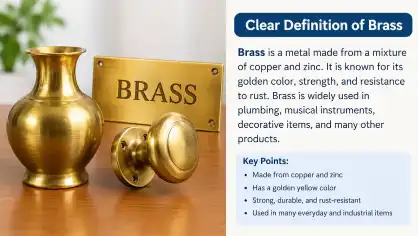
Brass is a metal alloy made mainly from copper and zinc. The amount of zinc affects the alloy’s color, hardness, strength, and ability to be shaped. Other elements may also be added to create brass grades suited to particular tasks.
Unlike bronze, which traditionally uses tin as its main additional metal, brass uses zinc. This difference in composition helps explain why the two materials behave differently during manufacturing and use.
Brass is especially popular for products that need an attractive finish, accurate shaping, or convenient machining. Depending on the grade, it can be formed into sheets, rods, tubes, fittings, and complex components.
Common uses of brass include:
- Door handles and knobs: Brass is widely used for household and commercial hardware.
- Plumbing fittings: Many taps, valves, connectors, and fittings are made from suitable brass alloys.
- Musical instruments: Trumpets, trombones, and many other instruments use brass components.
- Locks and keys: Brass is used in various lock parts and key blanks.
- Decorative products: Lamps, picture frames, ornaments, and furniture fittings may feature brass.
- Screws and machined parts: Certain brass grades are useful where shaping and machining are important.
Brass often has a bright yellow or gold,like appearance, making it popular in interior design and decoration. However, its color can vary according to its composition and surface treatment. Some brass products are polished, lacquered, plated, or deliberately aged to create a particular look.
Brass can also tarnish when exposed to air, moisture, and other environmental factors. Regular cleaning and appropriate care can help maintain its appearance, but the best method depends on the finish and the product manufacturer’s instructions.
In simple terms, brass is a copper,and,zinc alloy commonly chosen for decorative hardware, fittings, musical instruments, and products that benefit from its appearance and manufacturing properties.
Understanding Bronze and Brass in Simple Terms
The easiest way to understand bronze or brass is to remember the main metals used to make each alloy.
- Bronze = mainly copper + tin.
- Brass = mainly copper + zinc.
Both materials contain copper, which is why they can have similar colors and some overlapping uses. However, their different compositions affect their mechanical properties, corrosion behavior, and suitability for different applications.
Consider these everyday examples:
Example 1: A bronze statue
A sculptor may choose bronze because a suitable bronze alloy can be cast into detailed shapes. The finished statue may have a brown, reddish, or aged appearance.
Example 2: A brass door handle
A manufacturer may choose brass because a suitable grade can be shaped into a handle and finished with a polished, gold,like surface.
Example 3: A musical instrument
Brass is commonly used for instruments such as trumpets and trombones. Bronze is also used in certain musical applications, including bells and cymbals, depending on the alloy and desired sound.
Example 4: A machine component
A suitable bronze alloy may be selected for a bearing or bushing because of its wear properties. Brass may be more appropriate for other components, depending on the load, movement, and operating environment.
Here is a simple comparison:
| Feature | Bronze | Brass |
| Main ingredients | Copper and usually tin | Copper and zinc |
| Common appearance | Reddish,brown, brown, or sometimes golden | Yellow or gold,like |
| Common applications | Statues, bells, bearings, selected marine parts | Handles, taps, locks, musical instruments |
| Manufacturing | Many grades are suitable for casting | Many grades are suitable for forming and machining |
| Wear resistance | Often useful in suitable bearing applications | Depends on the grade and working conditions |
| Corrosion resistance | Depends on the alloy and environment | Depends on the alloy and environment |
| Decorative use | Sculptures, medals, aged finishes | Polished hardware, ornaments, fittings |
These are general guidelines rather than absolute rules. Some bronze alloys look similar to brass, and some brass products have dark or brown finishes. If the exact material matters, check the manufacturer’s specifications instead of relying on appearance alone.
Context and Usage of Bronze or Brass
The words bronze and brass appear in conversations about home improvement, art, engineering, history, jewelry, and product design. Although both refer to copper,based alloys, the correct term depends on the material being discussed.
In home decoration
Brass is popular for cabinet handles, taps, light fittings, and decorative hardware because it can provide a bright, warm finish. Bronze is often chosen for sculptures, furniture hardware, and fixtures designed to have a darker or more traditional appearance.
For example:
- “The kitchen cabinets have polished brass handles.”
- “A bronze sculpture stands beside the entrance.”
In construction and plumbing
Brass is widely used in plumbing fittings, valves, and connectors. Certain bronze alloys are also used in industrial and marine fittings. The correct choice depends on factors such as pressure, temperature, water chemistry, and applicable standards.
For example:
- “The plumber replaced the brass valve.”
- “The engineer selected a suitable bronze alloy for the component.”
In art and history
Bronze is strongly associated with sculpture and ancient metalworking. The Bronze Age takes its name from the widespread use of bronze tools and objects in many societies.
Brass also has a long history and appears in decorative objects, instruments, and household items. When describing a historical artifact, it is important to identify the actual material rather than assume it is bronze because of its age or color.
In engineering and manufacturing
Engineers choose between bronze and brass based on the properties required for a particular component. Some bronze grades are suitable for bearings and bushings, while brass grades are commonly used for fittings, connectors, and machined components.
For technical applications, the exact alloy matters more than the general name. Different grades of bronze and brass can have substantially different properties.
In jewelry and accessories
Both metals may be used in jewelry, watches, buckles, and decorative accessories. Buyers may compare them based on color, cost, weight, finish, and durability. Skin sensitivity can also depend on the alloy’s ingredients, so checking product details is useful.
Overall, bronze and brass serve many of the same broad industries, but they are not interchangeable in every situation. Understanding the context helps you identify the correct material and explain why it is suitable for a particular product.
The Origin of Bronze or Brass
Where Does the Word “Bronze” Come From?
The word bronze entered English through French, which borrowed it from Italian bronzo. The word’s deeper origin is uncertain, but its history is closely connected to the development of metalworking and the use of copper,based alloys.
Bronze became an important material thousands of years ago when people learned to combine copper with tin. This mixture often produced a useful metal for making tools, weapons, ornaments, and other objects. Compared with many earlier copper tools, bronze could offer advantages in hardness and performance, depending on the alloy and manufacturing method.
The importance of bronze was so great that historians named an entire period the Bronze Age. During this period, many societies used bronze for everyday tools, ceremonial objects, weapons, and artistic works. However, the timing of the Bronze Age differed across regions, and not every society adopted bronze at the same time.
Bronze continued to be used long after the Bronze Age. Ancient civilizations created statues, coins, bells, and decorative objects from different bronze alloys. Today, bronze remains important in sculpture, engineering, manufacturing, and design.
The word bronze is also used in everyday language for a brownish or golden,brown color. For example, someone might describe a bronze,colored lamp or a bronze finish on furniture. In these cases, the word describes the appearance rather than confirming the item’s actual metal composition.
Where Does the Word “Brass” Come From?
The word brass comes from Old English bræs. It has been used for centuries to describe a copper,based metal known for its distinctive appearance and practical uses.
Brass became popular because copper and zinc can form alloys with useful combinations of color, workability, and mechanical properties. Depending on its composition, brass can be shaped into decorative objects, household fittings, musical instruments, and machine components.
Throughout history, craftspeople used brass to create ornaments, vessels, hardware, and other useful items. Its golden appearance also made it attractive for decorative work. As metalworking methods developed, brass became increasingly useful in manufacturing and engineering.
Today, brass is found in many everyday products, including taps, door handles, locks, keys, screws, and musical instruments. It is also used in furniture fittings, lighting, and decorative accessories.
Like bronze, the word brass can describe a color or finish. A product advertised as having a brass finish may not be made entirely from brass. It could contain another material with a brass,colored coating or surface treatment.
Understanding the word’s meaning is therefore important when reading product descriptions. The term may identify the actual alloy or simply describe the item’s appearance.
Why Are Bronze and Brass Different?
Bronze and brass have different names because they refer to different families of alloys. Their main difference is the additional metal combined with copper.
- Bronze: Traditionally made mainly from copper and tin.
- Brass: Made mainly from copper and zinc.
These ingredients influence how each alloy behaves. They can affect hardness, strength, color, corrosion resistance, casting, and machining. The exact results depend on the proportions of the metals and any additional elements.
Bronze is often associated with sculptures, bells, and wear,resistant components. Brass is often associated with decorative fittings, plumbing components, and musical instruments. However, these uses are not exclusive, and the right material depends on the requirements of the product.
The words are not British and American spelling variations. Both bronze and brass are standard English words used in both regions.
British English vs American English Spelling
Is Bronze Spelled Differently in British and American English?
No. Bronze has the same spelling in British English and American English. The word does not change when you write for readers in the United Kingdom, the United States, Canada, Australia, or other English,speaking regions.
For example:
- British English: “The museum displays a bronze sculpture.”
- American English: “The museum displays a bronze sculpture.”
Both sentences are correct. The spelling and meaning of bronze remain unchanged.
Is Brass Spelled Differently in British and American English?
No. Brass is also spelled the same way in British and American English.
For example:
- British English: “The house has brass door handles.”
- American English: “The house has brass door handles.”
The word itself stays the same. However, the surrounding vocabulary may differ. British speakers commonly use tap, while American speakers commonly use faucet.
- British English: “The kitchen has a brass tap.”
- American English: “The kitchen has a brass faucet.”
In both examples, brass correctly identifies the material.
Bronze and Brass Spelling Comparison Table
| Feature | British English | American English |
| Metal name | Bronze | Bronze |
| Second metal name | Brass | Brass |
| Bronze sculpture | Correct | Correct |
| Brass handle | Correct | Correct |
| Bronze medal | Correct | Correct |
| Brass instrument | Correct | Correct |
| Common plumbing term | Tap | Faucet |
| Spelling difference in the metal names | None | None |
Why Do People Confuse Bronze and Brass?
People often confuse these words because both metals contain copper and may have similar golden, brown, or reddish colors. Their names may also appear together in product comparisons, decoration guides, and engineering discussions.
However, the difference is related to the material, not spelling. Bronze and brass cannot be used as alternative names for the same alloy.
For clear writing, identify the material accurately. If you are discussing an item whose composition is unknown, use a phrase such as bronze,colored finish or brass,colored finish only when you mean its appearance, not its confirmed composition.
Which Should You Choose: Bronze or Brass?
Choosing between bronze and brass depends on the intended use, the environment, the desired appearance, and the specific alloy. Since the words have the same spelling in British and American English, your decision should focus on the material rather than the audience’s location.
For Home Decoration
Brass is a popular choice for lamps, cabinet handles, taps, and decorative fittings. Its bright, golden appearance can suit both traditional and modern interiors.
Bronze may be preferable when you want a darker, warmer, or aged appearance. It is often used for sculptures, decorative hardware, and furniture details.
Before buying, check if the product is solid brass or bronze, plated metal, or simply finished to resemble one of these materials.
For Construction and Plumbing
Brass is commonly used for plumbing fittings, valves, and connectors. Some bronze alloys are also suitable for specific fittings and demanding environments.
The best choice depends on the product’s specifications, water conditions, pressure, temperature, and applicable safety standards. A material that works well in one plumbing system may not be suitable for another.
For this reason, it is best to follow the manufacturer’s recommendations rather than choosing based on color or price alone.
For Art and Sculpture
Bronze is a traditional material for sculptures because many bronze alloys can be cast into detailed forms. It is also valued for the way its surface can develop an aged appearance over time.
Brass can be used for decorative artwork, ornaments, and crafted objects. It may be selected when a bright golden color is part of the desired design.
The artist’s preferred appearance, production method, and budget help determine which material is suitable.
For Engineering and Machinery
Bronze is often used for bearings, bushings, and other components that need suitable wear properties. Brass is widely used for machined parts, connectors, and fittings.
However, neither metal is automatically the best engineering choice. The specific grade, load, friction, temperature, and operating environment all matter.
If the component will be exposed to seawater, chemicals, or heavy mechanical loads, consult the relevant material specifications before making a decision.
For Jewelry and Accessories
Both bronze and brass can be used for jewelry, buckles, watches, and decorative accessories. Brass often provides a bright gold,like appearance, while bronze may have a deeper or more muted tone.
Consider the finish, maintenance requirements, and possible skin sensitivity. The ingredients in an alloy can vary, so check the manufacturer’s information if you have concerns about metal allergies.
The simple rule: Choose bronze or brass based on the properties required for the job, not on the spelling or color alone.
Common Mistakes with Bronze or Brass
Mistake 1: Thinking Bronze and Brass Are the Same Material
Incorrect: “Bronze and brass are two names for the same metal.”
Correct: Bronze is mainly copper and tin, while brass is mainly copper and zinc.
Both belong to the copper,alloy family, but they have different compositions and properties.
Mistake 2: Assuming Color Always Identifies the Metal
Incorrect: “The object is yellow, so it must be brass.”
Correct: Color can provide a clue, but it cannot confirm the composition. Some bronze alloys look golden, and brass products may have brown, black, or aged finishes.
Check the product description or material specifications when identification matters.
Mistake 3: Believing Bronze Is Always Stronger
Incorrect: “Bronze is stronger than brass in every situation.”
Correct: Strength depends on the exact alloy and its treatment. Some bronze grades are suitable for demanding wear applications, while certain brass grades have excellent strength and workability for their intended uses.
Always compare the relevant material grades rather than making a general assumption.
Mistake 4: Thinking Brass Never Changes Color
Incorrect: “Brass always stays bright and shiny.”
Correct: Brass can tarnish or change appearance over time. Exposure to air, moisture, chemicals, and handling can affect its surface.
Protective coatings and proper cleaning may help maintain its appearance, depending on the product.
Mistake 5: Calling a Brass,Colored Product Solid Brass
Incorrect: “This item looks golden, so it must be made entirely from brass.”
Correct: A gold,like surface may be brass plating, a coating, or another finish. The product’s appearance does not prove its underlying material.
Read the product specifications carefully before purchasing.
Mistake 6: Treating Bronze and Brass as Regional Spellings
Incorrect: “Bronze is British English, while brass is American English.”
Correct: Both words are used in British and American English. They describe different metal alloys, not different regional spellings.
Mistake 7: Choosing a Metal Without Considering Its Environment
Incorrect: “Any bronze or brass product will work outdoors.”
Correct: Suitability depends on the alloy, weather, moisture, chemicals, and intended use. Some grades perform better than others in specific environments.
For outdoor or marine applications, check the manufacturer’s technical guidance before choosing a material.
Part 2 complete.
Bronze or Brass in Everyday Examples
Bronze and brass appear in many everyday situations, including home decoration, construction, engineering, jewelry, and art. Understanding how to use these terms correctly helps you describe products, communicate with suppliers, and choose suitable materials.
Bronze or Brass in Emails
When writing a professional email, use the correct metal name to make your request clear. This is especially important when ordering products, requesting prices, or discussing technical specifications.
Example 1: Asking about a product
Subject: Material Confirmation
Hello,
Could you please confirm if the door handles are made of brass or bronze? We would also appreciate details about the surface finish and material specifications.
Thank you.
Example 2: Requesting a quotation
Hello,
Please send us a quotation for the bronze bearings listed in our requirements. Include the available alloy grades, dimensions, and delivery information.
Best regards.
Example 3: Confirming an order
Hello,
We would like to confirm our order for brass fittings. Please ensure that the material and finish match the specifications provided.
Thank you for your assistance.
These examples show why choosing the right word matters. A supplier needs to know if you require bronze, brass, or another material.
Bronze or Brass in News and Articles
Writers use bronze and brass when reporting on historical discoveries, manufacturing, art, and new products.
Examples include:
- “Archaeologists discovered bronze objects at an ancient settlement.”
- “The museum added a bronze sculpture to its permanent collection.”
- “The manufacturer introduced a new range of brass plumbing fittings.”
- “The restoration team repaired the building’s decorative brass hardware.”
In these examples, bronze and brass identify the materials used to make the objects.
The word bronze can also refer to a third,place medal in a competition. For example, “The athlete won a bronze medal.” This meaning is different from describing the metal composition of an object, even though the word has the same spelling.
Bronze or Brass in Social Media
On social media, people often discuss these metals when sharing home renovations, DIY projects, jewelry, furniture, or artwork.
Examples include:
- “Would bronze or brass look better with dark wooden furniture?”
- “I love the warm golden finish of these brass handles.”
- “This bronze sculpture looks beautiful in natural light.”
- “Choosing between bronze and brass fittings can change the entire look of a room.”
These sentences use the terms naturally while discussing appearance, personal preferences, or product choices.
If you are posting a product photograph, avoid identifying an item as solid bronze or brass unless you know its material. A bronze,colored or brass,colored finish does not necessarily mean the object is made from that metal.
Bronze or Brass in Formal Writing
Formal writing requires accurate descriptions, particularly in academic, engineering, and manufacturing contexts.
Examples:
- “The sculpture was cast using a bronze alloy.”
- “The component is manufactured from brass for its intended mechanical application.”
- “The report compares the corrosion behavior of selected bronze and brass alloys.”
- “The material specification identifies the alloy composition and relevant mechanical properties.”
For scientific or technical documents, the general terms bronze and brass may not provide enough information. If possible, include the precise alloy designation and relevant specifications.
This makes the writing clearer and helps readers understand the material’s actual properties.
Bronze or Brass : Google Trends and Usage Data
People search for bronze or brass for different reasons. Some want to identify a metal, while others are comparing products, learning about history, or choosing materials for home improvement projects.
Search interest can vary by country, season, and topic. However, exact rankings and search volumes should not be assumed without checking current data.
Why Do People Search for Bronze or Brass?
1. Home improvement
Homeowners and designers may compare bronze and brass when selecting cabinet handles, taps, lighting, furniture hardware, and decorative finishes.
2. Education and history
Students may search for bronze when learning about the Bronze Age, ancient tools, sculptures, and archaeological discoveries. They may also look up brass to understand its composition and historical uses.
3. Engineering and manufacturing
Professionals may compare bronze and brass alloys when choosing materials for bearings, fittings, connectors, and machine components.
4. Art and decoration
Artists and buyers may compare the appearance, cost, finish, and maintenance requirements of bronze and brass sculptures or decorative products.
5. Jewelry and accessories
Shoppers may search for bronze or brass jewelry to compare colors, durability, care requirements, and material descriptions.
How to Compare Search Interest
To study search interest, compare terms such as “bronze or brass,” “bronze vs brass,” “brass fittings,” and “bronze sculpture” in Google Trends.
You can select a country or region, choose a time period, and examine how interest changes. Comparing related terms may also help identify if users are looking for general information, specific products, or technical explanations.
Remember that Google Trends reports relative search interest, not an exact number of searches. Results can vary according to the selected region, time range, and search category.
For an accurate article, avoid claiming that bronze is more popular than brass in a particular country unless the comparison has been checked against actual data.
Bronze vs Brass: Side,by,Side Comparison
Bronze and brass share copper as their main ingredient, but their other ingredients and typical applications differ. This table summarizes the key points.
| Feature | Bronze | Brass |
| Main composition | Copper and usually tin | Copper and zinc |
| Common color | Reddish,brown, brown, or sometimes golden | Yellow or gold,like |
| Common applications | Statues, bells, bearings, selected marine parts | Taps, handles, locks, musical instruments |
| Wear resistance | Often suitable for selected bearing applications | Depends on the alloy and application |
| Corrosion behavior | Depends on the alloy and environment | Depends on the alloy and environment |
| Manufacturing | Many grades are suitable for casting | Many grades are suitable for forming and machining |
| Decorative appearance | Often used for sculptures and aged finishes | Often used for polished, golden finishes |
| British spelling | Bronze | Brass |
| American spelling | Bronze | Brass |
Which Metal Is Better?
Neither bronze nor brass is always better. Bronze is often chosen for sculptures, bearings, and certain marine applications. Brass is popular for fittings, hardware, musical instruments, and decorative products.
The right choice depends on the exact alloy, the working environment, the required properties, and the desired appearance. For technical or safety,critical applications, follow the manufacturer’s specifications rather than choosing based on color alone.
Frequently Asked Questions
Q1: What Is the Main Difference Between Bronze and Brass?
Bronze is mainly made from copper and tin, while brass is mainly made from copper and zinc. These different ingredients affect their appearance, properties, and common uses.
Q2: Is Bronze Better Than Brass?
Neither metal is always better. Bronze may be suitable for some bearings and marine components, while brass is often useful for fittings, hardware, and decorative products. The best choice depends on the specific alloy and purpose.
Q3: How Can You Tell Bronze from Brass?
Bronze often has a reddish,brown appearance, while brass is commonly yellow or gold,like. However, finishes and alloy variations can make them look similar. Product specifications or material testing are more reliable than color alone.
Q4: Does Bronze Cost More Than Brass?
The price depends on the alloy, product design, weight, manufacturing process, and market conditions. Neither metal is always more expensive than the other.
Q5: Does Brass Rust?
Brass does not rust in the same way as iron because it does not contain iron as its main metal. However, brass can tarnish and corrode under certain environmental conditions.
Q6: Is Bronze Spelled Differently in British and American English?
No. Bronze has the same spelling in British and American English. It refers to the same general family of copper,based alloys in both varieties.
Q7: Is Brass Spelled Differently in British and American English?
No. Brass is spelled the same way in British and American English. The word describes a copper,and,zinc alloy, not a regional spelling variation.
Q8: Which Metal Is Better for Outdoor Use?
The answer depends on the environment and the alloy. Some bronze grades perform well in marine settings, while suitable brass grades may work well in other outdoor applications. Always check the manufacturer’s recommendations.
Q9: Can Bronze and Brass Look the Same?
Yes. Some bronze and brass objects have similar colors, particularly when polished, coated, or given an aged finish. Their appearance alone cannot reliably confirm their composition.
Q10: What Are Bronze and Brass Commonly Used For?
Bronze is commonly used for statues, bells, bearings, and selected marine components. Brass is commonly used for taps, door handles, locks, musical instruments, and decorative fittings.
Conclusion
Bronze and brass are two useful copper,based alloys with different compositions, appearances, and applications. Bronze is traditionally made mainly from copper and tin, while brass is made mainly from copper and zinc. Although both materials can have similar colors, they are not interchangeable in every situation.
Bronze is widely used for sculptures, bells, bearings, and certain marine components. Many bronze alloys offer useful wear resistance and casting properties. Brass is popular for taps, door handles, locks, musical instruments, and decorative fittings because many grades are easy to shape and provide an attractive finish.
The best material depends on the job. If you are choosing hardware for your home, appearance and maintenance may be important. If you are selecting a material for machinery or construction, alloy composition, strength, corrosion resistance, and operating conditions matter more.
It is also important to remember that bronze or brass is a comparison of two materials, not two spelling variations. Both words are correct in British and American English and have the same meanings in both regions.
By understanding their main differences and checking product specifications, you can identify these metals more accurately, avoid common mistakes, and choose the material that best suits your needs.
Read More About !

“I’m Charlotte Vans, and I enjoy making grammar and word usage easier to understand. Through my writing, I help readers understand confusing words, improve spelling, and write with greater confidence.”





1 thought on “Bronze or Brass: A Simple Guide to Their Properties and Uses”