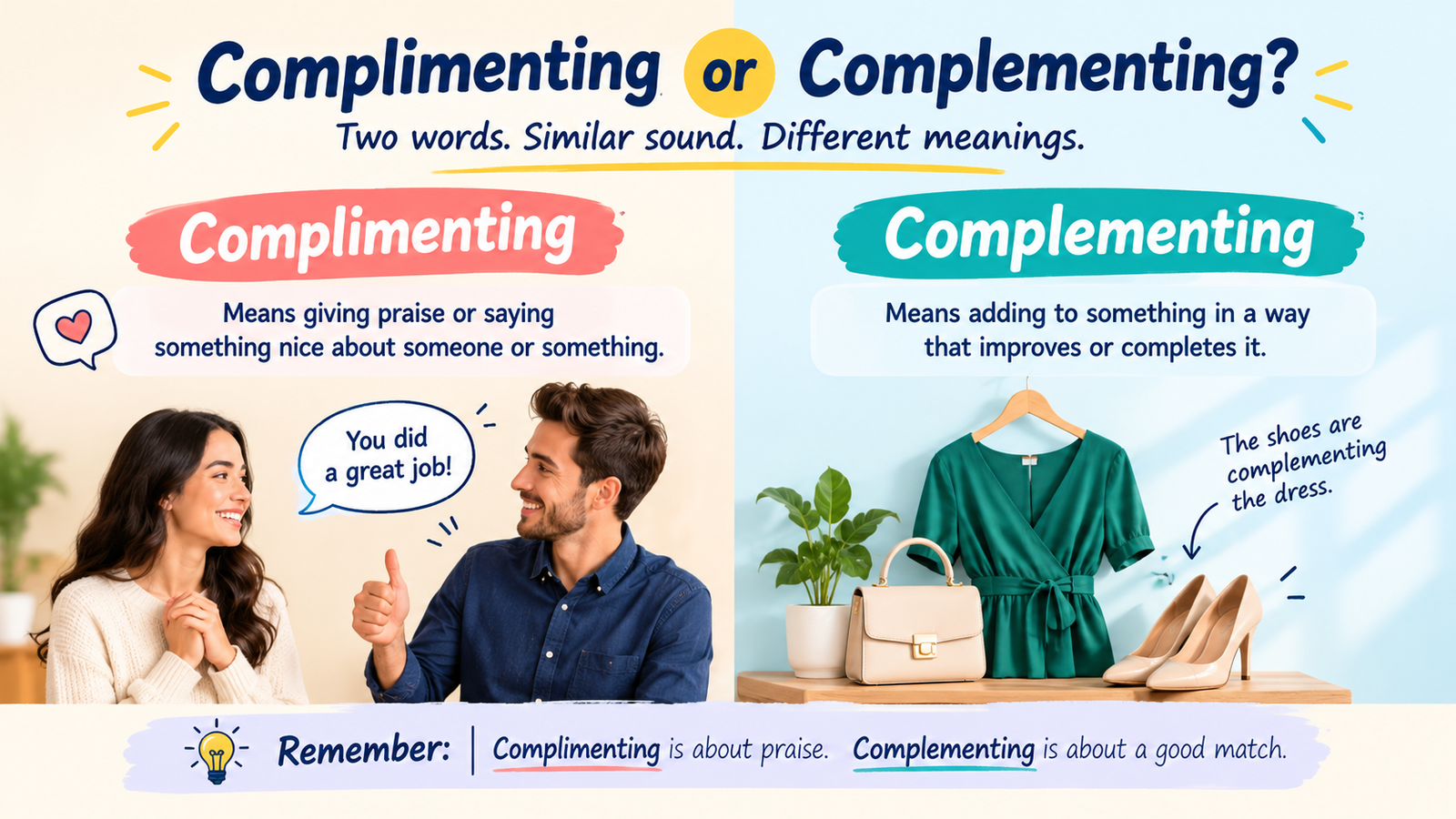
Complimenting is the correct word when you praise someone, while complementing means adding something that makes another thing better or complete. Both words are correct, but they have different meanings and uses.
Many people search for “complimenting or complementing” because these words sound alike and differ by only one letter. This small spelling change can cause confusion in emails, school assignments, social media posts, and professional writing. For example, you might compliment a friend on a new outfit, but a pair of shoes might complement that outfit.
Knowing the difference helps you choose the right word and express your ideas clearly. It also helps you avoid common spelling and grammar mistakes in everyday English. Although both words have different roots, their meanings are easy to remember once you learn a simple rule.
In this guide, you will learn what complimenting and complementing mean, where they come from, how to use them in British and American English, and which spelling fits different situations. You will also find clear examples, common mistakes, and answers to frequently asked questions.
Complimenting or Complementing : Quick Answer
Complimenting means praising someone or something, while complementing means adding to something in a way that improves or completes it.
- Complimenting: Sarah is complimenting her friend on her new dress.
- Complementing: Sarah’s shoes are complementing her new dress.
Both spellings are correct in British and American English. The right choice depends on what you want to say.
Easy tip: You compliment someone with praise, while one thing complements another when the two go well together.
Definition and Meaning of Complimenting or Complementing
The words complimenting and complementing sound almost the same, but they have different meanings. Both are forms of verbs, and each has a clear role in English.
What Does Complimenting Mean?
Complimenting means praising someone or something by saying something kind or positive.
People use this word to show respect, appreciation, or admiration.
Examples:
- I am complimenting my teacher on her clear lessons.
- He is complimenting his friend on his new haircut.
- The manager is complimenting the team on its hard work.
In each example, someone gives praise.
What Does Complementing Mean?
Complementing means going well with something or adding something that improves or completes it.
It often describes colors, clothes, skills, ideas, food, and other things that work well together.
Examples:
- The blue tie is complementing his white shirt.
- Her skills are complementing his experience.
- The sauce is complementing the flavor of the meal.
In these examples, one thing adds value to another.
Context and Usage
The easiest way to choose between the words is to look at the action.
- Use complimenting when someone gives praise.
- Use complementing when something matches, improves, or completes something else.
For example, a person may compliment your hairstyle by saying it looks great. A hair color may complement your natural features by making them look more balanced.
The Origin of Complimenting or Complementing
The words complimenting and complementing have different histories. Although they sound alike, they come from different roots and carry different meanings.
The Origin of Complimenting
The word compliment entered English through French and Italian. Its history is linked to polite expressions, courtesy, and praise. Over time, it came to mean saying something kind or showing admiration for someone.
The word complimenting describes the act of giving praise.
Example: The teacher is complimenting the student on her excellent work.
The Origin of Complementing
The word complement comes from the Latin word complementum, meaning something that fills up or completes. Its meaning developed around adding what is needed or making something more complete.
The word complementing describes the act of adding to or improving something.
Example: The soft lighting is complementing the room’s warm colors.
Why Do the Spellings Differ?
The two words have different origins, even though their sounds are similar. The spelling compliment is linked to praise, while complement is linked to completion or something that works well with another thing.
This difference explains why you should not use the words interchangeably.
British English vs American English Spelling
There is no spelling difference between British and American English for these two words. Both varieties use complimenting for praise and complementing for adding to or improving something.
British English Usage

British English uses both words with the same meanings found in other forms of English.
Examples:
- She is complimenting her colleague on his work.
- The curtains are complementing the furniture.
American English Usage
American English follows the same spelling and meaning rules.
Examples:
- He is complimenting his sister on her presentation.
- The jacket is complementing his outfit.
British vs American Comparison Table
| Word | British English | American English | Meaning |
| Complimenting | Complimenting | Complimenting | Giving praise |
| Complementing | Complementing | Complementing | Matching or improving |
| Complimented | Complimented | Complimented | Praised someone |
| Complemented | Complemented | Complemented | Added to or improved something |
The key point is simple: neither spelling belongs only to British or American English. The difference is meaning, not regional spelling.
Which Spelling Should You Use?
The correct spelling depends on what you want to say, not where your readers live. if you write for a US, UK, Commonwealth, or international audience, the same rule applies.
For American Readers
Use complimenting when talking about praise.
Example: The coach is complimenting the players on their effort.
Use complementing when describing things that work well together.
Example: The new logo is complementing the company’s website design.
For British and Commonwealth Readers
Follow the same distinction.
Examples:
- The teacher is complimenting the student.
- The green curtains are complementing the cream walls.
These spellings are also standard in countries such as Canada, Australia, and New Zealand.
For Global and Professional Writing
When writing emails, reports, articles, or school assignments, focus on the meaning of each word.
Ask yourself one simple question: Am I giving praise, or am I describing how things work together?
- Giving praise? Choose complimenting.
- Describing a match or improvement? Choose complementing.
This simple test works across English,speaking regions.
Common Mistakes with Complimenting or Complementing
Many writers confuse these words because they sound alike. The best way to avoid mistakes is to focus on the meaning of the sentence.
Mistake 1: Using Complementing for Praise
Incorrect: She is complementing my presentation by saying it was excellent.
Correct: She is complimenting my presentation by saying it was excellent.
Why? The sentence describes praise, so complimenting is the right word.
Mistake 2: Using Complimenting for Matching Colors
Incorrect: The black shoes are complimenting the blue suit.
Correct: The black shoes are complementing the blue suit.
Why? The shoes go well with the suit. They are not giving it praise.
Mistake 3: Confusing the Nouns
The same difference applies to the nouns compliment and complement.
- Compliment: He gave me a compliment on my writing.
- Complement: The scarf is a perfect complement to her coat.
A compliment is praise. A complement is something that completes or improves another thing.
Mistake 4: Confusing the Verb Forms
Both words can take the ending ,ing.
- Compliment → Complimenting
- Complement → Complementing
Keep the spelling of the original word in mind when adding the ending.
Mistake 5: Assuming One Spelling Is British
Neither spelling belongs only to British or American English. Both forms are standard in both varieties.
Memory tip: Complimenting is about kind words. Complementing is about things that fit together.
Complimenting or Complementing in Everyday Examples
Both words appear in daily conversations, emails, news stories, social media posts, and formal writing. These examples show how to use each word correctly.
Examples in Emails
Complimenting:
- Thank you for complimenting my presentation.
- I am complimenting the team on its excellent work.
Complementing:
- The new colors are complementing the existing design.
- This chart complements the report by making the results easier to understand.
Examples in News
Complimenting:
The coach is complimenting the players after their strong performance in the final match.
Complementing:
The new transport service complements the city’s existing bus network.
Examples on Social Media
Complimenting:
- Thanks for complimenting my new look!
- She is complimenting her friend on her beautiful artwork.
Complementing:
- These shoes are complementing my outfit perfectly.
- The music complements the mood of this video.
Examples in Formal Writing
Complimenting:
The director is complimenting the staff for their dedication and teamwork.
Complementing:
The study complements earlier research by providing additional evidence.
Complimenting or Complementing : Google Trends and Usage Data
People search for complimenting or complementing because the words sound alike but have different meanings. Google Trends can compare search interest for specific terms by country and date range, but it measures relative interest rather than providing exact search counts.
Why Do People Search for These Words?
Common reasons include:
- Checking which spelling fits a sentence.
- Learning the difference between praise and a good match.
- Improving grammar and spelling.
- Writing clear emails and work documents.
- Preparing school assignments or English tests.
Usage by Country and Context
Both words are used in the United States, the United Kingdom, Canada, Australia, and other English,speaking regions. Their meanings remain the same across these regions.
The words often appear in different contexts:
- Complimenting: praise, appearance, achievements, skills, and positive feedback.
- Complementing: colors, clothing, food, design, teamwork, and ideas.
Without a specific Google Trends comparison, it would be misleading to claim that one spelling is more popular in a particular country. The main point is to choose the word that matches your intended meaning.
Complimenting vs Complementing: Comparison Table
| Feature | Complimenting | Complementing |
| Meaning | Giving praise | Matching, improving, or completing |
| Root word | Compliment | Complement |
| Common context | People, work, achievements | Colors, clothes, skills, ideas |
| Example | She is complimenting her friend. | The shoes are complementing her dress. |
| Noun form | Compliment | Complement |
| British spelling | Complimenting | Complementing |
| American spelling | Complimenting | Complementing |
| Memory tip | Think of praise | Think of complete |
Remember: a compliment is something nice you say, while a complement is something that adds value or works well with another thing.
FAQs
Q1: Is complimenting or complementing correct?
Both are correct English words. Complimenting means giving praise, while complementing means matching, improving, or completing something.
Q2: How do I remember the difference?
Remember that a compliment is praise, such as telling someone they did a great job. A complement adds to something, such as shoes that match an outfit.
Q3: Is it complimenting my outfit or complementing my outfit?
It depends on the meaning. Someone is complimenting your outfit if they praise it. A jacket is complementing your outfit if it goes well with your other clothes.
Q4: Are complimenting and complementing pronounced the same?
They are commonly pronounced alike or very similarly in English. This similarity is one reason people confuse their spelling and meaning.
Q5: Does British English use complementing differently from American English?
No. Both varieties use complementing to describe something that matches, improves, or completes something else.
Q6: Can complementing describe people?
Yes. You can say that two people’s skills complement each other. This means their abilities work well together.
Example: Her creative ideas complement his technical skills.
Q7: What is the difference between compliment and complement?
A compliment is a kind or positive remark. A complement is something that completes, improves, or works well with something else.
Example: “He gave me a compliment” means he praised me. “The sauce complements the meal” means it improves the meal.
Conclusion
Understanding the difference between complimenting and complementing helps you write clearly and avoid common English mistakes. Although these words sound alike, they have different meanings and uses.
Use complimenting when someone gives praise, shows appreciation, or says something kind about another person or thing. For example, “She is complimenting her friend on her excellent work.”
Use complementing when something matches, improves, or adds value to something else. For example, “The blue curtains are complementing the white walls.”
Both spellings are correct in British and American English. You do not need to change either word based on your audience or location. Instead, focus on the message you want to express.
If you are unsure which word to choose, ask yourself if the sentence describes praise or a good match. This simple check can help you select the correct spelling in emails, essays, social media posts, and professional documents.
With regular practice, you can use both words confidently and make your English writing more accurate and natural.
Read More About !

“I’m Charlotte Vans, and I enjoy making grammar and word usage easier to understand. Through my writing, I help readers understand confusing words, improve spelling, and write with greater confidence.”


2 thoughts on “Complimenting or Complementing: Which Word Is Correct?”