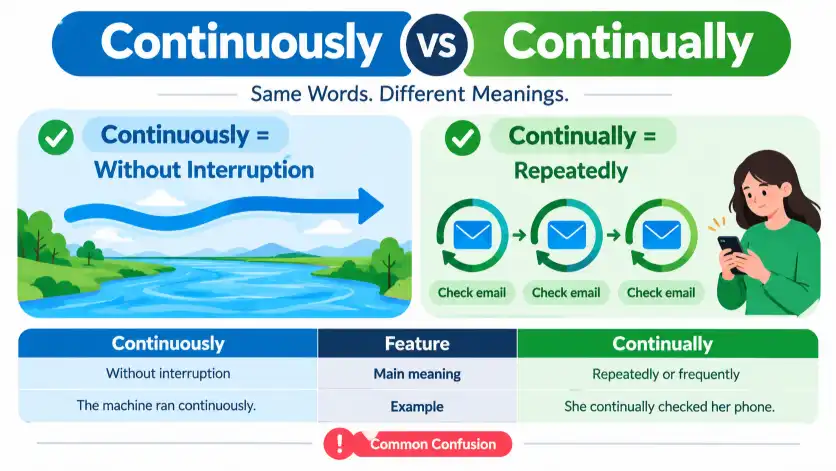
Have you ever wondered if something happens continuously or continually? Both words describe something that happens repeatedly over time, so they are easy to confuse. However, they do not mean exactly the same thing.
Continuously usually means something happens without stopping or interruption. Continually usually means something happens again and again, often with short breaks between occurrences. Understanding this small difference can make your writing more precise, especially in academic, professional, and everyday English.
The confusion often comes from the fact that both adverbs come from related words and can sometimes be used in similar contexts. In some sentences, either word may sound natural, but the intended meaning can change.
In this guide, you will learn the clear difference between continuously and continually, their meanings, origins, regional usage, common mistakes, and practical examples. You will also see simple memory tips and comparison tables to help you choose the right word with confidence.
Continuously or Continually: Featured Snippet Answer
Continuously means something happens without interruption, while continually means something happens repeatedly or frequently, usually with pauses between events. For example, “The machine ran continuously” means it did not stop, while “She continually checked her phone” means she checked it again and again.
Continuously or Continually : Quick Answer
The main difference is interruption.
- Continuously = without stopping or breaking.
- Continually = repeatedly or frequently, with possible breaks.
Examples
Continuously:
The river flows continuously toward the sea.
The flow does not stop.
Continually:
He continually forgets his keys.
He forgets them again and again.
Another simple example:
It rained continuously for six hours.
This suggests that the rain did not stop during those six hours.
It rained continually throughout the week.
This suggests repeated periods of rain, possibly with breaks.
Easy Memory Tip
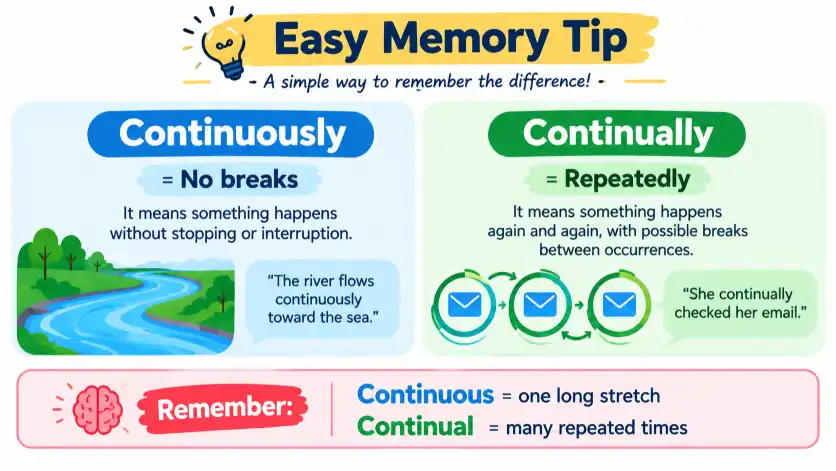
Think of continuous as one uninterrupted flow.
Think of continual as something happening again and again.
So, if there are no breaks, continuously is usually the better choice. If something keeps happening repeatedly, continually is usually more precise.
What Does Continuously or Continually Mean?
Continuously and continually are both adverbs. They describe how often or in what pattern an action happens.
Meaning of Continuously
Continuously means happening without interruption or stopping.
It describes an action, process, sound, movement, or condition that continues in an unbroken way.
For example:
The fan ran continuously throughout the night.
The fan kept running and was not switched off.
Other examples include:
- Water flowed continuously from the pipe.
- The computer operated continuously for twelve hours.
- The light flashed continuously.
- The machine worked continuously during the test.
The key idea is no interruption.
Meaning of Continually
Continually means happening repeatedly or very often.
Something described as continual may happen many times, but it does not necessarily happen without a break.
For example:
She continually asked the same question.
She asked the question many times. There were pauses between the questions.
Other examples include:
- He continually changes his plans.
- The children continually interrupted the teacher.
- Prices are continually changing.
- She continually checks her email.
The key idea is repetition.
Why Are They Confused?
The two words are closely related. Both come from continue, which means to keep going.
Because of this shared meaning, many speakers use them interchangeably in casual English. However, careful writing can use the distinction to show if an action is uninterrupted or repeated.
A Simple Comparison
| Word | Main idea | Does it stop? |
| Continuously | Without interruption | Usually no |
| Continually | Again and again | Usually yes |
This distinction is especially useful when the timing of an action matters.
The Origin of Continuously or Continually
Both words are connected to the verb continue, which comes from Latin roots associated with joining, maintaining, or keeping something going.
Continuously comes from continuous, meaning something that continues without a break.
Continually comes from continual, meaning something that continues through repeated occurrence.
Over time, English speakers developed slightly different meanings for these related forms. The distinction became useful because English needed ways to describe two different kinds of continuation.
One describes an unbroken process. The other describes repeated events.
For example:
The machine operated continuously.
This focuses on an uninterrupted process.
The machine continually stopped and restarted.
This focuses on repeated events.
Modern dictionaries generally recognize this distinction, although actual usage can overlap. In informal English, continually is sometimes used where continuously might be more technically precise.
The difference is therefore less about grammar rules and more about communicating the exact pattern of an action.
British English vs American English
The distinction between continuously and continually is generally understood in both British and American English.
| Feature | British English | American English | Example |
| Continuously | Without interruption | Without interruption | The machine ran continuously. |
| Continually | Repeatedly or frequently | Repeatedly or frequently | He continually changed his mind. |
| Basic distinction | Commonly recognized | Commonly recognized | Both forms are standard. |
| Casual overlap | Possible | Possible | Either may appear in informal contexts. |
There is no major spelling difference between British and American English for these words.
Both varieties use:
- continuously
- continually
- continuous
- continual
The important issue is meaning, not regional spelling.
Publishing and Style Preferences
Professional editors often prefer continuously when an action is genuinely uninterrupted.
For repeated actions, continually can make the intended meaning clearer.
For example:
The alarm sounded continuously.
This suggests an uninterrupted sound.
The alarm sounded continually.
This can suggest that the alarm sounded repeatedly.
In careful writing, choosing the more precise word helps readers understand exactly what happened.
Which Version Should You Use?
The choice between continuously and continually depends on what you want to describe. The simplest rule is to ask if the action happens without interruption or again and again.
United States
Use continuously when something happens without stopping.
The system runs continuously during the test.
Use continually when something happens repeatedly.
The customer continually changed the order.
Both words are standard in American English.
United Kingdom
British English follows the same basic distinction.
The engine operated continuously for eight hours.
The manager continually reminded the team about the deadline.
The choice depends on the meaning, not on British versus American spelling.
Canada
Canadian English also uses both forms.
For precise writing, use continuously for an uninterrupted process and continually for repeated events.
Australia
Australian English follows the same general pattern.
The water flowed continuously through the pipe.
The child continually asked questions.
International Writing
For international readers, the distinction is useful because it removes ambiguity.
If you mean without a break, choose continuously.
If you mean repeatedly, choose continually.
Academic Writing
Academic writing often benefits from precise word choice.
The samples were monitored continuously for 24 hours.
This indicates uninterrupted monitoring.
The researchers continually revised the hypothesis.
This indicates repeated revisions.
Business Writing
In emails, reports, and workplace documents, choose the word that matches the actual situation.
Without interruption:
The service operated continuously throughout the business day.
Repeatedly:
The client continually requested changes to the proposal.
Common Mistakes
Because these words are so similar, writers sometimes use one when the other would communicate the intended meaning more clearly.
Mistake 1: Using “Continually” for an Unbroken Action
Incorrect for the intended meaning:
The machine operated continually for 12 hours without stopping.
Better:
The machine operated continuously for 12 hours without stopping.
Why?
The phrase “without stopping” clearly describes an uninterrupted action.
Mistake 2: Using “Continuously” for Repeated Events
Less precise:
She continuously called me throughout the day.
If she made separate calls with pauses between them, continually is more precise.
Better:
She continually called me throughout the day.
This shows repeated calls rather than one uninterrupted call.
Mistake 3: Assuming They Are Completely Interchangeable
The words can overlap in everyday English, but their core meanings are different.
Compare:
The baby cried continuously for an hour.
This suggests the crying did not stop.
The baby cried continually during the evening.
This can mean the baby kept crying at different times during the evening.
Memory Tip
Remember:
Continuous = no breaks
Continual = repeated breaks
A simple way to remember it is:
Continuously = one long stretch
Continually = many repeated times
Everyday Examples
Understanding these words becomes much easier when you see them in real,life situations.
Emails
Professional emails often describe processes, services, or repeated actions.
Continuously:
Our monitoring system operates continuously to detect unusual activity.
Continually:
We are continually improving our customer support process.
The first sentence describes an uninterrupted process. The second describes ongoing improvements made repeatedly over time.
Business Writing
Both words are common in workplace communication.
Continuously:
The production line must operate continuously during the scheduled test.
Continually:
Our team continually reviews customer feedback.
The production line is expected to keep running. The team reviews feedback repeatedly.
News Headlines
News writing may use these words to describe ongoing developments or repeated events.
Examples:
Temperatures Continue to Rise Continuously
This suggests an uninterrupted process, although the exact wording of headlines depends on the context.
Another example:
Officials Continually Update Safety Guidance
This suggests repeated updates.
Blogs
Blog writers can use these words to make explanations more precise.
Technology is continually changing the way people communicate.
The changes happen repeatedly over time.
The software must remain continuously connected to the server.
The connection should remain unbroken.
Social Media
Informal posts may use the words less precisely.
For example:
My phone is continually buzzing today!
This normally means the phone keeps buzzing repeatedly.
If the phone were producing an uninterrupted sound, continuously would better describe the situation.
Academic Writing
Academic and scientific writing often needs a clear distinction between uninterrupted measurements and repeated activity.
Continuously:
The temperature was continuously monitored during the experiment.
This means monitoring continued without interruption.
Continually:
The researchers continually adjusted the equipment.
This means they made adjustments repeatedly.
Daily Conversation
You may hear both words in ordinary speech.
He continually forgets where he puts his glasses.
This means it happens repeatedly.
The water was flowing continuously.
This means the water kept flowing without stopping.
Google Trends & Modern Usage
People often search for “continuously or continually” because the two words look and sound very similar. The confusion is especially common among students, ESL learners, writers, and people checking their wording before publishing.
There is no need to assume that one word is always correct and the other is always wrong. Both are established English words.
The most useful distinction is semantic:
- Continuously focuses on an uninterrupted duration.
- Continually focuses on repeated occurrence.
- Context determines which word communicates the intended meaning more accurately.
Search interest in word,comparison phrases can also come from proofreading and editing needs. Someone writing a sentence about a machine, service, process, habit, or repeated action may want to know which adverb expresses the intended idea.
Exact Google Trends numbers can change over time and depend on the selected country, date range, and search category. Therefore, no fixed popularity statistic should be assumed without checking current Google Trends data for a specific region and period.
Quick Comparison Table
| Version | Meaning | Correct? | Region | Example |
| Continuously | Without interruption | Yes | US, UK, Canada, Australia, International | The machine ran continuously. |
| Continually | Repeatedly or frequently | Yes | US, UK, Canada, Australia, International | She continually checked her email. |
| Continuous | Continuing without interruption | Yes | Standard English | There was continuous noise. |
| Continual | Happening repeatedly | Yes | Standard English | There were continual interruptions. |
Key Takeaways
- Continuously usually means without interruption.
- Continually usually means again and again.
- Both words are correct standard English.
- The difference is mainly about the pattern of an action.
- Use continuously for an unbroken process or activity.
- Use continually for repeated actions or events.
- British and American English generally use the same distinction.
- Context matters more than regional spelling.
FAQs
Q1: What is the difference between continuously and continually?
Continuously usually means something happens without stopping or interruption. Continually usually means something happens repeatedly or frequently, with breaks between occurrences. For example, “The machine ran continuously” means it kept running without stopping, while “She continually checked her phone” means she checked it many times.
Q2: Is continuously or continually correct?
Both continuously and continually are correct English words. The right choice depends on the meaning. Use continuously when you mean something happens without interruption. Use continually when you mean something happens repeatedly or again and again.
Q3: Is continually the same as continuously?
They are closely related, but they are not exactly the same. Continuously emphasizes an uninterrupted action or condition. Continually emphasizes repeated action or occurrence. In casual English, people sometimes use them interchangeably, but careful writing can use the distinction to make the meaning clearer.
Q4: Does continuously mean without stopping?
Yes. Continuously normally describes something that continues without a break. For example, “The machine operated continuously for eight hours” means the machine kept operating throughout those eight hours without stopping. The word is useful when uninterrupted duration is the important part of the sentence.
Q5: Does continually mean repeatedly?
Yes. Continually generally means repeatedly, frequently, or over and over. For example, “He continually changes his plans” means he changes them again and again. The action can have pauses between individual occurrences, so continual activity does not necessarily mean that it happens every second.
Q6: Can continuously and continually be used interchangeably?
Sometimes they can appear in similar contexts, especially in informal English. However, they can communicate different ideas. If an action happens without interruption, continuously is more precise. If an action happens repeatedly, continually is usually clearer.
Q7: Which is correct: “continuously changing” or “continually changing”?
Both can be correct, but the intended meaning matters. Continuously changing suggests a change that occurs without interruption. Continually changing suggests repeated changes over time. For example, a process that changes at every moment may be described as continuously changing.
Q8: Is continuously more formal than continually?
Neither word is inherently more formal. Both are standard English adverbs and can be used in academic, professional, and everyday writing. The important difference is meaning. Choosing the word that accurately describes the action is more important than choosing one based on formality.
Q9: Which word should ESL learners use?
ESL learners can remember a simple distinction: continuously = without a break, while continually = repeatedly. When describing an uninterrupted process, choose continuously. When describing something that keeps happening at different times, choose continually. This rule works well in most ordinary writing situations.
Q10: Is there a spelling difference between British and American English?
No significant spelling difference exists between these words in British and American English. Both varieties use continuously and continually. The main issue is not spelling but meaning. Writers should select the word that best matches if the action is uninterrupted or repeated.
Conclusion
The difference between continuously and continually is small but useful. Continuously normally describes something that happens without interruption, while continually describes something that happens repeatedly or frequently.
For example, if a machine runs for six hours without stopping, you can say it runs continuously. If someone repeatedly changes their plans, you can say they continually change their plans.
Both words are correct in British, American, Canadian, Australian, and international English. They are not different spellings for different regions. Instead, the choice depends on the meaning you want to express.
When you are unsure, ask yourself one simple question: Does the action happen without a break, or does it happen again and again? If there is no interruption, choose continuously. If the action repeats, choose continually.
Remember: continuously means one uninterrupted flow, while continually means repeated action. Use this simple distinction to make your writing clearer and more precise.
Read More About !

“I’m Charlotte Vans, and I enjoy making grammar and word usage easier to understand. Through my writing, I help readers understand confusing words, improve spelling, and write with greater confidence.”








3 thoughts on “Continuously or Continually: What’s the Difference?”