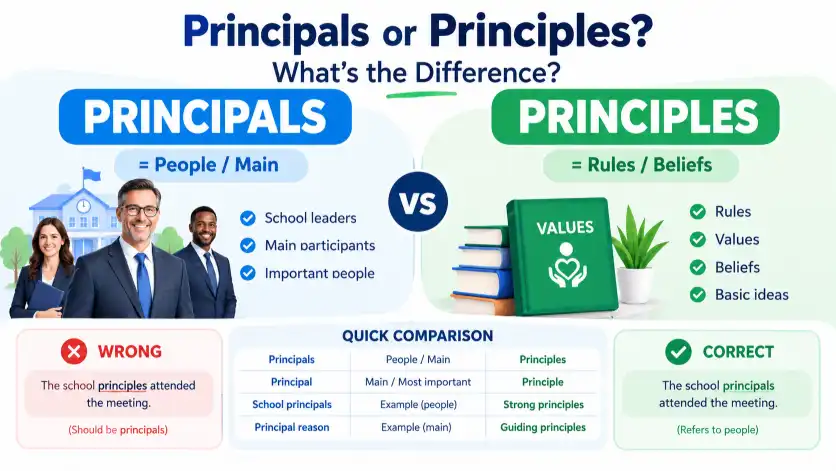
The two terms have different meanings and uses. “Principals” describes people in authority or the main parties involved, whereas “principles” refers to rules, values, beliefs, or basic ideas that guide actions and decisions.Understanding this distinction helps you use the right word in your writing.
The confusion happens because principal and principle sound very similar in everyday speech. When people hear the words instead of seeing them written, it can be difficult to know which spelling they need. This is especially common among students, ESL learners, writers, and people learning English.
For example, a school can have several principals, but a person can also have strong principles. The first word is connected with people or importance, while the second is connected with rules and beliefs.
In this guide, we will explain principals or principles with simple definitions, examples, common mistakes, and practical usage tips. By the end, choosing the correct word should be much easier.
Principals or Principles: Featured Snippet Answer
Principals means people in charge, such as school leaders, or the main people involved in something. Principles means rules, values, beliefs, or basic ideas that guide behavior or decisions. For example, “The principals attended the meeting” refers to people, while “She follows strong principles” refers to values or beliefs.
Principals or Principles :Quick Answer
The difference between principals and principles is mainly about meaning.
- Principals = people in charge or important people.
- Principles = rules, beliefs, values, or basic ideas.
- Principal can also mean main or most important.
- Principle means a fundamental rule or belief.
Example 1: Principals
The school principals attended the education conference.
Here, principals means people who lead schools.
Example 2: Principles
Honesty and fairness are important principles.
Here, principles means values or beliefs.
Example 3: Principal Meaning “Main”
The principal reason for the delay was bad weather.
In this sentence, principal means the main or most important reason.
Easy Memory Tip
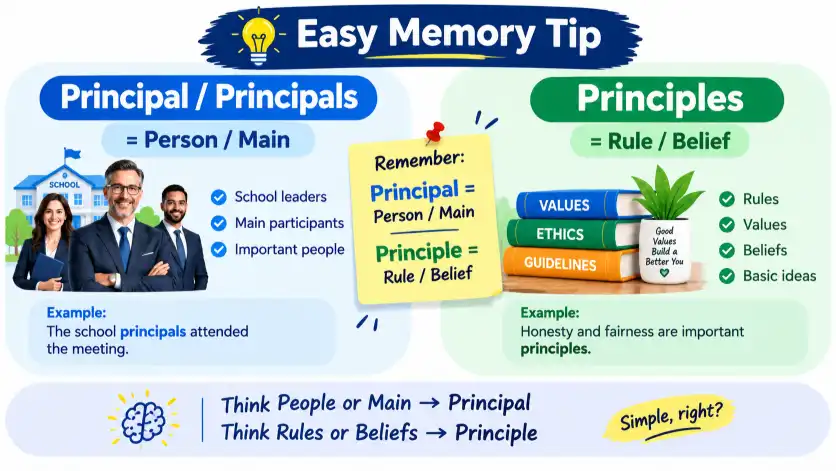
A useful way to remember the difference is:
Principal = person or main
Principle = rule or belief
Think about a school principal. A principal is a person. Then think about a personal principle. A principle is a belief or rule.
What Does Principals or Principles Mean?
Although principals and principles look almost identical, they are separate words. Understanding the singular forms makes the difference easier.
What Does “Principals” Mean?
Principals is the plural form of principal.
One common meaning of principal is a person who leads a school. Therefore, principals means more than one school leader.
Several school principals joined the meeting.
The word can also refer to important people who are directly involved in a business deal, agreement, negotiation, or other situation.
The principals of the two companies met to discuss the agreement.
In this context, principals means the main people involved.
Principal Can Also Mean “Main”
The word principal has another important use. It can mean main, chief, or most important.
For example:
The principal objective of the project is to improve communication.
Here, principal does not mean a school leader. It means main.
Another example is:
Safety is our principal concern.
This means safety is our main concern.
This meaning is important because it helps explain why principal is different from principle.
What Does “Principles” Mean?
Principles is the plural form of principle.
A principle is a basic rule, belief, value, or idea that guides someone or something.
For example:
She believes strongly in the principles of honesty and fairness.
The word can describe personal values:
He refuses to compromise his principles.
It can also describe basic ideas in a subject or system:
Students first learn the basic principles of science.
In both cases, principles refers to ideas, rules, or beliefs rather than people.
Principles in Different Contexts
The meaning of principles can vary slightly depending on context.
Moral principles
These are beliefs about right and wrong.
Honesty is one of her strongest moral principles.
Business principles
These are basic ideas that guide how a business operates.
The company follows clear ethical principles.
Scientific principles
These are fundamental ideas or rules used to explain how something works.
The lesson introduced the basic principles of physics.
Personal principles
These are values that guide an individual’s choices.
He made the decision according to his personal principles.
Why Are Principals and Principles Confusing?
The biggest reason is pronunciation.
Principal and principle are pronounced very similarly, and in standard English they are commonly homophones. This means that hearing the word alone may not tell you which spelling is being used.
For example, if someone says:
“The principals met yesterday.”
You need the context to understand if they mean school leaders or something else.
The spelling becomes especially important in writing because principals and principles cannot normally be used interchangeably.
A simple test can help:
Are you talking about people or something main?
Use principal/principals.
Are you talking about rules, values, beliefs, or basic ideas?
Use principle/principles.
The Origin of Principals or Principles
The words principal and principle have related historical roots, but their meanings developed in different directions.
Origin of “Principal”
Principal ultimately comes from Latin principalis, which means something like “first in importance” or “chief.”
This origin connects naturally with the modern meaning of principal as main, chief, or most important.
Over time, the word also came to be used for a person holding an important or leading position. This is why principal can refer to the head of a school.
The plural form is:
principal → principals
For example:
The principals met to discuss the new policy.
Origin of “Principle”
Principle comes from the Latin principium, meaning a beginning, foundation, or source.
This developed into the modern idea of a fundamental rule, belief, or basic truth.
The plural form is:
principle → principles
For example:
The organization is guided by several important principles.
How Their Meanings Became Different
Both words are connected to ideas of beginnings, importance, or foundations. However, English developed separate meanings for them.
Principal became associated with something that is first in importance, and from there it could describe a main person or leader.
Principle developed toward the meaning of a fundamental idea, rule, or belief.
That difference remains clear in modern English.
A Simple Way to Remember Their Origins
You do not need to memorize their Latin origins to use the words correctly. For everyday writing, this shortcut is enough:
Principal → principal person / main thing
Principle → fundamental rule / belief
For example:
The school principal addressed the students.
But:
The students learned an important principle of mathematics.
This distinction will help you choose the correct spelling even when both words sound alike.
British English vs American English
There is no major spelling difference between principals and principles in British and American English. Both forms are standard in both varieties. The important difference is the meaning of each word.
| Meaning | British English | American English | Example |
| School leaders | principals | principals | The school principals attended the meeting. |
| Main or most important | principal | principal | The principal reason was cost. |
| Rules or beliefs | principles | principles | She follows strong principles. |
| Basic ideas | principles | principles | Students learned the principles of science. |
Regional Differences
Unlike words such as colour/color or centre/center, principal and principle do not normally change spelling between British and American English.
The same rule applies:
- principal = a person in charge or something main
- principle = a rule, belief, or basic idea
For example, an American writer might say:
The school principals met on Monday.
A British writer can use exactly the same spelling:
The school principals met on Monday.
The difference is therefore not regional. It is based on meaning and context.
Style Guides and Publishing
Professional writers, editors, teachers, and publishers should use the spelling that matches the intended meaning.
If you are referring to school leaders, use principals.
If you are referring to values or rules, use principles.
This remains true if you are writing an academic paper, business document, news article, blog post, or everyday message.
Which Version Should You Use?
The correct choice depends on what you want to communicate, not on the country where you are writing.
United States
Use principals when talking about school leaders or other main people.
The school principals met with the education officials.
Use principles for rules, beliefs, and values.
The organization follows strict ethical principles.
United Kingdom
British English follows the same distinction.
Several principals attended the conference.
The policy is based on important legal principles.
Canada
Canadian English also uses principals for people and principles for rules, values, and ideas.
The principals discussed the issue.
The decision was based on several important principles.
Australia
Australian English uses the same standard distinction.
The school principals met to discuss the changes.
These principles guide the organization.
International Writing
If your article or website has an international audience, the safest approach is to focus on meaning.
Ask yourself:
Does the word refer to a person or something important?
Choose principal.
Does it refer to a rule, value, belief, or basic idea?
Choose principle.
Academic Writing
Both words can appear in academic writing.
Principles is particularly common when discussing theories, rules, methods, or foundational concepts.
The research examines the principles of effective communication.
Principals may be used when research participants are school leaders.
The researchers interviewed 50 school principals.
Business Writing
Business writing can also use both words.
The principals of the companies signed the agreement.
Here, principals means the main people involved.
Transparency and accountability are important business principles.
Here, principles means guiding values.
Common Mistakes
The similar pronunciation of these words makes spelling mistakes common. The following examples show how to avoid them.
Mistake 1: Using “Principals” for Rules
Incorrect:
Honesty is one of my most important principals.
Correct:
Honesty is one of my most important principles.
Explanation:
The sentence refers to personal values. Therefore, principles is correct.
Memory tip:
Rules and values are principles.
Mistake 2: Using “Principles” for School Leaders
Incorrect:
The school principles attended the meeting.
Correct:
The school principals attended the meeting.
Explanation:
The sentence refers to people who lead schools. The correct plural is principals.
Memory tip:
A school principal is a person.
Mistake 3: Writing “Principle Reason”
Incorrect:
The principle reason for the change was cost.
Correct:
The principal reason for the change was cost.
Explanation:
Here, principal means “main” or “most important.”
The principal problem is a lack of time.
The word principle would be incorrect in this meaning.
Mistake 4: Writing “Guiding Principals”
Incorrect:
The company has several guiding principals.
Correct:
The company has several guiding principles.
Explanation:
A guiding principle is a rule, belief, or value that helps direct decisions.
Mistake 5: Choosing the Word by Sound
Because the words sound alike, listening for the difference can be difficult.
Instead, look at the meaning.
People or main things → principal
Rules or beliefs → principle
This simple test works in most everyday situations.
Everyday Examples
Seeing these words in different types of writing can make the distinction easier to remember.
Emails
Dear School Principals,
We are pleased to invite you to our annual education conference.
Here, principals refers to school leaders.
Another example:
Our company is committed to the principles of fairness and transparency.
Here, principles means values.
Business Writing
The principals of the two companies met to discuss the contract.
Principals means the main people involved.
The agreement follows several important business principles.
Principles means basic rules or values.
News Headlines
School Principals Meet to Discuss Education Changes
This headline refers to school leaders.
Another possible headline is:
New Study Examines the Principles Behind Effective Leadership
Here, principles refers to fundamental ideas.
Blogs
Five Principles of Better Writing
This means five basic ideas or rules.
What School Principals Want Parents to Know
This refers to school leaders.
Social Media
Great leaders understand the principles of effective communication.
School principals shared their experiences at today’s conference.
The surrounding context makes the meaning clear.
Academic Writing
The researchers examined the principles underlying the theory.
Here, principles means fundamental ideas.
The researchers interviewed several school principals.
Here, principals means school leaders.
Daily Conversation
The principal called my parents.
I try to live according to my personal principles.
The first sentence refers to a person. The second refers to values.
Google Trends & Modern Usage
The search phrase “principals or principles” reflects a common English spelling and usage confusion. People often search for the two words together because they sound similar but have different meanings.
The search intent is mainly informational and educational. Students, ESL learners, writers, editors, and general readers may want to know which word is correct in a particular sentence.
Both words remain common in modern English, but they appear in different contexts.
Principals is commonly associated with:
- School leaders
- Company or business leaders
- Main people involved in an agreement
- Important participants
Principles is commonly associated with:
- Moral values
- Personal beliefs
- Business values
- Scientific ideas
- Basic rules
- Fundamental concepts
Exact search,volume or Google Trends figures should not be stated without checking current data. General usage patterns, however, clearly show that the confusion comes from the words’ similar pronunciation and different meanings.
Quick Comparison Table
| Version | Meaning | Correct? | Region | Example |
| Principals | People in authority or main participants | Yes | US, UK, Canada, Australia, International | The principals attended the meeting. |
| Principles | Rules, values, beliefs, or basic ideas | Yes | US, UK, Canada, Australia, International | These principles guide our work. |
| Principal | Main, most important, or person in charge | Yes | US, UK, Canada, Australia, International | The principal spoke to the students. |
| Principle | Fundamental rule, belief, or idea | Yes | US, UK, Canada, Australia, International | This principle is important. |
The Fastest Way to Choose
When you are unsure, replace the word mentally.
If you mean people, use principals.
The school principals met.
If you mean rules or beliefs, use principles.
The company’s principles are clear.
If you mean main, use principal.
The principal reason is cost.
This three,part test can solve most principals or principles questions quickly.
British English vs American English
There is no major spelling difference between principals and principles in British and American English. Both forms are standard in both varieties. The important difference is the meaning of each word.
| Meaning | British English | American English | Example |
| School leaders | principals | principals | The school principals attended the meeting. |
| Main or most important | principal | principal | The principal reason was cost. |
| Rules or beliefs | principles | principles | She follows strong principles. |
| Basic ideas | principles | principles | Students learned the principles of science. |
Regional Differences
Unlike words such as colour/color or centre/center, principal and principle do not normally change spelling between British and American English.
The same rule applies:
- principal = a person in charge or something main
- principle = a rule, belief, or basic idea
For example, an American writer might say:
The school principals met on Monday.
A British writer can use exactly the same spelling:
The school principals met on Monday.
The difference is therefore not regional. It is based on meaning and context.
Style Guides and Publishing
Professional writers, editors, teachers, and publishers should use the spelling that matches the intended meaning.
If you are referring to school leaders, use principals.
If you are referring to values or rules, use principles.
This remains true if you are writing an academic paper, business document, news article, blog post, or everyday message.
Which Version Should You Use?
The correct choice depends on what you want to communicate, not on the country where you are writing.
United States
Use principals when talking about school leaders or other main people.
The school principals met with the education officials.
Use principles for rules, beliefs, and values.
The organization follows strict ethical principles.
United Kingdom
British English follows the same distinction.
Several principals attended the conference.
The policy is based on important legal principles.
Canada
Canadian English also uses principals for people and principles for rules, values, and ideas.
The principals discussed the issue.
The decision was based on several important principles.
Australia
Australian English uses the same standard distinction.
The school principals met to discuss the changes.
These principles guide the organization.
International Writing
If your article or website has an international audience, the safest approach is to focus on meaning.
Ask yourself:
Does the word refer to a person or something important?
Choose principal.
Does it refer to a rule, value, belief, or basic idea?
Choose principle.
Academic Writing
Both words can appear in academic writing.
Principles is particularly common when discussing theories, rules, methods, or foundational concepts.
The research examines the principles of effective communication.
Principals may be used when research participants are school leaders.
The researchers interviewed 50 school principals.
Business Writing
Business writing can also use both words.
The principals of the companies signed the agreement.
Here, principals means the main people involved.
Transparency and accountability are important business principles.
Here, principles means guiding values.
Common Mistakes
The similar pronunciation of these words makes spelling mistakes common. The following examples show how to avoid them.
Mistake 1: Using “Principals” for Rules
Incorrect:
Honesty is one of my most important principals.
Correct:
Honesty is one of my most important principles.
Explanation:
The sentence refers to personal values. Therefore, principles is correct.
Memory tip:
Rules and values are principles.
Mistake 2: Using “Principles” for School Leaders
Incorrect:
The school principles attended the meeting.
Correct:
The school principals attended the meeting.
Explanation:
The sentence refers to people who lead schools. The correct plural is principals.
Memory tip:
A school principal is a person.
Mistake 3: Writing “Principle Reason”
Incorrect:
The principle reason for the change was cost.
Correct:
The principal reason for the change was cost.
Explanation:
Here, principal means “main” or “most important.”
The principal problem is a lack of time.
The word principle would be incorrect in this meaning.
Mistake 4: Writing “Guiding Principals”
Incorrect:
The company has several guiding principals.
Correct:
The company has several guiding principles.
Explanation:
A guiding principle is a rule, belief, or value that helps direct decisions.
Mistake 5: Choosing the Word by Sound
Because the words sound alike, listening for the difference can be difficult.
Instead, look at the meaning.
People or main things → principal
Rules or beliefs → principle
This simple test works in most everyday situations.
Everyday Examples
Seeing these words in different types of writing can make the distinction easier to remember.
Emails
Dear School Principals,
We are pleased to invite you to our annual education conference.
Here, principals refers to school leaders.
Another example:
Our company is committed to the principles of fairness and transparency.
Here, principles means values.
Business Writing
The principals of the two companies met to discuss the contract.
Principals means the main people involved.
The agreement follows several important business principles.
Principles means basic rules or values.
News Headlines
School Principals Meet to Discuss Education Changes
This headline refers to school leaders.
Another possible headline is:
New Study Examines the Principles Behind Effective Leadership
Here, principles refers to fundamental ideas.
Blogs
Five Principles of Better Writing
This means five basic ideas or rules.
What School Principals Want Parents to Know
This refers to school leaders.
Social Media
Great leaders understand the principles of effective communication.
School principals shared their experiences at today’s conference.
The surrounding context makes the meaning clear.
Academic Writing
The researchers examined the principles underlying the theory.
Here, principles means fundamental ideas.
The researchers interviewed several school principals.
Here, principals means school leaders.
Daily Conversation
The principal called my parents.
I try to live according to my personal principles.
The first sentence refers to a person. The second refers to values.
Google Trends & Modern Usage
The search phrase “principals or principles” reflects a common English spelling and usage confusion. People often search for the two words together because they sound similar but have different meanings.
The search intent is mainly informational and educational. Students, ESL learners, writers, editors, and general readers may want to know which word is correct in a particular sentence.
Both words remain common in modern English, but they appear in different contexts.
Principals is commonly associated with:
- School leaders
- Company or business leaders
- Main people involved in an agreement
- Important participants
Principles is commonly associated with:
- Moral values
- Personal beliefs
- Business values
- Scientific ideas
- Basic rules
- Fundamental concepts
Exact search,volume or Google Trends figures should not be stated without checking current data. General usage patterns, however, clearly show that the confusion comes from the words’ similar pronunciation and different meanings.
Quick Comparison Table
| Version | Meaning | Correct? | Region | Example |
| Principals | People in authority or main participants | Yes | US, UK, Canada, Australia, International | The principals attended the meeting. |
| Principles | Rules, values, beliefs, or basic ideas | Yes | US, UK, Canada, Australia, International | These principles guide our work. |
| Principal | Main, most important, or person in charge | Yes | US, UK, Canada, Australia, International | The principal spoke to the students. |
| Principle | Fundamental rule, belief, or idea | Yes | US, UK, Canada, Australia, International | This principle is important. |
The Fastest Way to Choose
When you are unsure, replace the word mentally.
If you mean people, use principals.
The school principals met.
If you mean rules or beliefs, use principles.
The company’s principles are clear.
If you mean main, use principal.
The principal reason is cost.
This three,part test can solve most principals or principles questions quickly.
Conclusion
Understanding principals or principles is simple once you focus on meaning. Principals refers to people in authority or the main people involved in something, while principles refers to rules, values, beliefs, or fundamental ideas. Remember: principal = person or main, principle = rule or belief. Use this simple trick to choose the correct word confidently in every sentence.
Read More About !

“I’m Charlotte Vans, and I enjoy making grammar and word usage easier to understand. Through my writing, I help readers understand confusing words, improve spelling, and write with greater confidence.”








2 thoughts on “Principals or Principles: What’s the Difference?”