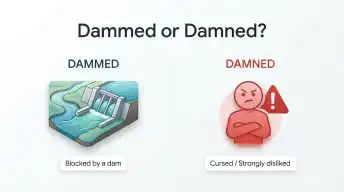
Dammed and damned are both correct English words, but they have completely different meanings. Dammed is related to a dam and usually describes something blocked or controlled, especially water. Damned comes from damn and can mean condemned, cursed, or strongly disliked.
People often search for dammed or damned because the two words sound almost identical when spoken. This makes them easy to mix up in writing, even though they belong to different word families. Using the wrong spelling can change the meaning of a sentence.
The good news is that the difference is easy to understand once you connect each word with its base form.In this guide, you’ll learn what dammed and damned mean, how to use them, where they come from, and how to choose the right word in everyday and formal writing. You will also see clear examples that make the distinction easy to remember.
Dammed or Damned: How Are They Different?
Dammed and damned look very similar, but they have completely different meanings and uses. A dam stops, holds back, or controls water, so we use dammed for this action. We use damned when someone condemns, curses, or expresses strong annoyance. Damned, on the other hand, relates to condemnation, a curse, or strong disapproval. Choosing the right word depends on the meaning you want to express.You can also use damned informally to show frustration or add emphasis. For example, “Workers dammed the river” shows that people controlled the water, while “That damned noise is annoying” shows that the speaker feels frustrated.
Dammed or Damned: Quick Answer
The easiest way to understand dammed or damned is to look at their base words.
- Dammed comes from dam.
- Damned comes from damn.
- Dammed is usually related to water, rivers, or barriers.
- Damned can express condemnation, a curse, or strong annoyance.
Examples of “Damned”
People damned him for his actions.
She called it a damned mistake in frustration.
That damned machine keeps making noise.
They damned the decision as unfair.
In these examples, damned expresses condemnation, criticism, or strong frustration.
That damned computer keeps freezing.
The story describes a damned soul.
Here, damned comes from the verb damn and has no connection with a water dam.
A Simple Rule to Remember
Dam + med = dammed
Damn + ed = damned
If you are talking about a dam, choose dammed.
If the word comes from damn, choose damned.
What Does Dammed or Damned Mean?
What Does “Dammed” Mean?
Dammed is the past tense and past participle of the verb dam.
To dam something means to block or control the flow of water by using a dam or barrier.
For example:
Workers dammed the river during construction.
This means the workers blocked or controlled the river using a dam.
Examples of “Damned”
People damned him for his actions.
She called it a damned mistake in frustration.
That damned machine keeps making noise.
They damned the decision as unfair.
In these examples, damned expresses condemnation, criticism, or strong frustration.ovide water for nearby farms.
Here, dammed clearly describes the control of water.
What Does “Damned” Mean?
Damned is the past tense and past participle of the verb damn.
The traditional meaning of damn is to condemn someone or something. It can have a religious meaning related to punishment or condemnation.
For example:
Many people considered the character damned because of his actions.
In modern informal English, speakers also use damned to express anger, frustration, or strong emphasis.
For example:
This damned phone won’t charge.
The speaker does not literally mean that the phone has faced condemnation. Instead, damned shows the speaker’s annoyance or frustration.
Why Do People Confuse Dammed and Damned?
People often confuse dammed and damned because the words look and sound very similar. However, they have different meanings and uses. Dammed relates to blocking or controlling water with a dam, while damned expresses condemnation, criticism, or strong frustration. Understanding the meaning of each word makes it easier to choose the correct spelling.
The river was dammed.
and
That damned machine is broken.
The pronunciation may sound similar, but the meanings are completely different.
The best solution is to remember the base words:
dam → dammed
damn → damned
This makes the spelling much easier to identify.
The Origin of Dammed and Damned
Although dammed and damned look almost identical, they come from different words and have different histories.
Origin of “Dammed”
Dammed comes from the noun and verb dam.
A dam is a barrier built to hold back or control water. The related verb dam means to block or restrict the flow of water.
When the past,tense ending ,ed is added, the final consonant is doubled:
dam + ed → dammed
The double m is therefore important. It shows that the word comes from dam.
For example:
The river was dammed in the nineteenth century.
The word refers to the construction or use of a dam.
Origin of “Damned”
Damned comes from the verb damn.
The word damn has historical roots connected with condemnation or judgment. Over time, damn also developed informal uses expressing anger, frustration, or strong emphasis.
When ,ed is added to damn, the spelling becomes:
damn + ed → damned
The n remains because it is part of the base word.
For example:
He was damned for his actions.
Or, in informal speech:
That damned car won’t start.
The two words therefore have different origins and should be treated as separate vocabulary items.
British English vs American English
There is no major British,American spelling difference between dammed and damned. Both words are correctly spelled the same way in British English and American English.
The important difference is their meaning, not their regional spelling.
| Word | British English | American English | Example |
| Dammed | Correct | Correct | The river was dammed. |
| Damned | Correct | Correct | That damned machine is broken. |
Dammed in British and American English
In both varieties, dammed is used when talking about blocking or controlling water.
The river was dammed to create a reservoir.
Engineers dammed the stream during the project.
The spelling does not change between British and American English.
Damned in British and American English
Damned also has the same basic meanings in both varieties.
It can mean condemned, or it can be used informally to express annoyance or emphasis.
The character was damned for his actions.
That damned printer won’t work.
The second example is informal, so it may not be suitable for formal or professional writing.
What About Canada and Australia?
Canadian and Australian English also use dammed and damned according to their meanings.
There is no standard regional spelling such as changing dammed to dammed or damned to another form. The spelling remains the same.
The key question is always:
Are you talking about a dam, or are you using the word from “damn”?
Which Version Should You Use?
Choosing between dammed and damned is not really a matter of choosing British or American English. Instead, choose the word based on what you mean.
United States
Use dammed when discussing:
- Rivers
- Dams
- Reservoirs
- Water control
- Flood management
- Hydroelectric projects
Example:
The river was dammed to provide water for the city.
Use damned when the meaning involves condemnation or informal emotional emphasis.
That damned alarm woke me up.
United Kingdom
British English follows the same distinction.
The stream was dammed to prevent flooding.
It was a damned difficult situation.
The first sentence is about water control. The second uses damned as an informal intensifier.
Canada
Canadian English also uses both spellings.
The river was dammed several years ago.
He called it a damned unfair decision.
Again, the spelling depends on the meaning, not the country.
Australia
Australian English follows the same basic rule.
Use dammed for something related to a dam:
The creek was dammed during the dry season.
Use damned when it comes from damn:
That damned noise is driving me limit.
International Writing
For international readers, context is especially helpful.
If you are discussing water infrastructure, dammed is clear and precise.
If you use damned as an emotional expression, remember that it can sound informal or strong. Consider your audience before using it.
Academic Writing
Dammed is completely appropriate in academic writing when discussing rivers, water management, engineering, geography, or environmental science.
The river was dammed to regulate seasonal water flow.
Damned is much less common in academic writing unless the word itself is being studied or discussed.
For example:
The study examines how the term “damned” was used in nineteenth,century literature.
Business Writing
In professional writing, dammed may be used naturally in technical or environmental contexts.
The proposed project would require the river to be dammed.
The emotional use of damned should generally be avoided in professional communication.
Instead of:
This damned system keeps failing.
A professional writer might say:
This system continues to experience technical problems.
Common Mistakes
Because dammed and damned sound similar, spelling mistakes are common. The easiest solution is to identify the base word before writing.
Mistake 1: Using “damned” for a River
❌ The river was damned to control flooding.
✅ The river was dammed to control flooding.
Explanation: The sentence refers to a physical dam and water control. Therefore, the correct word is dammed.
Mistake 2: Using “dammed” for Annoyance
❌ This dammed computer keeps freezing.
✅ This damned computer keeps freezing.
Explanation: Here, the writer is expressing frustration. The intended word comes from damn, so damned is correct.
Mistake 3: Writing “damned” When You Mean a Dam
❌ The engineers damned the river.
✅ The engineers dammed the river.
Explanation: The engineers built or used a barrier to control the river. The action comes from the verb dam.
Mistake 4: Forgetting the “n” in “Damned”
❌ That dammed problem is impossible to solve.
✅ That damned problem is impossible to solve.
Explanation: When damned means strongly disliked or frustrating, it comes from damn. The n must remain.
Easy Memory Tip
Use this simple trick:
DAM → DAMMED → WATER
DAMN → DAMNED → ANNOYANCE
Think of a dam holding back water.
Dam → dammed
Then remember that damn has an n.
Damn → damned
This makes the spelling much easier to recall.
Everyday Examples
Understanding how these words appear in real writing can make the difference easier to remember.
Emails
Dammed:
The project involves restoring a section of the dammed river.
This is suitable for an environmental or engineering email.
Damned:
That damned software has stopped working again.
This is understandable in casual communication, but it may sound too emotional for a formal workplace email.
A professional alternative would be:
The software has stopped working again.
Business Writing
Dammed can appear in reports about infrastructure, water management, and construction.
The river was dammed to create a reliable water supply.
This is precise and professional.
In formal business writing, damned is usually best avoided when it is being used as an emotional intensifier.
News Headlines
A news report about water infrastructure might use:
River Dammed to Create New Reservoir
Here, dammed clearly describes what happened to the river.
A news story might also use damned when reporting a quotation or discussing criticism:
Officials Condemn “Damned” Conditions
The exact use would depend on the context and editorial style.
Blogs
Blogs often use both words depending on the topic.
A travel or environmental blog might say:
The river was dammed decades ago, creating a large lake.
A personal blog might say:
I couldn’t find the damned keys anywhere.
The first is factual. The second expresses frustration.
Social Media
Informal social media posts commonly use damned for emphasis:
This damned traffic is never,ending.
A science or environmental post might use dammed:
The river was dammed to generate hydroelectric power.
Academic Writing
In academic writing, dammed is useful when discussing environmental or engineering subjects:
Researchers examined the ecological effects of the dammed river.
The word damned is normally limited to contexts where its meaning is directly relevant.
For example:
The researcher analyzed the use of the word “damned” in early English literature.
Daily Conversation
In everyday conversation, you might hear:
They dammed the river years ago.
Or:
This damned phone won’t connect to Wi,Fi.
The meaning is clear from the context.
The first sentence describes water control. The second expresses annoyance.
Google Trends & Modern Usage
People who search for dammed or damned are usually trying to solve a spelling or word,choice problem. The confusion is understandable because the two words are pronounced very similarly in many English varieties.
However, they are not alternative spellings of the same word.
Dammed remains closely connected with the noun dam and is mainly used when discussing barriers, rivers, water flow, reservoirs, or related subjects.
Damned has a broader range of meanings. It can refer to condemnation, and in informal modern English it can also express irritation or strong emphasis.
Search interest in this type of word comparison often comes from people who know how a word sounds but are unsure which spelling matches the intended meaning.
The safest approach is not to choose based on pronunciation. Instead, identify the base word:
dam → dammed
damn → damned
Quick Comparison Table
| Version | Meaning | Correct? | Region | Example |
| Dammed | Blocked or controlled with a dam | ✅ Yes | All major English varieties | The river was dammed. |
| Damned | Condemned or cursed | ✅ Yes | All major English varieties | He was damned for his actions. |
| Damned | Used to express annoyance | ✅ Yes | All major English varieties | That damned computer is slow. |
| Dammed | Related to water control | ✅ Yes | All major English varieties | Engineers dammed the stream. |
| Dammed | Alternative spelling of “damned” | ❌ No | None | Use the word that matches the meaning. |
| Damned | Alternative spelling of “dammed” | ❌ No | None | It does not mean blocked by a dam. |
Key Takeaways
- Dammed and damned are both correct spellings.
- Dammed comes from dam.
- Damned comes from damn.
- Use dammed when something is blocked or controlled by a dam.
- Use damned for condemnation or informal emotional emphasis.
- British and American English use the same spellings.
- Dammed is common in technical and environmental writing.
- Damned can sound informal or strong, so use it carefully in professional writing.
Available next action: Create a downloadable DOCX file here in this chat containing the editable prose above
FAQs
Q1: Is “dammed” or “damned” correct?
Both dammed and damned are correct English words, but they have different meanings. Dammed comes from dam and usually refers to blocking or controlling water. Damned comes from damn and can mean condemned, cursed, or strongly disliked. The correct choice depends on the meaning of your sentence.
Q2: What is the difference between dammed and damned?
Dammed means blocked or controlled with a dam, especially when talking about a river or water. Damned comes from damn and can mean condemned or used to express anger or annoyance. For example, “The river was dammed” is correct, while “That damned computer is broken” uses damned to show frustration.
Q3: Is “dammed” the past tense of dam?
Yes. Dammed is the past tense and past participle of the verb dam. It means to block or control something with a dam. For example, “Engineers dammed the river” means that engineers blocked or controlled the river’s flow by using a dam or similar barrier.
Q4: Is “damned” a swear word?
Damned can be considered a mild swear word or strong expression when it is used to show anger, irritation, or emphasis. For example, “That damned car won’t start” expresses frustration. However, damned can also have a literal meaning related to condemnation, so its meaning depends on the context.
Q5: How can I remember dammed vs damned?
A simple memory trick is to connect each word to its base form. Dammed comes from dam, which is associated with water. Damned comes from damn, which contains an n. Remember: dam → dammed and damn → damned.
Q6: Is “damned” the same as “dammed”?
No. They are different words with different meanings. Dammed relates to a dam and usually describes something blocked or controlled, especially water. Damned comes from damn and can mean condemned or strongly disliked. Their similar pronunciation is the main reason they are often confused.
Q7: What does “dammed river” mean?
A dammed river is a river whose flow has been blocked or controlled by a dam. Dams can be built for several purposes, including water storage, irrigation, flood management, and electricity generation. In this expression, dammed is correct because the word comes from dam.
Q8: Can “damned” mean “very”?
Yes. In informal English, damned can work as an intensifier meaning something like very or extremely, often with an emotional tone. For example, “It was a damned difficult task” means it was very difficult. This use can sound strong or informal, so it may not suit formal writing.
Q9: Should I use “dammed” or “damned” in formal writing?
Use dammed in formal writing when discussing dams, rivers, water management, engineering, or related topics. Use damned only when its meaning is necessary, such as in literary analysis or a quotation. Avoid using damned as an emotional intensifier in formal business or academic writing.
Q10: Why do “dammed” and “damned” sound similar?
Dammed and damned sound very similar because their base words, dam and damn, have similar pronunciations in many varieties of English. Their meanings, however, are different. Looking at the base word is the easiest way to choose the correct spelling.
Conclusion
The difference between dammed or damned becomes simple when you focus on the words they come from. Dammed comes from dam and usually describes something that has been blocked or controlled with a dam. It is commonly used when discussing rivers, streams, reservoirs, water management, and related subjects.
Damned, on the other hand, comes from damn. It can mean condemned or cursed, and it is also used informally to express annoyance, frustration, or strong emphasis. Because these words sound very similar, it is easy to confuse them when writing, but they are not interchangeable.
There is also no major British,American spelling difference between them. Both dammed and damned are standard forms in major varieties of English.
The easiest memory trick is to look at the base word: dam → dammed and damn → damned. If you remember that simple connection, you can choose the correct spelling with confidence.
Remember: “dammed” is connected to a dam, while “damned” keeps the “n” from “damn.”
Read More About !

“I’m Charlotte Vans, and I enjoy making grammar and word usage easier to understand. Through my writing, I help readers understand confusing words, improve spelling, and write with greater confidence.”








1 thought on “Dammed or Damned: What’s the Difference?”