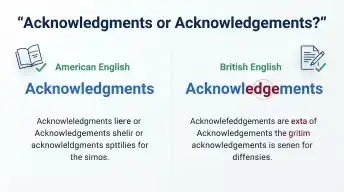
If you are unsure if to write acknowledgments or acknowledgements, both spellings are correct. Acknowledgments is the standard American English spelling, while acknowledgements is more common in British English and other varieties that follow British spelling.
This difference often causes confusion because the two words look almost identical and have exactly the same basic meaning. You may see either spelling in books, academic papers, theses, reports, business documents, and websites.
The choice usually depends on the type of English you are using. American writers generally choose acknowledgments, while British writers commonly use acknowledgements.
In this guide, we will explain the difference clearly, look at the meaning and origin of both forms, compare American and British usage, and show you which spelling to use in academic, professional, and everyday writing.
Acknowledgments or Acknowledgements: Which One Should You Use?
Both “acknowledgments” and “acknowledgements” are accepted English spellings. The form “acknowledgments” is commonly used in American English, whereas “acknowledgements” is widely used in British English. The two versions carry the same meaning, so the right choice mainly depends on your region, audience, or preferred style guide. Both forms have the same meaning and refer to expressions of thanks, recognition, or appreciation. The main difference is regional spelling, so your choice should depend on your target audience or the style guide you are following.
Acknowledgments or Acknowledgements: Quick Answer
The difference is mainly about regional spelling.
- Acknowledgments = American English
- Acknowledgements = British English
- Both spellings are correct.
- Both have the same meaning.
- The singular forms are acknowledgment and acknowledgement.
Example in American English
The author included a list of acknowledgments at the end of the book.
Example in British English
The author included a list of acknowledgements at the end of the book.
Both sentences are correct. The spelling simply reflects the variety of English being used.
Why Are There Two Spellings?
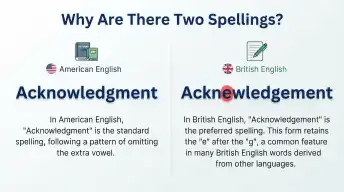
The difference comes from different spelling conventions that developed in American and British English.
American English often prefers the shorter form:
acknowledgment
British English commonly retains the extra e:
acknowledgement
This does not create a difference in meaning.
What Does Acknowledgments or Acknowledgements Mean?
Acknowledgments and acknowledgements are plural nouns referring to statements of thanks, recognition, or appreciation.
An acknowledgment may recognize someone’s help, support, contribution, advice, or involvement.
Simple Definition
An acknowledgment is a statement that recognizes or thanks someone for their help, contribution, or support.
The plural form is:
acknowledgments
or:
acknowledgements
Example
The book’s acknowledgments thank everyone who helped with the project.
Here, the writer is recognizing people who provided assistance.
Acknowledgments in Books
Authors often include an Acknowledgments or Acknowledgements section in books.
This section may thank:
- Editors
- Publishers
- Researchers
- Teachers
- Colleagues
- Friends
- Family members
- Organizations
For example:
The acknowledgments section thanks the editor and research team.
A British publisher might write:
The acknowledgements section thanks the editor and research team.
Acknowledgments in Academic Writing
The word is also very common in academic writing.
Students may include an acknowledgments section in:
- Theses
- Dissertations
- Research papers
- Academic books
- University projects
For example:
The acknowledgements section recognizes everyone who contributed to the research.
In American academic writing, the same sentence would normally use:
The acknowledgments section recognizes everyone who contributed to the research.
Acknowledgments in Professional Writing
The word can also be used in business and professional documents.
For example:
The report contains acknowledgments of the team’s contributions.
Here, the word refers to formal recognition.
Acknowledgment vs Thanks
Although acknowledgment can mean thanks, the two words are not always interchangeable.
Thanks is usually more natural in casual conversation.
Acknowledgment sounds more formal and is often used in books, academic documents, reports, and official writing.
For example:
Thanks for helping me.
sounds natural in everyday conversation.
But:
The report includes an acknowledgment of the research team’s contribution.
sounds more appropriate in formal writing.
The Origin of Acknowledgments or Acknowledgements
The spelling difference is connected to the history of English spelling and the development of American and British conventions.
The word comes from the verb acknowledge, which means to recognize, accept, admit, or show awareness of something.
The noun is formed by adding the suffix ,ment:
acknowledge → acknowledgment / acknowledgement
The plural is then formed by adding ,s:
acknowledgment → acknowledgments
acknowledgement → acknowledgements
The main difference is the extra e before ,ment.
Why Does American English Use “Acknowledgment”?
American English often favors shorter spellings in certain words where British English retains an additional letter.
Therefore, American English commonly uses:
acknowledgment
while British English commonly uses:
acknowledgement
This is a spelling convention, not a difference in pronunciation or meaning.
Is One Form More Correct?
No.
It would be misleading to say that acknowledgement is wrong simply because American English uses acknowledgment.
Likewise, acknowledgments is not wrong when used in American English.
The important question is:
Which variety of English are you writing for?
British English vs American English
The main difference can be seen clearly in the following table:
| British English | American English | Example |
| acknowledgement | acknowledgment | She received an acknowledgment of her work. |
| acknowledgements | acknowledgments | The book includes several acknowledgments. |
British English
British English commonly uses:
acknowledgement
and:
acknowledgements
Example:
The author wrote a heartfelt acknowledgement to her teachers.
Plural:
The author wrote several acknowledgements in the final chapter.
American English
American English generally uses:
acknowledgment
and:
acknowledgments
Example:
The author wrote a heartfelt acknowledgment to her teachers.
Plural:
The author wrote several acknowledgments in the final chapter.
Same Meaning, Different Spelling
There is no difference in what the words mean.
Both forms can describe:
- Recognition
- Appreciation
- Thanks
- Credit
- Formal recognition of assistance
The difference is simply the spelling convention.
Which Version Should You Use?
The best spelling depends on your audience.
United States
For American English, use:
acknowledgments
Example:
The acknowledgments appear before the first chapter.
United Kingdom
For British English, use:
acknowledgements
Example:
The acknowledgements appear before the first chapter.
Canada
Canadian English can use both forms depending on the publication or style guide.
If you are writing for a Canadian university, company, or publisher, check its preferred spelling system.
Australia
Acknowledgements is commonly seen in Australian English, although individual organizations and publications may have their own style preferences.
International English
For international readers, either spelling can be understood easily.
The most important thing is consistency.
If the rest of your article uses British spelling, acknowledgements will fit naturally.
If you use American spelling throughout your content, choose acknowledgments.
Academic Writing
Academic writers should follow the style requirements of their university, journal, or publisher.
For example, if your institution requires American English, use:
acknowledgments
If it requires British English, use:
acknowledgements
Do not change between the two forms randomly.
Business Writing
Business writers should consider their target market.
For a US,based company:
acknowledgments
For a UK,focused company:
acknowledgements
If a company has its own editorial style guide, that guide should take priority.
Common Mistakes with Acknowledgments and Acknowledgements
Because acknowledgments and acknowledgements differ by only one letter, writers sometimes assume that one must be incorrect. The real issue is usually regional spelling or inconsistent usage.
Mistake 1: Saying “Acknowledgements” Is Always Wrong
This is incorrect.
Acknowledgements is a standard spelling in British English.
Correct:
The acknowledgements section appears at the end of the book.
For American English, use:
The acknowledgments section appears at the end of the book.
Mistake 2: Saying “Acknowledgments” Is a British English Error
This is also incorrect.
Acknowledgments is the standard American English spelling and is widely accepted in American books, articles, reports, and academic writing.
Mistake 3: Mixing Both Spellings
Avoid switching between the two forms in the same document without a reason.
For example:
The acknowledgments section thanks the research team.
The acknowledgements also mention the university.
If both words refer to the same section, this creates unnecessary inconsistency.
Choose one spelling based on your target variety of English.
Mistake 4: Thinking the Meaning Is Different
The spelling does not change the meaning.
Both forms refer to recognition, thanks, or appreciation.
The author included acknowledgments.
and:
The author included acknowledgements.
Both sentences communicate the same idea.
Mistake 5: Using “Acknowledgment” When You Need the Plural
The singular and plural forms are different.
Singular:
acknowledgment
acknowledgement
Plural:
acknowledgments
acknowledgements
For example:
The author gave an acknowledgment to her editor.
But:
The author included several acknowledgments in the book.
Easy Memory Tip
Use this simple rule:
American English → acknowledgment → acknowledgments
British English → acknowledgement → acknowledgements
Think of the British version as keeping the extra “e.”
Everyday Examples
The word appears in many types of formal and written English. Here are practical examples.
In Books
American English:
The acknowledgments appear before the first chapter.
British English:
The acknowledgements appear before the first chapter.
Authors often use this section to thank people who helped create the book.
In Academic Papers
American English:
The acknowledgments recognize the researchers who assisted with the study.
British English:
The acknowledgements recognize the researchers who assisted with the study.
In a Thesis
I would like to express my sincere acknowledgments to everyone who supported this research.
A more natural formal sentence could be:
I would like to acknowledge everyone who supported this research.
The verb acknowledge is often useful when you want to avoid repeating the noun.
In Business Writing
The report includes acknowledgments of the employees who contributed to the project.
This wording is suitable when a formal document gives credit to contributors.
In Emails
The noun is less common in ordinary emails. Instead, writers often use thanks or appreciation.
For example:
Thank you for your support throughout the project.
However, the noun can still be used in formal contexts:
I would like to acknowledge your valuable contribution to the project.
In News Writing
The report included acknowledgments of the volunteers who helped during the event.
News writing may use either spelling depending on the publication’s regional style.
In Blog Writing
The acknowledgments section gives credit to the people who helped make this guide possible.
This is especially common in books, long,form guides, and personal projects.
On Social Media
The word is less common in casual social media posts.
A person might write:
A big thank,you to everyone who supported this project!
instead of:
Acknowledgments to everyone who supported this project.
The second sentence sounds much more formal.
In Daily Conversation
People usually use thanks, appreciation, or recognition rather than acknowledgment.
For example:
I really appreciate your help.
This sounds more natural in conversation than:
I want to give you an acknowledgment.
Google Trends & Modern Usage
People searching for acknowledgments or acknowledgements are often trying to solve a spelling or style question.
The search may come from students writing a thesis, authors preparing a book, editors checking a manuscript, or writers deciding which English variety to follow.
The two spellings are closely connected to regional English usage.
Acknowledgments is strongly associated with American English, while acknowledgements is commonly associated with British English.
Modern digital publishing has made this distinction more visible because readers regularly encounter content from different English,speaking countries.
A US website may use acknowledgments, while a UK university website may use acknowledgements. Seeing both forms does not mean that one source has necessarily made a spelling mistake.
Why Do People Search “Acknowledgments or Acknowledgements”?
Common reasons include:
- Checking the correct spelling
- Writing a thesis or dissertation
- Preparing a book manuscript
- Editing an academic paper
- Following a publisher’s style
- Writing for a US or UK audience
- Checking if the extra e is necessary
- Choosing between American and British English
Can Google Trends Show Which One Is More Popular?
Google Trends can be useful for comparing search interest by country and time period. However, search interest should not automatically be treated as proof of overall word usage.
For this reason, it is better to describe the two forms through established regional spelling patterns rather than inventing exact percentages or search,volume figures.
Quick Comparison Table
| Version | Meaning | Correct? | Region | Example |
| acknowledgment | Recognition or expression of thanks | Yes | Mainly American English | The report includes an acknowledgment. |
| acknowledgement | Recognition or expression of thanks | Yes | Mainly British English | The report includes an acknowledgement. |
| acknowledgments | Multiple expressions of thanks or recognition | Yes | Mainly American English | The book has several acknowledgments. |
| acknowledgements | Multiple expressions of thanks or recognition | Yes | Mainly British English | The book has several acknowledgements. |
Acknowledgments vs Acknowledgements in Academic Writing
Academic writing is one of the most common places where this spelling question appears.
A thesis or dissertation may contain a dedicated section called Acknowledgments or Acknowledgements.
This section usually allows the writer to recognize people and organizations that contributed to the research or writing process.
For example:
I would like to thank my supervisor for her guidance throughout this research.
A formal acknowledgments section may also recognize:
- Research supervisors
- Academic departments
- Universities
- Research assistants
- Funding organizations
- Participants
- Editors
- Family members
Which Heading Should You Use?
If you are writing an American English thesis:
Acknowledgments
If you are writing a British English thesis:
Acknowledgements
However, your university’s official formatting requirements should always come first.
Acknowledgment vs Recognition vs Appreciation
These words are related but are not always interchangeable.
Acknowledgment
An acknowledgment formally recognizes someone’s contribution, assistance, or involvement.
The book contains an acknowledgment of the editor’s help.
Recognition
Recognition focuses on giving credit or identifying someone’s achievement or contribution.
The researcher received recognition for her work.
Appreciation
Appreciation emphasizes gratitude or a positive feeling toward someone’s help.
The team expressed its appreciation for the volunteers.
The three words overlap, but the best choice depends on the context.
How to Choose the Right Spelling
Before choosing between the two forms, ask three simple questions:
1. Who Is Your Audience?
Are you writing primarily for American readers or British readers?
2. What Style Guide Are You Following?
If your university, publisher, employer, or client has a style guide, follow it.
3. What Spelling Do You Use Elsewhere?
Keep your spelling consistent throughout the document.
If your article uses:
color, organize, center
then acknowledgment will usually fit an American English style.
If it uses:
colour, organise, centre
then acknowledgement will usually fit a British English style.
This consistency helps readers understand which variety of English you are using.
Key Takeaways
- Acknowledgments is the common American English spelling.
- Acknowledgements is common in British English.
- Both forms are correct.
- Both have the same meaning.
- The singular forms are acknowledgment and acknowledgement.
- Academic writers should follow their university or journal style guide.
- Business writers should follow their organization’s preferred style.
- Avoid switching between American and British spellings without a reason.
- The extra e is the main spelling difference.
- When in doubt, identify your target audience and use its preferred English variety.
FAQs
Q1: Is acknowledgments or acknowledgements correct?
Both acknowledgments and acknowledgements are correct. Acknowledgments is generally used in American English, while acknowledgements is common in British English. The meaning does not change between the two spellings. Choose the version that matches your target audience or the style guide you are following.
Q2: Is acknowledgment American or British English?
Acknowledgment is primarily the American English spelling. American English commonly removes the extra e found in the British form acknowledgement. If you are writing for a US audience, acknowledgment and acknowledgments are usually the appropriate forms.
Q3: Is acknowledgement British English?
Yes. Acknowledgement is a common British English spelling. Its plural form is acknowledgements. You can find this spelling in British books, academic documents, reports, and other formal writing.
Q4: Do acknowledgments and acknowledgements mean the same thing?
Yes. Both forms have the same meaning. They refer to expressions of thanks, recognition, or appreciation. The only significant difference is the spelling convention associated with different varieties of English.
Q5: Which spelling should I use in a thesis?
Follow the spelling requirements of your university or institution. If your thesis uses American English, choose acknowledgments. If it follows British English, choose acknowledgements. Most importantly, use the same spelling consistently throughout your thesis.
Q6: Is acknowledgements a misspelling?
No. Acknowledgements is a valid English spelling, particularly in British English. It should not be considered incorrect simply because American English generally uses acknowledgments.
Q7: Should I use acknowledgments in American English?
Yes. Acknowledgments is the standard form commonly used in American English. For example: “The acknowledgments section appears at the end of the book.” Always check a specific publisher or institutional style guide if one applies.
Q8: Which is more common, acknowledgments or acknowledgements?
Usage depends on the region. Acknowledgments is associated with American English, while acknowledgements is widely used in British English. The popularity of either spelling can therefore vary depending on the country, publication, or writing style being considered.
Q9: How do you spell acknowledgments in the UK?
In British English, the usual spelling is acknowledgements, with an extra e before ,ments. For example: “The acknowledgements section thanks everyone who contributed to the project.”
Q10: Can I use both spellings in one article?
It is better to choose one spelling and use it consistently. Switching between acknowledgments and acknowledgements can make your writing look inconsistent. Select the version that matches your target audience, region, or style guide.
Conclusion
Acknowledgments and acknowledgements are both correct spellings of the same word. The difference is mainly based on regional English conventions, not meaning or grammar. Acknowledgments is the usual American English form, while acknowledgements is common in British English.
If you are writing for readers in the United States, acknowledgments is the natural choice. For British English, use acknowledgements. In Canada, Australia, and international writing, usage can vary, so checking the relevant style guide is a good idea.
The same distinction applies to the singular forms: acknowledgment and acknowledgement.
For academic papers, theses, books, business documents, and websites, consistency is the key. Once you choose the spelling that matches your audience or style requirements, use it throughout the entire document.
Remember: American English usually drops the extra “e,” while British English commonly keeps it.
Read More About !

“I’m Charlotte Vans, and I enjoy making grammar and word usage easier to understand. Through my writing, I help readers understand confusing words, improve spelling, and write with greater confidence.”