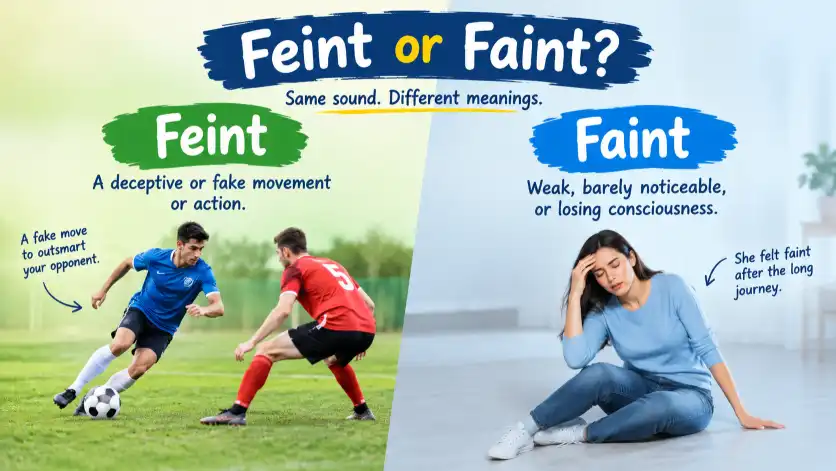
Feint and faint may sound alike, but they have different meanings. Feint means a deceptive move or action, while faint describes something weak or unclear or means to lose consciousness.
These words are easy to confuse because they sound alike in many varieties of English. The spelling is also close, with only one letter creating a completely different meaning. This can cause problems in writing, especially for students, ESL learners, writers, and anyone who hears the words before seeing them in print.
For example, a boxer may make a feint to trick an opponent, while a person may faint because of heat or shock. You might also describe a faint sound as one that is difficult to hear.
In this guide, you will learn what feint or faint means, how the words differ, where they came from, how to use them correctly, and how to remember the difference.
Feint or Faint: Featured Snippet Answer
Feint means a deceptive movement or action intended to distract or trick someone. Faint means weak, barely noticeable, or losing consciousness. For example, a boxer can make a feint, while a person can faint from heat. Both words are correct, but they cannot normally be used interchangeably.
Feint or Faint: Quick Answer
The simplest way to remember the difference is:
- Feint = a trick or deceptive movement
- Faint = weak, barely noticeable, or losing consciousness
Examples
Feint:
The boxer made a quick feint to the left.
Here, the boxer pretends to move one way to mislead the opponent.
Faint:
She felt dizzy and almost fainted.
Here, fainted means she nearly lost consciousness.
Faint:
I heard a faint sound outside.
Here, faint means weak or barely noticeable.
A Simple Memory Tip
Think of feint as a fake move.
Think of faint as something that is weak or connected with losing consciousness.
What Do Feint and Faint Mean?
Although feint and faint look and sound similar, their meanings are different.
What Does Feint Mean?
A feint is a movement or action designed to deceive someone.
It is often used in sports, fighting, military strategy, and other situations where one person wants another person to believe something that is not actually going to happen.
Example:
The player made a feint before passing the ball.
The player used a fake movement to make another player react.
Feint can be used as both a noun and a verb.
As a noun:
The boxer used a feint to confuse his opponent.
As a verb:
The boxer feinted to the left before moving right.
So, feint is closely associated with deception, trickery, and false movements.
What Does Faint Mean?
Faint has several common meanings.
As an adjective, it can describe something that is weak or difficult to notice.
There was a faint smell of smoke in the room.
It can also describe something that is not strong or clear.
I could hear a faint voice in the distance.
As a verb, faint means to lose consciousness for a short time.
He fainted after standing in the heat for too long.
As a noun, faint can refer to an episode of losing consciousness, although phrases such as “a faint” are less common in everyday modern English than the verb faint.
Feint vs. Faint at a Glance
| Word | Main Meaning | Common Use | Example |
| Feint | A deceptive movement or action | Sports, fighting, strategy | The boxer made a feint. |
| Faint | Weak or barely noticeable | Sounds, smells, light, signs | I heard a faint noise. |
| Faint | Lose consciousness | Health, physical situations | She fainted suddenly. |
The key difference is simple: feint involves deception, while faint usually involves weakness, low intensity, or loss of consciousness.
The Origin of Feint and Faint
The history of these two words helps explain why they are so similar.
Origin of Feint
Feint entered English through French and is related to the French verb feindre, meaning “to pretend” or “to feign.”
Its historical sense is connected with pretending or making a deceptive action. Over time, English developed the modern meaning of a feint as a false or misleading movement.
This meaning is especially common in contexts such as:
- Boxing
- Fencing
- Football and other sports
- Military strategy
- Competitive situations
For example:
The player used a feint to get past the defender.
The movement is not the action the person truly intends to make. It is meant to mislead someone.
Origin of Faint
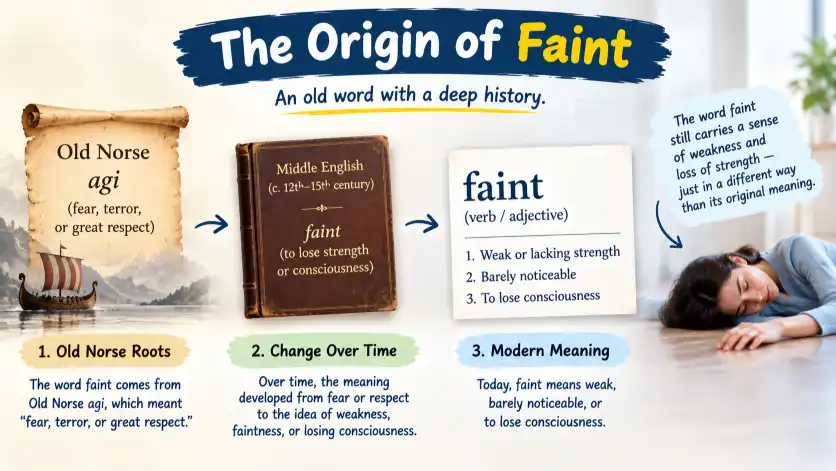
Faint also has historical connections with French words related to feindre. Its development in English led toward meanings associated with weakness, timidity, lack of strength, and eventually loss of consciousness.
Modern English now uses faint in several distinct ways.
For example:
She felt faint.
This means she felt as though she might lose consciousness.
It can also mean barely noticeable:
A faint light appeared in the distance.
Although feint and faint have related historical roots, their modern meanings are clearly different.
British English vs American English
There is no major British,American spelling difference between feint and faint. Both words are spelled the same in British English and American English.
| Word | British English | American English | Example |
| Feint | Feint | Feint | The player made a feint. |
| Faint | Faint | Faint | She felt faint. |
| Fainted | Fainted | Fainted | He fainted suddenly. |
| Fainting | Fainting | Fainting | She was worried about fainting. |
The main issue is therefore meaning, not regional spelling.
Usage in Different English Varieties
if you are writing for readers in the UK, US, Canada, Australia, or elsewhere, the distinction remains the same.
Use feint when you mean:
a deceptive action or movement.
Use faint when you mean:
weak, barely noticeable, or losing consciousness.
This makes the words different from pairs such as recognising/recognizing, where British and American spelling conventions can affect the form.
For feint or faint, changing from British English to American English does not normally change the spelling.
Which Version Should You Use?
The correct word depends on what you are trying to say.
United States
Use feint for a deceptive movement.
The fighter made a feint before attacking.
Use faint for weakness, low intensity, or loss of consciousness.
She began to feel faint.
United Kingdom
The same distinction applies in British English.
The player made a feint.
He nearly fainted.
Canada
Canadian English also uses feint and faint according to their standard meanings.
The goalkeeper was fooled by the feint.
She felt faint after standing outside.
Australia
Australian English follows the same basic distinction.
The boxer used a feint.
He fainted in the crowded room.
International Writing
For international readers, choose the word based on meaning rather than pronunciation.
If the sentence involves trickery or a fake movement, use feint.
If it involves weakness, something barely noticeable, or losing consciousness, use faint.
Academic Writing
In academic writing, accuracy matters more than choosing between British and American spelling in this case.
Use feint when discussing a deceptive action or strategy.
Use faint when describing something weak, barely visible, barely audible, or related to loss of consciousness.
Business Writing
The word feint may appear when discussing strategy or competitive behavior.
The company made a strategic feint toward a new market.
However, faint is much more common in everyday business writing when describing something weak or unclear.
There was a faint indication that the plan might change.
Common Mistakes
Because the words sound similar, people sometimes use one in place of the other.
Mistake 1: Using “faint” for a deceptive movement
Incorrect:
The boxer made a faint toward his opponent.
Correct:
The boxer made a feint toward his opponent.
Why?
A deceptive movement is a feint.
Mistake 2: Using “feint” for losing consciousness
Incorrect:
She feinted after standing in the heat.
Correct:
She fainted after standing in the heat.
Why?
The verb faint means to lose consciousness.
Mistake 3: Confusing “faint” with “feint” in descriptions
Incorrect:
There was a feint smell of flowers.
Correct:
There was a faint smell of flowers.
Why?
A weak or barely noticeable smell is faint, not feint.
Memory Tip
Use this quick rule:
FEINT = FAKE MOVE
FAINT = WEAK / LOSE CONSCIOUSNESS
If someone is trying to trick another person, think feint.
If something is weak, barely noticeable, or someone loses consciousness, think faint.
Everyday Examples
In Emails
I noticed a faint error in the document.
Here, faint suggests something slight or barely noticeable, although “minor” or “small” may often sound more natural in professional writing.
For a strategic situation:
The competitor’s announcement may have been a feint.
In Business Writing
The sudden change may have been a feint designed to distract competitors.
Here, the company appears to be using a misleading action.
Another example:
There was a faint possibility that the meeting would be postponed.
Here, faint means very small or unlikely.
In News Headlines
News writing may use feint when discussing sports, politics, military strategy, or competition.
Late Feint Changes the Course of the Match
Faint can appear when reporting physical conditions or weak signs.
Witness Reports Faint Sound Before Storm
The exact meaning depends on the context.
In Blogs
The runner made a quick feint before changing direction.
Or:
A faint scent of coffee filled the kitchen.
Both sentences use the correct word because their meanings are different.
On Social Media
You might see:
That shoulder movement was a clever feint!
Or:
I could hear a faint noise in the background.
The first describes a deceptive movement. The second describes something weak or difficult to hear.
In Academic Writing
The author describes the character’s action as a feint intended to mislead the other characters.
Another example:
The study found only a faint relationship between the two variables.
Here, faint means weak rather than deceptive.
In Daily Conversation
I almost fainted when I heard the news.
I could hear a faint sound from upstairs.
The player used a feint to get around the defender.
These examples show the three most useful everyday patterns.
Google Trends & Modern Usage
People often search for feint or faint because these words sound the same in many English accents but have completely different meanings. This makes them a common spelling and word,choice problem for students, ESL learners, writers, and editors.
There are no reliable universal statistics that can show exactly how often people confuse these two words. However, their usage patterns are clear from standard English dictionaries and everyday writing.
How “Feint” Is Used Today
Feint is mainly used when talking about a deceptive action or movement.
Common contexts include:
- Boxing
- Fencing
- Football and other sports
- Military strategy
- Competition
- Negotiation
- Strategic behavior
For example:
The boxer made a quick feint before throwing a punch.
The boxer is pretending to make one movement in order to mislead the opponent.
The word can also be used figuratively:
The company’s announcement was seen as a strategic feint.
Here, feint describes an action intended to distract or mislead.
How “Faint” Is Used Today
Faint has a much wider range of everyday uses.
It can describe something that is:
- Weak
- Slight
- Barely visible
- Barely audible
- Barely noticeable
Examples:
There was a faint smell of coffee.
I heard a faint voice outside.
A faint light appeared in the distance.
Faint is also commonly used as a verb:
She fainted after feeling dizzy.
Because of these different meanings, faint appears in many more everyday contexts than feint.
Why People Search “Feint or Faint”
The search query usually reflects a spelling or meaning question.
Someone may hear:
“The boxer made a feint.”
and wonder if it should be spelled faint.
Another person may want to write:
“She felt faint.”
but may confuse the spelling with feint.
The pronunciation makes this especially tricky. When you only hear the word, the surrounding context becomes important.
Modern Usage Rule
A quick modern usage test is:
Is it a trick or fake movement? → Feint
Is it weak, barely noticeable, or related to losing consciousness? → Faint
This rule covers most common situations.
Quick Comparison Table
| Version | Meaning | Correct? | Region | Example |
| Feint | A deceptive movement | Yes | US, UK, Canada, Australia, International | The boxer made a feint. |
| Feint | A deceptive action or strategy | Yes | US, UK, Canada, Australia, International | It was a strategic feint. |
| Faint | Weak or barely noticeable | Yes | US, UK, Canada, Australia, International | I heard a faint sound. |
| Faint | Feeling weak or close to losing consciousness | Yes | US, UK, Canada, Australia, International | She felt faint. |
| Faint | To lose consciousness | Yes | US, UK, Canada, Australia, International | He fainted suddenly. |
Feint vs. Faint in One Sentence
The boxer made a feint, while the spectator felt faint.
This sentence provides an easy way to see the difference.
Feint describes the deceptive movement.
Faint describes the person’s physical condition.
Key Takeaways
- Feint and faint are both correct English words.
- Feint means a deceptive or misleading movement or action.
- Faint can mean weak, slight, or barely noticeable.
- Faint can also mean to lose consciousness.
- Feint is often used in sports, combat, and strategy.
- Faint is common in everyday descriptions of sounds, smells, light, feelings, and physical conditions.
- The two words sound alike in many English accents.
- They are not British and American spelling variants.
- Use feint for a fake move and faint for weakness or loss of consciousness.
FAQs About Feint or Faint
Q1: What is the difference between feint and faint?
Feint means a deceptive movement or action intended to mislead someone. Faint can mean weak, slight, or barely noticeable, and it can also mean losing consciousness. For example, a boxer makes a feint, while a person may faint because of heat, dizziness, or another physical cause.
Q2: Is it “faint” or “feint” in boxing?
The correct word is feint. In boxing, a feint is a deceptive movement that makes an opponent think an attack is coming from one direction. For example: “The boxer used a feint to make his opponent lower his guard.” The spelling faint would be incorrect in this context.
Q3: Is “feint” a real English word?
Yes. Feint is a standard English word. As a noun, it means a deceptive movement or action. As a verb, feint means to make such a deceptive movement. For example, “The player made a feint” and “The player feinted to the left.”
Q4: Does “faint” mean fake?
No. Faint does not mean fake. It usually describes something weak or barely noticeable, such as a faint sound or faint light. As a verb, it means to lose consciousness. Feint is the word associated with a fake or deceptive movement.
Q5: What is an example of a feint?
A simple example is a football player pretending to move toward the left before quickly moving toward the right. The fake movement is a feint because it is designed to deceive the defender. Similar movements can occur in boxing, fencing, martial arts, and other competitive activities.
Q6: What does “faint” mean in a sentence?
Faint can mean weak or difficult to notice. For example, “I heard a faint sound outside” means the sound was very quiet. It can also describe a physical condition: “She felt faint” means she felt weak or as though she might lose consciousness.
Q7: Are “feint” and “faint” homophones?
Yes. Feint and faint are homophones in many standard varieties of English because they have the same pronunciation but different spellings and meanings. This is one reason they are frequently confused in writing. Context helps determine which word is correct.
Q8: How can I remember feint and faint?
Remember “feint = fake move.” If someone is deliberately trying to deceive another person with an action or movement, use feint. Use faint for something weak or barely noticeable, or when someone loses consciousness. This memory trick works for most common uses.
Q9: Can “faint” be a noun?
Yes. Faint can be used as a noun to mean an episode of losing consciousness, as in “He had a faint.” However, this construction is less common in everyday English. The verb is much more familiar, as in “He fainted.”
Q10: Should I use “feint” or “faint” for a weak sound?
Use faint. For example: “There was a faint sound coming from the hallway.” Here, faint means weak or difficult to hear. Feint would be incorrect because it refers to a deceptive action or movement.
Conclusion
Feint or faint are both correct English words, but they have different meanings and should not normally be substituted for each other. Feint refers to a deceptive movement, action, or strategy used to mislead someone. It is especially common in sports, fighting, and strategic situations.
Faint has several meanings. It can describe something weak or barely noticeable, such as a faint sound, faint smell, or faint light. It can also describe a person who feels weak or loses consciousness, as in “She fainted.”
The two words are easy to confuse because they sound alike in many varieties of English. However, there is no British,versus,American spelling difference to remember. The correct choice depends on the meaning of the sentence.
A simple memory trick can make the distinction easier: feint = fake move, while faint = weak or lose consciousness.
Keep this rule in mind whenever you are unsure which spelling to use.
Remember: A feint tricks, while a faint weakens or causes someone to lose consciousness.
Read More About !

“I’m Charlotte Vans, and I enjoy making grammar and word usage easier to understand. Through my writing, I help readers understand confusing words, improve spelling, and write with greater confidence.”