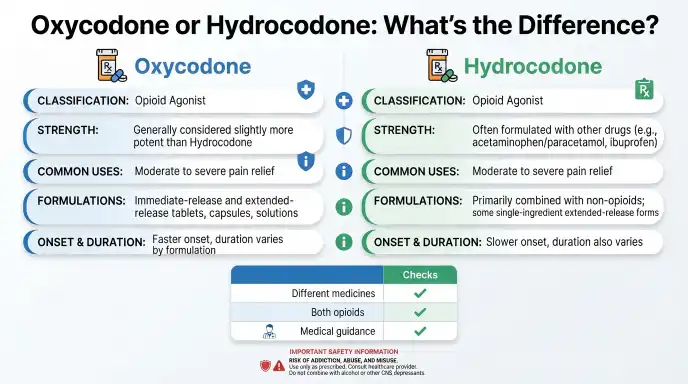
When comparing oxycodone or hydrocodone, the most important point is that they are two different prescription opioid medications, not two spellings of the same drug. Both can be used to manage significant pain, but they have different drug identities, formulations, and clinical considerations.
People often search for these both because the names look and sound similar. They may also want to understand if one medication is stronger, if the two can be substituted, or why a doctor might prescribe one instead of the other. These are important questions because prescription opioids can cause serious side effects and carry risks such as dependence, misuse, and overdose.
In this guide, we will explain the difference between these both in simple language. You will learn what each term means, how they are used, if there is any British or American spelling difference, and what common mistakes to avoid. We will also look at everyday examples and answer common questions readers have about these two medications.
Oxycodone or Hydrocodone: Featured Snippet & AI Overview
These are both different prescription opioid medications. Both can be used to relieve significant pain, but they are not interchangeable drugs. Their effects, formulations, risks, and appropriate use can differ. A healthcare professional should determine which medication is suitable for an individual patient.
Oxycodone or Hydrocodone: Quick Answer
These are both prescription opioids, but they are different medicines. Neither name is a British or American spelling of the other.
Both medications can be prescribed for significant pain. However, the exact medicine, formulation, and prescription instructions matter.
The basic difference
- Oxycodone is an opioid medication used for pain relief.
- Hydrocodone is a different opioid medication also used for pain relief.
- Both can cause drowsiness, nausea, constipation, and other side effects.
- Both can cause dependence and can be dangerous when misused.
- They should not be switched or combined without advice from a qualified healthcare professional.
Simple example
If a prescription says:
“Oxycodone”
it refers specifically to oxycodone.
If it says:
“Hydrocodone”
it refers specifically to hydrocodone.
The two names cannot be used interchangeably.
Why the confusion happens
The names have a similar structure and both are associated with opioid pain treatment. This can make them look like alternative names for the same medicine.
They are not.
It is also important to remember that some prescription products contain an opioid together with another active ingredient. Therefore, checking the complete medication name and active ingredients is important.
What Does Oxycodone or Hydrocodone Mean?
The phrase “oxycodone or hydrocodone” is a comparison between two different prescription medications.
It is not a grammar question like “color or colour” or “congratulation or congratulations.” Instead, it is a medical terminology comparison.
What is oxycodone?
Oxycodone is a prescription opioid analgesic used to relieve significant pain.
An analgesic is a medicine that helps relieve pain. Oxycodone works through the body’s opioid system and changes how the brain and nervous system respond to pain.
Oxycodone may be available in different formulations. Some forms are designed for shorter-term pain relief, while extended-release formulations are designed differently.
Because formulations can vary, the name of the exact product matters.
What is hydrocodone?
Hydrocodone is another prescription opioid analgesic used to relieve significant pain.
Like oxycodone, hydrocodone affects the body’s opioid receptors and changes the way pain is perceived.
Hydrocodone may also appear in combination products. This means that a medication containing hydrocodone can include another active ingredient as well.
Oxycodone vs. hydrocodone in simple terms
| Feature | Oxycodone | Hydrocodone |
| Drug type | Opioid | Opioid |
| Main purpose | Pain relief | Pain relief |
| Same drug? | No | No |
| Same spelling? | No | No |
| British/American variant? | No | No |
| Can they be automatically substituted? | No | No |
The table shows the main point clearly: they belong to the same broad medication class but are different drugs.
Why people search for this comparison
Someone searching these both may be trying to answer several different questions:
- Are they the same medicine?
- What is the difference between oxycodone and hydrocodone?
- Which medication was prescribed?
- Are their effects similar?
- Can one replace the other?
- Do they have similar side effects?
- Why would a doctor choose one over the other?
These questions should not be answered simply by saying that one is “better.” The appropriate medication depends on the patient’s circumstances and the specific prescription.
The Origin of Oxycodone and Hydrocodone
Unlike ordinary English word comparisons, these both are scientific drug names.
Both names developed within pharmaceutical and medical terminology. They identify specific chemical compounds rather than regional versions of an English word.
This is why it would be incorrect to say:
“Oxycodone is the British version of hydrocodone.”
That statement is false.
Likewise, hydrocodone is not an American spelling of oxycodone.
Why do the names look similar?
The two names have similar-looking endings and belong to the same general family of opioid terminology. Their visual similarity can make them confusing to people who are unfamiliar with medical drug names.
However, similar names do not mean identical medicines.
This is an important distinction in medical writing. A small difference in a drug name can identify a completely different medication.
Generic names and brand names
Another source of confusion is the difference between generic drug names and brand names.
A generic name identifies the active drug. A brand name identifies a particular marketed product.
For example, a product may contain oxycodone while using a different brand name. Another product may contain hydrocodone under a different brand name.
Therefore, readers should not assume that two products are equivalent simply because both are used for pain.
Why exact terminology matters
Correct drug names are especially important in:
- medical articles
- prescriptions
- healthcare communication
- pharmacy records
- academic writing
- patient education
- medication instructions
When discussing medication, precision is more important than choosing a word based on how familiar it sounds.
British English vs American English
There is no British English versus American English spelling difference between oxycodone and hydrocodone.
Both names refer to specific medications.
| Term | British English | American English | Example |
| Oxycodone | oxycodone | oxycodone | The prescription contains oxycodone. |
| Hydrocodone | hydrocodone | hydrocodone | The medication contains hydrocodone. |
| Opioid | opioid | opioid | Both medicines are opioids. |
| Analgesic | analgesic | analgesic | The drug is an analgesic. |
Are the spellings different in the UK and US?
No.
You should write:
oxycodone
and
hydrocodone
in both British and American English.
The difference between these terms is therefore medical, not regional.
What can vary by country?
Although the spelling remains the same, other aspects of medication use can vary between countries.
These may include:
- available brands
- approved formulations
- prescribing practices
- regulations
- product availability
- healthcare terminology
For this reason, international readers should pay attention to the exact medication information provided by their local healthcare professional or official medicine information.
Example
Incorrect assumption:
“British doctors use oxycodone, while American doctors use hydrocodone.”
Correct understanding:
These both are different opioid medications that may be used in different clinical circumstances.”
The key lesson is simple: do not treat oxycodone and hydrocodone as regional spelling alternatives.
Part 1 complete.
Which Version Should You Use?
With oxycodone or hydrocodone, there is no single “correct” version to use. The correct term depends on which medication you mean.
Unlike spelling comparisons such as color vs. colour, you should never choose between these two names based on if you are writing for American or British readers.
United States
In the United States, use oxycodone when referring to oxycodone and hydrocodone when referring to hydrocodone.
When writing about a prescription, use the exact medication name shown on the prescription or medicine label.
United Kingdom
The same basic rule applies in the UK.
Do not change oxycodone to hydrocodone, or vice versa, because of British English conventions. They are separate drug names.
Canada
Canadian readers should also see the exact generic medication name being discussed. If a brand name is mentioned, explaining its active ingredient can make the article clearer.
Australia
For Australian readers, use the exact generic drug name and follow the terminology used by the relevant healthcare professional or official medicine information.
International Writing
For an international audience, avoid assuming that readers know a brand name.
A clearer sentence is:
These both are different prescription opioid medications.”
This immediately tells the reader that the two terms refer to different medicines.
Academic Writing
Academic and medical writing should be precise.
Use oxycodone and hydrocodone only when referring to the specific drugs. Avoid using the terms as synonyms.
Business and General Writing
If your article is written for general readers, briefly explain the terms the first time they appear.
For example:
“Oxycodone and hydrocodone are prescription opioid medicines used for pain relief.”
This approach makes the content easier for students, ESL learners, and general readers to understand.
Common Mistakes
The similar appearance of oxycodone and hydrocodone can lead to several mistakes.
Mistake 1: Thinking They Are Two Spellings of the Same Word
Incorrect:
“Hydrocodone is the American spelling of oxycodone.”
Correct:
“Hydrocodone and oxycodone are different medications.”
Explanation:
The two terms identify different drugs. They are not regional spelling variations.
Memory tip:
Two names = two different medicines.
Mistake 2: Using One Name When You Mean the Other
Incorrect:
“The patient was prescribed hydrocodone,” when the prescription actually says oxycodone.
Correct:
“The patient was prescribed oxycodone.”
Explanation:
Medication names should be copied accurately from reliable medication information. Do not replace one with another because the names look similar.
Mistake 3: Assuming They Can Be Switched Automatically
Incorrect:
“I have hydrocodone, so I can use it instead of oxycodone.”
Correct:
“A healthcare professional should confirm if a different opioid is appropriate.”
Explanation:
Different opioid medicines and formulations can have different properties. Medication changes should be discussed with a doctor or pharmacist.
Mistake 4: Comparing Them Only by “Strength”
Incorrect:
“The stronger medicine is always the better choice.”
Correct:
“The appropriate medication depends on the individual situation and clinical assessment.”
Explanation:
There is no simple universal answer to which medicine is “better.” Factors such as the type of pain, previous opioid exposure, formulation, other medicines, and individual health circumstances can matter.
Mistake 5: Ignoring Combination Products
Some prescription medicines contain an opioid together with another active ingredient.
For example, a product containing an opioid may also contain another medicine intended to provide additional pain relief.
That means two products should not be considered identical simply because they contain a related opioid.
Memory tip:
When comparing medicines, check the active ingredients, not just the brand name.
Everyday Examples
The terms oxycodone and hydrocodone are most often used in medical, educational, and healthcare contexts.
Emails
“Could you please confirm if the prescription is for oxycodone or hydrocodone?”
This is a clear way to ask about the exact medication.
Business Writing
“The report examines the risks associated with prescription opioids, including oxycodone and hydrocodone.”
This sentence uses both terms correctly without treating them as synonyms.
News Headlines
A headline might say:
Study Examines Prescription Opioid Use
The article could then explain if the research involved oxycodone, hydrocodone, or another opioid.
Blogs
“Oxycodone and hydrocodone are both opioid medications, but they are not the same drug.”
This is a useful sentence for a general-audience article.
Social Media
“Always check the exact medication name and follow your healthcare professional’s instructions.”
Short, clear wording is especially important when discussing medication online.
Academic Writing
“Oxycodone and hydrocodone are prescription opioid analgesics used in the management of pain.”
Academic writing should avoid casual claims about which medication is universally stronger or better.
Daily Conversation
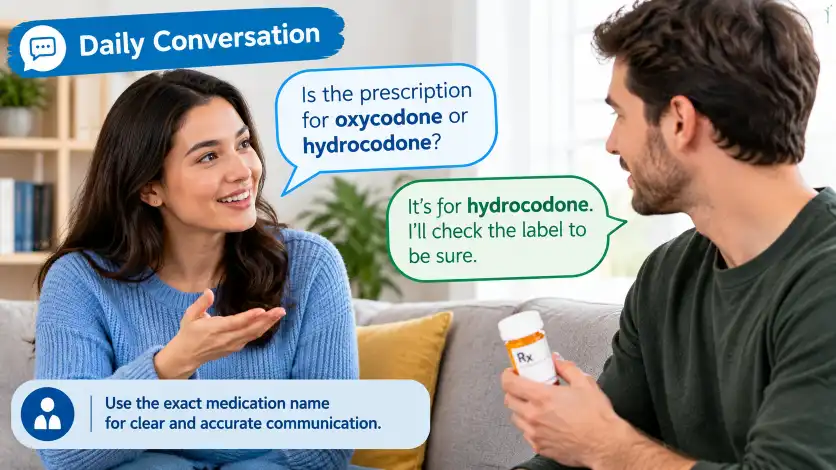
“Is the prescription for oxycodone or hydrocodone?”
This is a natural way to distinguish between the two medications.
Patient Education
“Oxycodone and hydrocodone are different medicines. Do not assume that one can be substituted for the other.”
This wording is simple enough for general readers while making the important distinction clear.
Google Trends & Modern Usage
The search phrase “oxycodone or hydrocodone” reflects a common need for medication information rather than a spelling question.
People may search the phrase after seeing one of these drug names on a prescription, medicine label, medical website, or health-related discussion.
Why are people confused?
The names share several visual and sound patterns.
Both:
- are prescription opioid medications
- are associated with pain treatment
- have similar-looking names
- can appear in discussions about opioid safety
- may be encountered in combination medicines
These similarities can make the terms easy to confuse.
Modern usage
Today, both oxycodone and hydrocodone are established generic medication names. They are used in medical and pharmaceutical contexts rather than as ordinary everyday vocabulary.
Searchers may also use longer phrases such as:
- oxycodone vs hydrocodone
- oxycodone or hydrocodone difference
- difference between oxycodone and hydrocodone
- are oxycodone and hydrocodone the same
- oxycodone compared with hydrocodone
- oxycodone and hydrocodone side effects
- can oxycodone replace hydrocodone
These searches show that users are generally looking for comparison and clarification.
About Google Trends data
Exact search-volume numbers should not be stated unless they have been checked against current Google Trends or another reliable data source.
Therefore, it is better to describe the search pattern generally rather than invent percentages, rankings, or popularity statistics.
The main search intent is clear: people want to understand if these two similarly named medications are the same and how they differ.
Quick Comparison Table
| Version | Meaning | Correct? | Region | Example |
| Oxycodone | A specific prescription opioid medication | Yes | International | “The prescription contains oxycodone.” |
| Hydrocodone | A different prescription opioid medication | Yes | International | “The medication contains hydrocodone.” |
| Oxycodone = hydrocodone | Treats both medicines as identical | No | None | “They are the same drug.” |
| Oxycodone = British hydrocodone | Treats them as regional spellings | No | None | “Oxycodone is the UK version.” |
| Hydrocodone = American oxycodone | Treats them as regional spellings | No | None | “Hydrocodone is the US spelling.” |
The easiest way to remember
If you remember only one thing from this comparison, remember:
Oxycodone and hydrocodone are two different drug names, not two different English spellings.
This distinction is especially important when reading prescriptions, writing health content, or discussing medications with a healthcare professional.
Key Takeaways
- Oxycodone and hydrocodone are different prescription opioid medications.
- Neither term is a British or American spelling of the other.
- Both can be used for significant pain, but they are not automatically interchangeable.
- Medication formulations can differ, so the exact product and active ingredients matter.
- Do not switch, combine, or change opioid medicines without professional medical advice.
- Both medicines can have serious risks, including dependence, misuse, and overdose.
- In medical writing, always use the exact medication name you mean.
- The easiest rule is: oxycodone means oxycodone, and hydrocodone means hydrocodone.
FAQs
Q1:Is oxycodone the same as hydrocodone?
No. Oxycodone and hydrocodone are different opioid medications. They may have similar medical purposes, but they are separate drugs. They should not be treated as interchangeable simply because their names look similar. If you are unsure which medicine you have been prescribed, check the medication label or ask a doctor or pharmacist.
Q2:Which is stronger, oxycodone or hydrocodone?
There is no simple answer that applies to everyone. The effects of an opioid depend on the specific medicine, formulation, prescribed amount, individual patient, and other factors. It is not safe to choose between oxycodone and hydrocodone simply by assuming that one is always stronger or better.
Q3:Are oxycodone and hydrocodone both opioids?
Yes. Both oxycodone and hydrocodone are opioid medications. They can be prescribed for significant pain. Because opioids can also cause serious adverse effects and carry risks of dependence and overdose, they should be taken only according to professional medical advice.
Q4:Is oxycodone the British spelling of hydrocodone?
No. This is incorrect. Oxycodone and hydrocodone are separate medication names, not British and American versions of the same word. Their spellings do not change based on if you are writing in British English or American English.
Q5:Can oxycodone and hydrocodone be taken together?
Do not combine these medicines unless a qualified healthcare professional has specifically instructed you to do so. Taking opioid medicines together can increase the risk of excessive sedation and dangerous breathing problems. If you have been given more than one prescription, ask your doctor or pharmacist how they should be used.
Q6:Can hydrocodone replace oxycodone?
You should not assume that hydrocodone can replace oxycodone. Different opioid medicines can have different effects and formulations. If your prescribed medicine is unavailable or you are considering a change, speak with a healthcare professional rather than making the substitution yourself.
Q7:What are common side effects of oxycodone and hydrocodone?
Both medicines can cause effects such as drowsiness, nausea, constipation, dizziness, and slowed breathing. Serious breathing problems can be life-threatening. The risk can increase when opioids are combined with certain other substances or medicines, so follow the instructions provided by your healthcare professional.
Q8:Do oxycodone and hydrocodone have different brand names?
Yes. Oxycodone and hydrocodone can be sold under different brand names and can also appear in combination products. This can make medication names confusing. The generic name and active ingredients on the medication label are important when identifying what a product actually contains.
Q9:Are oxycodone and hydrocodone addictive?
Both can lead to physical dependence and opioid use disorder. The risk varies between individuals and circumstances. Prescription opioids should be used exactly as directed. If you are concerned about dependence, withdrawal, or difficulty controlling your use, speak with a qualified healthcare professional.
Q10:What should I do if I think someone has an opioid overdose?
An opioid overdose can be an emergency. Signs may include very slow or difficult breathing, extreme sleepiness, inability to wake, or loss of consciousness. Seek emergency medical help immediately. If naloxone is available and appropriate, it can be used to reverse an opioid overdose while emergency help is being obtained.
Conclusion
When deciding between oxycodone or hydrocodone, the first thing to understand is that these are two different opioid medications. They are not alternative spellings, and the difference has nothing to do with British or American English.
Both medicines can be used for significant pain, but that does not mean they can automatically replace each other. Their formulations, effects, risks, and appropriate use can differ. This is why medication decisions should be based on professional medical advice rather than a simple comparison of which drug seems stronger.
For writers and students, the rule is straightforward: use oxycodone when you mean oxycodone and hydrocodone when you mean hydrocodone. For patients, always check the exact name and active ingredients on the medication label.
Most importantly, prescription opioids should be used carefully because they can cause serious harm when misused.
Read More About !

“I’m Charlotte Vans, and I enjoy making grammar and word usage easier to understand. Through my writing, I help readers understand confusing words, improve spelling, and write with greater confidence.”








2 thoughts on “Oxycodone or Hydrocodone: What’s the Difference?”