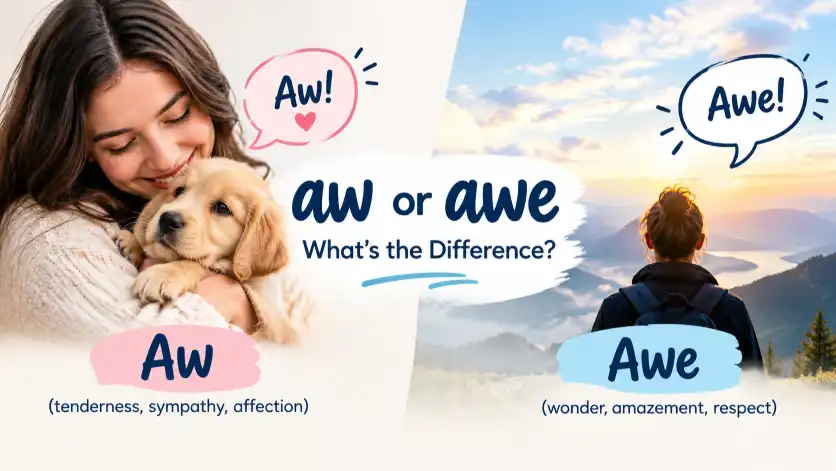
Aw and awe are both correct English words, but they have different meanings and uses. This simple distinction can be confusing because the two words sound alike and are often seen in similar emotional contexts. If you have ever wondered if to write “aw, so cute” or “awe, so cute,” you are not alone.
People often search for aw or awe because they hear the words in conversation but are unsure about the correct spelling. The confusion becomes even greater online, where informal spellings such as aww and awww are common.
The key difference is meaning. Aw is an informal interjection used to express emotions such as affection, sympathy, or disappointment. Awe is a noun or verb connected with strong feelings of wonder, admiration, or respect.
For example, you might say, “Aw, that puppy is adorable!” But you could write, “We stood in awe of the beautiful mountains.”
This guide explains the difference clearly, with definitions, examples, origins, usage rules, and common mistakes.
Aw or Awe : Quick Answer
Aw is an informal expression used to show a reaction such as affection, sympathy, or disappointment. Awe describes a strong feeling of wonder, admiration, or respect.
Examples
Aw, that puppy is so cute!
We stood in awe of the mountains.
The performance left the audience in awe.
Easy Rule
- Aw = emotional reaction
- Awe = wonder or admiration
If you are reacting to something cute or sweet, use aw.
If you are describing a powerful feeling of wonder or admiration, use awe.
Definition and Meaning of Aw or Awe
Although aw and awe look and sound similar, they have different grammatical roles and meanings.
What Does Aw Mean?
Aw is an informal interjection. An interjection is a word or short expression used to communicate an immediate emotion or reaction.
Depending on the situation, aw can express:
- Affection
- Sympathy
- Tenderness
- Disappointment
- Mild surprise
For example:
Aw, your puppy is adorable!
Here, aw expresses affection.
Another example is:
Aw, that’s unfortunate.
Here, it expresses sympathy or disappointment.
The exact emotion depends on the speaker’s tone and the situation.
What Does Awe Mean?
Awe is mainly used as a noun or verb.
As a noun, awe means a strong feeling of wonder, admiration, or respect.
The visitors stood in awe of the ancient monument.
As a verb, awe means to cause someone to feel this strong emotion.
The spectacular performance awed the audience.
The word is often associated with things that are extraordinary, powerful, beautiful, or impressive.
Different Uses of Awe
A person may feel awe when experiencing:
- A breathtaking natural landscape
- A magnificent building
- An extraordinary performance
- A major achievement
- A powerful historical event
- Something vast or mysterious
For example:
The view from the mountain filled her with awe.
Here, awe describes a deep emotional response to something impressive.
The Origin of Aw or Awe
The similar appearance of aw and awe does not mean they have the same modern function.
Origin of Aw
Aw developed as an English interjection used to express emotion. Like many interjections, its history is less straightforward than that of ordinary vocabulary words.
Its modern use is strongly linked to spoken and informal English.
Today, you may see aw in:
- Conversations
- Text messages
- Social media
- Online comments
- Informal dialogue
You may also see longer forms such as:
Aww, that’s adorable!
Awww, what a cute puppy!
These are informal extensions of aw. They add emphasis but are not normally used in formal writing.
Origin of Awe
Awe has a much older linguistic history. It is related to Old Norse agi, a word associated with fear, terror, and great respect.
Over time, the meaning developed toward the modern idea of a powerful emotional response involving wonder, admiration, and respect.
This helps explain why awe can describe a feeling caused by something impressive or overwhelming.
For example:
The enormous waterfall left the visitors in awe.
The word suggests much more than simple surprise. It describes a strong emotional response.
British English vs American English Spelling
There is no major British,American spelling difference between aw and awe.
Both varieties generally use the same spellings.
| Word | British English | American English | Example |
| Aw | Aw | Aw | Aw, that’s adorable! |
| Awe | Awe | Awe | They stood in awe. |
| Awed | Awed | Awed | The audience was awed. |
| Aww | Informal | Informal | Aww, that’s cute! |
The Main Difference Is Meaning
Unlike spelling pairs such as recognising and recognizing, there is no British,versus,American spelling choice here.
The important question is what you mean.
Use aw as an emotional reaction:
Aw, look at that kitten!
Use awe when describing wonder or admiration:
We looked at the painting in awe.
Both forms are used in British and American English.
Which Spelling Should You Use?
United States

Use aw for an informal emotional reaction.
Aw, that’s so sweet!
Use awe when referring to wonder or admiration.
The view filled us with awe.
United Kingdom
The same distinction applies in British English.
Aw, that’s lovely!
They looked at the landscape in awe.
Canada and Australia
Canadian and Australian English also use aw and awe according to their meanings rather than a different spelling rule.
International English
For an international audience, focus on meaning.
Use aw when you are reacting emotionally.
Use awe when you are describing wonder, admiration, or deep respect.
Academic Writing
Awe can be appropriate in academic writing when discussing emotional responses.
The researchers examined how natural environments can produce feelings of awe.
Aw is generally too informal for academic prose unless it appears in a quotation or dialogue.
Business Writing
Awe may be suitable when describing an impressive experience.
The building’s design left visitors in awe.
Aw is normally limited to casual communication.
Common Mistakes with Aw or Awe
Mistake 1: Using “awe” as an Exclamation
Incorrect:
Awe, that’s so cute!
Correct:
Aw, that’s so cute!
When you are reacting to something adorable, aw is the appropriate informal interjection.
Mistake 2: Using “aw” for Wonder
Incorrect:
We stood in aw of the magnificent view.
Correct:
We stood in awe of the magnificent view.
The phrase “in awe” refers to a strong feeling of wonder or admiration.
Mistake 3: Confusing “Aww” With “Awe”
Incorrect in formal spelling:
Awe, what a cute baby!
Better:
Aw, what a cute baby!
Or, in very informal online writing:
Aww, what a cute baby!
Aww is simply an extended informal form of aw.
Memory Tip
Remember:
Aw = reaction
Awe = wonder
If you are expressing an immediate reaction such as affection or sympathy, think aw.
If you are describing wonder or admiration, think awe.
Aw or Awe in Everyday Examples
Understanding the meaning is easier when you see aw and awe in real situations. The correct word depends on if you are making an emotional reaction or describing a feeling of wonder and admiration.
In Emails
Aw is suitable for casual emails between friends, family members, or close colleagues.
Aw, thank you for remembering my birthday!
For professional or formal emails, awe may be appropriate when describing something impressive.
The team’s achievement left everyone in awe.
Avoid using aw in formal business writing unless you are quoting someone directly.
In News Writing
News articles are more likely to use awe because it works naturally in formal descriptions.
Visitors stood in awe as the historic monument was illuminated.
Aw may appear when a journalist quotes someone’s exact words:
“Aw, that’s wonderful news,” she said.
This is because aw represents spoken emotion and is usually informal.
On Social Media
Aw is very common on social media.
Aw, look at this adorable puppy!
You may also see:
Aww, this is so sweet!
The longer spelling adds emotional emphasis.
Awe is also used online when describing something impressive:
I was completely in awe of this performance.
In Formal Writing
Use awe when you need to describe a strong feeling of wonder or admiration.
The visitors watched the spectacular ceremony in awe.
Aw is normally avoided in formal writing because it is an informal interjection.
However, it can appear in dialogue:
“Aw, don’t worry about it,” she replied.
In Daily Conversation
Both words can occur naturally in conversation.
Aw, that’s really sweet of you.
I was in awe when I first saw the mountains.
The first sentence expresses an immediate emotional reaction. The second describes a deeper feeling of wonder.
Aw or Awe: Google Trends & Usage Data
People search for aw or awe mainly because the words are easy to confuse in speech and writing. They can sound alike, but they have different meanings and grammatical functions.
Exact search,volume numbers vary by country, date, and keyword research platform. Without current verified data, it would not be accurate to claim a specific search volume or ranking.
General Usage Patterns
Aw is strongly associated with informal communication, including:
- Text messages
- Social media
- Online comments
- Casual conversations
- Informal dialogue
Awe has a wider role in standard written English and commonly appears in:
- News articles
- Books
- Academic writing
- Formal descriptions
- Everyday speech
Why People Confuse Them
The main source of confusion is pronunciation.
When someone hears:
“Aw, that’s cute!”
they may not know if the speaker means aw or awe.
Context usually solves the problem.
If the speaker is reacting to something cute, sad, or sweet, aw is usually correct.
If the sentence describes admiration or wonder, awe is correct.
Quick Comparison Table
| Feature | Aw | Awe |
| Main meaning | Emotional reaction | Wonder, admiration, or respect |
| Part of speech | Interjection | Noun / Verb |
| Typical use | Informal | Standard and formal |
| Common setting | Conversation, texting, social media | Everyday and formal writing |
| Example | Aw, that’s adorable! | We stood in awe. |
| Extended form | Aww / Awww | Not normally extended |
| British spelling | Aw | Awe |
| American spelling | Aw | Awe |
Side,by,Side Examples
Aw:
Aw, your kitten is adorable!
Awe:
We stood in awe of the enormous waterfall.
Aw:
Aw, I feel sorry for him.
Awe:
The artist’s talent filled the audience with awe.
Aw:
Aww, that’s such a sweet message!
Awe:
The visitors were awed by the spectacular view.
Key Takeaways
- Aw is an informal interjection used to express an emotional reaction.
- Awe describes a strong feeling of wonder, admiration, or respect.
- Aww and awww are informal extended versions of aw.
- Awe can function as both a noun and a verb.
- Aw is common in conversations, texting, and social media.
- Awe is suitable for both everyday and formal writing.
- There is no important British,American spelling difference between aw and awe.
- Remember: aw = reaction, while awe = wonder.
FAQs About Aw or Awe
Q1: Is it “aw” or “awe” when something is cute?
Use aw when reacting to something cute, sweet, or adorable. For example: “Aw, that puppy is adorable!” In informal online writing, you may also see aww or awww. Awe is not normally used as an exclamation to mean something is cute.
Q2: What does “awe” mean?
Awe means a strong feeling of wonder, admiration, or respect caused by something impressive, powerful, beautiful, or extraordinary. For example: “The visitors stood in awe of the enormous mountain.” It can also be a verb, as in “The performance awed the audience.”
Q3: What does “aw” mean?
Aw is an informal interjection that expresses an immediate emotional response. Depending on context, it can show affection, sympathy, tenderness, disappointment, or mild surprise. For example: “Aw, that’s so sweet!” The tone of the speaker helps determine the exact emotion.
Q4: Is “awe” a feeling?
Yes. Awe describes a powerful emotional response involving wonder, admiration, or respect. People may feel awe when they encounter something unusually beautiful, impressive, powerful, or vast. A breathtaking landscape, extraordinary achievement, or magnificent building can all inspire awe.
Q5: Is “aw” a real word?
Yes. Aw is a recognized English interjection. It is mainly used in informal speech and writing to express an emotional reaction. Common examples include “Aw, that’s cute” and “Aw, that’s too bad.” The exact meaning depends on the context and tone.
Q6: What is the difference between “aw” and “awe”?
Aw is an informal expression of emotion, while awe refers to a strong feeling of wonder, admiration, or respect. For example, “Aw, what a cute puppy!” uses aw, while “We watched the performance in awe” uses awe.
Q7: Is “aww” the same as “aw”?
Yes. Aww is an informal extended spelling of aw, often used in texts, comments, and social media. It adds emphasis to the emotional reaction. For example: “Aww, that’s adorable!” It is generally not appropriate for formal or academic writing.
Final Difference at a Glance
| Word | Meaning | Example |
| Aw | Informal emotional reaction | Aw, that’s adorable! |
| Awe | Wonder, admiration, or respect | We stood in awe of the view. |
| Aww | Extended informal form of aw | Aww, that’s so sweet! |
Easy Memory Tip
Think of aw as something you say, while awe is something you feel.
Aw = reaction
Awe = wonder
Conclusion
Although aw and awe sound similar, they serve different purposes in English. Aw is an informal interjection used to express an immediate emotional reaction, such as affection, sympathy, delight, or disappointment. You might say, “Aw, that puppy is adorable!” In casual digital communication, aww and awww are also common variations.
Awe, on the other hand, refers to a powerful feeling of wonder, admiration, or respect. It is used in both everyday and formal English. For example, “The audience watched the performance in awe.” Unlike aw, it can also function as a verb, as in “The beautiful view awed the visitors.”
The easiest way to remember the difference is aw = emotional reaction and awe = wonder or admiration. Once you connect each word with its meaning and context, choosing the correct spelling becomes much easier.
Read More About !

“I’m Charlotte Vans, and I enjoy making grammar and word usage easier to understand. Through my writing, I help readers understand confusing words, improve spelling, and write with greater confidence.”








2 thoughts on “Aw or Awe: What’s the Difference?”