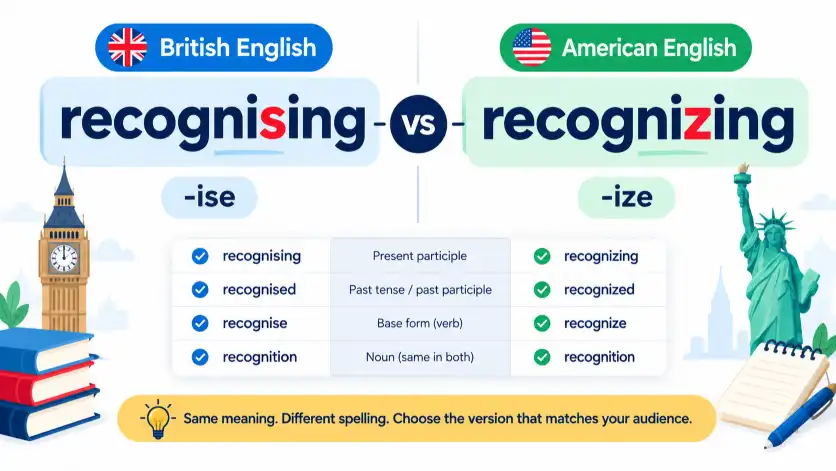
Recognising is the common British English spelling, while recognizing is the standard American English spelling, and both mean identifying, understanding, or acknowledging something.
Recognising and recognizing are both correct spellings of the same word. The main difference is regional: recognising is commonly used in British English, while recognizing is the standard spelling in American English.
This small spelling difference often confuses students, ESL learners, writers, and editors. Both forms have the same meaning, and both are pronounced in essentially the same way. The difference comes from the spelling conventions used in different varieties of English.
The word means to identify someone or something, become aware of something, or acknowledge a fact, achievement, or situation. British English commonly uses the ,ise spelling in words such as recognise and recognising, while American English generally uses ,ize, giving us recognize and recognizing.
In this guide, you will learn the difference between recognising or recognizing, when each spelling should be used, how the forms developed, and which version is appropriate for different types of writing.
Recognising or Recognizing: Featured Snippet & AI Overview
Recognising is the British English spelling, while recognizing is the American English spelling, and both have the same meaning. Both forms have the same meaning and pronunciation. Use the spelling that matches your intended variety of English, and keep your spelling consistent throughout your writing.
Recognising or Recognizing: Quick Answer
The difference is mainly a matter of regional spelling.
- Recognising is commonly used in British English.
- Recognizing is standard in American English.
- Both spellings are correct.
- Both have the same meaning.
- Both are pronounced essentially the same way.
- The difference is the s in recognising and the z in recognizing.
Examples
British English:
She is recognising the importance of good communication.
American English:
She is recognizing the importance of good communication.
Both sentences mean exactly the same thing.
Another example:
The school is recognising her achievements.
American English:
The school is recognizing her achievements.
So, if you are wondering “recognising or recognizing?”, neither spelling is universally wrong. Your choice depends on the English variety you are following.
What Does Recognising Mean?
Recognising is the commonly used British English spelling of the present participle of recognise.
The word can have several related meanings.
1. Identifying Someone or Something

Recognising can mean identifying a person or thing because you have seen, heard, or experienced it before.
I had no trouble recognising her voice.
The speaker knows the voice because they have heard it previously.
2. Becoming Aware of Something
The word can also mean understanding or noticing an important fact.
The company is recognising the need for better training.
Here, recognising means becoming aware of or accepting the importance of that need.
3. Acknowledging Something
It can also mean giving attention or credit to something.
The award is recognising his contribution to the project.
In this sentence, the award acknowledges his contribution.
Recognising in Everyday English
You may see recognising in:
- British newspapers
- UK school assignments
- British websites
- Academic writing
- Business documents
- Commonwealth English
- Everyday British conversations
In American English, the equivalent spelling is normally recognizing.
The Origin of Recognising
The word recognise has a long history in English and is related to the Latin verb recognoscere, meaning to know again, identify, or recognize.
The English word developed through historical influences from Latin and French. Over time, different English,speaking regions developed their own spelling preferences.
One important difference involves words ending in ,ise and ,ize.
For example:
| British English | American English |
| recognise | recognize |
| recognising | recognizing |
| organise | organize |
| organising | organizing |
| realise | realize |
| realising | realizing |
American English generally favors ,ize in these words.
British English commonly uses ,ise, although British spelling is more varied than this simple rule suggests. Some British dictionaries, publishers, and style guides accept or prefer ,ize forms.
That means it is not accurate to say that recognize is always wrong in British English. The appropriate choice depends on the style being followed.
British English vs American English
The most noticeable difference is the letter s versus z.
| British English | American English | Example |
| recognising | recognizing | She is recognising/recognizing the problem. |
| recognise | recognize | I recognise/recognize her voice. |
| recognised | recognized | They recognised/recognized her achievement. |
| recognises | recognizes | He recognises/recognizes the importance of practice. |
British English
Recognising is widely used in British English.
The company is recognising outstanding employees.
This spelling fits the common British ,ise pattern.
American English
American English normally uses recognizing.
The company is recognizing outstanding employees.
This follows the common American ,ize spelling pattern.
Is the Pronunciation Different?
No significant pronunciation difference exists between the two forms.
Both are pronounced approximately:
REK,uh,nye,zing
The difference is primarily visible in writing.
So, when someone says the word aloud, you usually cannot tell if they would write recognising or recognizing.
Which Version Should You Use?
Your choice should depend on your audience, location, and required style guide.
United States
Use recognizing in standard American English.
The teacher is recognizing the student’s progress.
United Kingdom
Recognising is commonly used in British English.
The teacher is recognising the student’s progress.
However, some British publishers and style guides use ,ize spellings. If you are writing for a specific publication, follow its rules.
Canada
Canadian English can use both ,ise and ,ize spellings depending on the publication or style guide.
If you are writing for a Canadian audience, consistency and the relevant editorial standard should guide your choice.
Australia
Recognising is commonly used in Australian English.
The organization is recognising the importance of education.
Australian English often follows British,based spelling conventions, although individual style guides may have their own preferences.
International Writing
For international readers, either form can work.
The important thing is to choose one spelling system and use it consistently.
For example, do not write:
The company is recognising the problem and will organize a meeting.
Instead, maintain a consistent style.
British,style:
The company is recognising the problem and will organise a meeting.
American,style:
The company is recognizing the problem and will organize a meeting.
Academic Writing
Academic writers should follow the spelling system required by their university, instructor, journal, or style guide.
If the required style is American English, use recognizing.
If the required style uses British ,ise spelling, use recognising.
Business Writing
Business writing should match the audience and organization.
For a US company:
We are recognizing our employees’ achievements.
For a UK,focused company:
We are recognising our employees’ achievements.
The key is not to switch between regional spellings without a reason.
Common Mistakes
The difference between recognising and recognizing is simple, but writers often make mistakes when they mix British and American spelling conventions.
Mistake 1: Thinking One Spelling Is Always Wrong
Some writers assume that recognising is incorrect because they are more familiar with recognizing.
That is not true.
Recognising is a valid spelling commonly used in British English, while recognizing is the standard American form.
Incorrect assumption:
Recognising is a spelling mistake.
Correct understanding:
Recognising and recognizing are both correct regional spellings.
Memory tip:
Think S = common British spelling and Z = common American spelling.
Mistake 2: Mixing British and American Spellings
A common problem is using both spelling systems in the same piece of writing.
For example:
The company is recognising the problem and will organize a new training program.
Here, recognising follows a common British spelling pattern, while organize follows the American spelling pattern.
A consistent British,style version would be:
The company is recognising the problem and will organise a new training program.
A consistent American,style version would be:
The company is recognizing the problem and will organize a new training program.
The issue is not that either individual word is necessarily wrong. The problem is inconsistent spelling style.
Mistake 3: Assuming British English Always Uses ,ise
It is tempting to remember a simple rule:
British English = ,ise
American English = ,ize
This is useful as a general guide, but it is not the whole story.
British English has variation in ,ise and ,ize spellings. Some British dictionaries, publishers, and style guides use ,ize forms.
Therefore, always check the required style when working on formal or professional content.
Mistake 4: Changing the Meaning by Changing the Spelling
Changing recognising to recognizing does not change the meaning.
Compare:
She is recognising his contribution.
and:
She is recognizing his contribution.
Both sentences communicate the same idea.
The difference is regional spelling, not vocabulary or meaning.
Mistake 5: Using “Recognisation”
Another mistake is creating an incorrect noun form such as:
The recognisation of his work was important.
The usual noun is:
The recognition of his work was important.
The standard noun is recognition.
Remember:
- recognise / recognize = verb
- recognising / recognizing = present participle
- recognised / recognized = past tense or past participle
- recognition = noun
Everyday Examples
The best way to understand recognising or recognizing is to see how the word appears in real writing.
Emails
British English:
Thank you for recognising my contribution to the project.
American English:
Thank you for recognizing my contribution to the project.
Both versions are natural. Choose the one that matches your overall spelling style.
Business Writing
British,style example:
The company is recognising employees who have demonstrated excellent leadership.
American,style example:
The company is recognizing employees who have demonstrated excellent leadership.
The meaning remains unchanged.
News Headlines
A British publication might write:
Local School Recognising Outstanding Student Achievement
An American publication might write:
Local School Recognizing Outstanding Student Achievement
News organizations normally follow their own editorial style, so the spelling may vary from one publication to another.
Blogs
For a British,focused blog:
Recognising the difference between formal and informal English can improve your writing.
For an American,focused blog:
Recognizing the difference between formal and informal English can improve your writing.
Both are grammatically correct.
Social Media
British English:
We are recognising our amazing community today!
American English:
We are recognizing our amazing community today!
Social media writing is informal, but regional spelling preferences can still appear.
Academic Writing
British English:
Recognising the limitations of the study is important when interpreting the results.
American English:
Recognizing the limitations of the study is important when interpreting the results.
In academic writing, the required institutional or publication style should always take priority.
Daily Conversation
British English:
I remember recognising him from school.
American English:
I remember recognizing him from school.
Although the spelling differs in writing, the spoken form is essentially the same.
Google Trends & Modern Usage
People searching for recognising or recognizing are usually trying to solve a spelling or grammar question.
The confusion is understandable because both versions appear frequently online. A reader may encounter recognising on a British website and recognizing on an American website and wonder which one is correct.
The answer is that both are established spellings.
Regional Usage
The broad pattern is:
- Recognising is strongly associated with British English.
- Recognizing is standard in American English.
- Australian English commonly uses recognising.
- Canadian English can show variation depending on the style being followed.
- International websites may use either form.
Online content makes these differences more visible because readers regularly encounter English from different countries.
Why Do People Search This Keyword?
People commonly search for this phrase when:
- They are writing an essay.
- They are checking a spelling in a document.
- They are learning British or American English.
- They are editing website content.
- They are preparing academic work.
- They are unsure if the s or z spelling is correct.
- They have seen both forms in different sources.
Modern Digital Writing
For websites and blogs, consistency is especially useful.
If your website follows American English, use:
recognizing
throughout the article.
If your website follows British English with ,ise spellings, use:
recognising
throughout the article.
You do not need to use both forms repeatedly just because people search for both.
The search phrase “recognising or recognizing” can be addressed naturally in the article while the main content follows one consistent spelling system.
Quick Comparison Table
| Version | Meaning | Correct? | Region | Example |
| recognising | Identifying or acknowledging | Yes | Common in British English | She is recognising the problem. |
| recognizing | Identifying or acknowledging | Yes | Standard American English | She is recognizing the problem. |
| recognise | Identify or acknowledge | Yes | Common British form | I recognise her voice. |
| recognize | Identify or acknowledge | Yes | American form | I recognize her voice. |
| recognised | Identified or acknowledged | Yes | Common British form | They recognised her work. |
| recognized | Identified or acknowledged | Yes | American form | They recognized her work. |
The key difference is the spelling pattern, not the meaning.
Key Takeaways
- Recognising and recognizing are both correct.
- Recognising is commonly associated with British English.
- Recognizing is the standard American English spelling.
- Both forms have the same basic meaning.
- The pronunciation is essentially the same.
- The difference is mainly the use of s versus z.
- British English can vary between ,ise and ,ize depending on the style guide.
- American English generally prefers ,ize.
- Do not mix spelling systems unnecessarily in the same article.
- Recognition is the standard noun form, not recognisation.
FAQs
Q1: Is recognising or recognizing correct?
Both recognising and recognizing are correct spellings. Recognising is commonly used in British English, while recognizing is the standard American English form. Both words have the same meaning and are pronounced essentially the same way. The choice depends on which variety of English you are using.
Q2: Is recognising British or American English?
Recognising is commonly associated with British English. American English generally uses recognizing. The difference follows the broader spelling pattern in which British English often uses ,ise, while American English generally uses ,ize. However, British English itself has some variation, so specific style guides should be followed when required.
Q3: Is recognizing American English?
Yes. Recognizing is the standard American English spelling. It follows the common American preference for ,ize endings. Other examples include organizing and realizing. If you are writing for a US audience, recognizing is normally the appropriate form.
Q4: Do recognising and recognizing mean the same thing?
Yes. Recognising and recognizing have the same meaning. Both can mean identifying someone or something, becoming aware of something, or acknowledging a fact, achievement, or contribution. The difference is spelling rather than meaning, so changing one form to the other does not change the message.
Q5: Which spelling should I use in an American essay?
Use recognizing if your essay follows American English. For example, you could write, “The study is recognizing the importance of social factors.” If your teacher, university, or required style guide specifies another spelling system, follow those instructions instead.
Q6: Which spelling is correct in British English?
Recognising is a common British English spelling. However, British English also allows variation in words ending in ,ise and ,ize. Some publishers and style guides prefer ,ize. Therefore, if you are writing for a particular British publication or institution, follow its stated spelling conventions.
Q7: How can I remember recognising vs recognizing?
A useful memory tip is S for the common British form and Z for the American form: recognising versus recognizing. This is a simple guide rather than an absolute rule for every English,speaking region. The most important point is to use one spelling system consistently.
Q8: Is “recognisation” correct?
The standard noun is recognition, not recognisation. For example, write, “She received recognition for her work.” The related forms are recognise/recognize, recognising/recognizing, and recognised/recognized.
Q9: Should I use recognising or recognizing on a website?
Choose the spelling according to your main audience and overall editorial style. A website aimed at US readers will normally use recognizing, while a website following British,style spelling may use recognising. Whichever version you choose, use it consistently across your articles and other content.
Q10: Are recognise and recognize pronounced differently?
No. Recognise and recognize have essentially the same pronunciation. The difference is primarily written. Likewise, recognising and recognizing are pronounced in essentially the same way, despite the different spellings.
Conclusion
Recognising and recognizing are both correct spellings, but they belong to different spelling conventions. Recognising is commonly used in British English, while recognizing is the standard American English form. Both express the same meaning, if the word refers to identifying someone, becoming aware of something, or acknowledging an achievement.
For writers in the United States, recognizing is usually the natural choice. For British,style writing, recognising is commonly preferred, although some British style guides use ,ize spellings. Canadian and Australian English can also vary, so the relevant dictionary or style guide should be followed when a formal standard is required.
The most useful rule is to consider your audience and remain consistent. Avoid switching between British and American spellings without a reason.
Remember: recognising and recognizing have the same meaning, but the spelling reflects the English variety you are using.
Read More About !

“I’m Charlotte Vans, and I enjoy making grammar and word usage easier to understand. Through my writing, I help readers understand confusing words, improve spelling, and write with greater confidence.”








1 thought on “Recognising or Recognizing: Which Spelling Is Correct?”