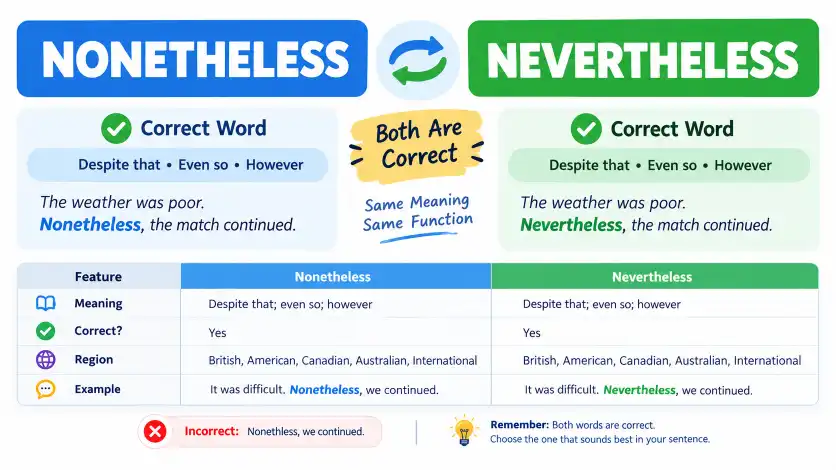
If you are confused about nonetheless or nevertheless, both words are correct and usually have the same meaning. They are used to show contrast and can often replace each other without changing the meaning of a sentence. In simple terms, both can mean “despite that,” “even so,” or “however.”
People often search for nonetheless or nevertheless because the two words look and sound similar. They may wonder if one is grammatically correct, if one is used in American English and the other in British English, or if there is a small difference in meaning. The good news is that there is no major grammar rule that forces you to choose one over the other.
Both words are useful in essays, business writing, articles, reports, and everyday English. The main difference is usually a matter of style and personal preference.
In this guide, we will explain the meaning, usage, origin, regional use, and common mistakes involving these two words. Let’s begin with the simplest answer.
Featured Snippet & AI Overview
Nonetheless and nevertheless are both correct words that usually mean “despite that,” “even so,” or “however.” They are generally interchangeable and can be used to introduce a contrasting idea. For example, “The task was difficult. Nonetheless, she finished it” and “The task was difficult. Nevertheless, she finished it” have the same basic meaning.
Nonetheless or Nevertheless – Quick Answer
Nonetheless and nevertheless are both correct. In most situations, they mean the same thing and can be used interchangeably.
Both words show that something is true or happens despite another fact or situation.
Example 1
The weather was cold. Nonetheless, we went outside.
This means:
The weather was cold. Despite that, we went outside.
You can replace nonetheless with nevertheless:
The weather was cold. Nevertheless, we went outside.
The meaning stays the same.
Example 2
The exam was difficult. Nonetheless, she passed.
Or:
The exam was difficult. Nevertheless, she passed.
Both sentences tell us that passing the exam was surprising because the exam was difficult.
Example 3
He was tired. He nevertheless continued working.
You can also write:
He was tired. He nonetheless continued working.
Again, the meaning is almost identical.
So, which one is correct?
Both are correct.
- Nonetheless = correct
- Nevertheless = correct
- Nonetheles = incorrect spelling
- Neverthless = incorrect spelling
A simple way to remember them
Think of both words as meaning:
“That is true, but this is also true.”
For example:
The car is expensive. Nevertheless, I want to buy it.
The car is expensive, but the speaker still wants it.
The same idea works with nonetheless:
The car is expensive. Nonetheless, I want to buy it.
What Does Nonetheless or Nevertheless Mean?
Nonetheless and nevertheless are adverbs that are commonly used to show contrast or concession.
A concession happens when you accept one fact but then introduce another fact that seems surprising or different.
Meaning of Nonetheless
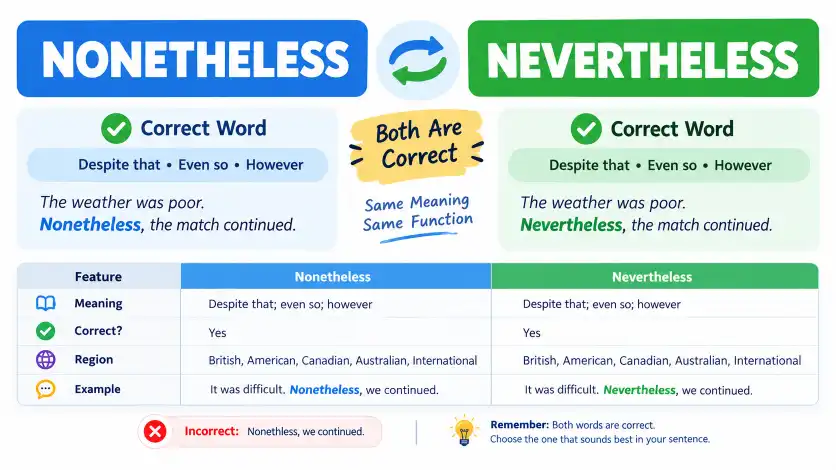
Nonetheless means:
- despite that
- even so
- nevertheless
- in spite of that
- however
Example:
The restaurant was crowded. Nonetheless, we found a table.
The restaurant was crowded, but we still found a table.
Meaning of Nevertheless
Nevertheless has essentially the same meaning.
Example:
The restaurant was crowded. Nevertheless, we found a table.
Again, the second statement happens despite the first statement.
Are they synonyms?
Yes. In normal modern English, nonetheless and nevertheless are treated as synonyms.
This is why you can often replace one with the other.
| Sentence with Nonetheless | Sentence with Nevertheless |
| It was raining. Nonetheless, we left. | It was raining. Nevertheless, we left. |
| She was nervous. Nonetheless, she spoke well. | She was nervous. Nevertheless, she spoke well. |
| The plan was risky. Nonetheless, they approved it. | The plan was risky. Nevertheless, they approved it. |
The basic meaning remains unchanged.
When should you use these words?
Use nonetheless or nevertheless when the second idea contrasts with the first one.
For example:
The instructions were confusing. Nevertheless, I completed the task.
The confusing instructions could have prevented success, but the person completed the task anyway.
Another example:
The product was expensive. Nonetheless, customers continued buying it.
The high price creates a contrast with the continued sales.
Sentence position
Both words are flexible.
They can appear at the beginning of a sentence:
Nonetheless, we decided to continue.
They can appear after a semicolon:
The journey was long; nevertheless, we enjoyed it.
They can also appear later in a sentence:
She was tired but continued working nevertheless.
This flexibility makes both words useful in formal and general writing.
The Origin of Nonetheless and Nevertheless
The forms nonetheless and nevertheless developed from older English expressions.
Nevertheless is historically connected with the phrase “never the less.” Nonetheless is connected with the expression “none the less.” Over time, these expressions became established as single words.
Today, however, readers do not normally think about their separate historical parts. Nonetheless and nevertheless function as complete adverbs.
Why do they look so similar?
Both words developed around the idea of something remaining true despite another condition.
For example:
The road was dangerous. Nevertheless, they continued.
The danger was real, but it did not stop them.
Similarly:
The road was dangerous. Nonetheless, they continued.
The same contrast is being expressed.
Has their meaning changed?
Their modern meaning has become closely connected to the idea of “despite that” or “even so.”
For today’s writers, the historical difference is much less important than their current use.
You do not need to understand the historical construction to use either word correctly.
Why are both still used?
English often keeps multiple words that have similar meanings. Writers may choose between them because of:
- personal preference
- sentence rhythm
- writing style
- formality
- regional habits
- the surrounding context
This is common in English. Having two similar words does not mean one must be wrong.
British English vs American English
One common question is if nonetheless is British English while nevertheless is American English.
That is not the case.
Both words are used in British English and American English. Neither word belongs exclusively to one variety.
| British English | American English | Example |
| Nonetheless | Nonetheless | The task was difficult. Nonetheless, we finished it. |
| Nevertheless | Nevertheless | The task was difficult. Nevertheless, we finished it. |
| Both are correct | Both are correct | Both words can express contrast. |
Is there a British spelling?
No special British spelling is required.
British writers can use:
Nonetheless
or:
Nevertheless
Both are standard.
Is there an American spelling?
American writers can also use:
Nonetheless
or:
Nevertheless
There is no American spelling rule that requires one word instead of the other.
Why do people think they are different?
The confusion may come from the fact that some words really do have British and American differences.
For example:
- colour / color
- centre / center
- organise / organize
But nonetheless and nevertheless are not like these examples.
They are spelled the same in both major varieties of English.
Which sounds more formal?
Both can sound formal.
Nevertheless may feel slightly more traditional or formal to some readers, especially in essays and formal prose.
Nonetheless is also common in formal writing and can sound polished and concise.
There is no strict rule saying that one must be used in formal writing.
Academic writing
Both words can work well in academic writing.
For example:
The study had several limitations. Nevertheless, the results were useful.
Or:
The study had several limitations. Nonetheless, the results were useful.
Both sentences are clear and professional.
Business writing
The same applies to business writing:
Sales declined during the first quarter. Nonetheless, the company remained profitable.
Or:
Sales declined during the first quarter. Nevertheless, the company remained profitable.
Choose the form that fits the tone of the document.
Quick Rule to Remember
If you are still unsure, remember this:
Nonetheless = Nevertheless = Despite that = Even so
For example:
The project was difficult. Nonetheless, we completed it.
and:
The project was difficult. Nevertheless, we completed it.
Both are correct.
The important thing is not which word you choose. The important thing is that the sentence contains a clear contrast.
Which Version Should You Use?
The good news is that you do not need to memorize a complicated rule for nonetheless or nevertheless. Both are correct, and your choice should mainly depend on the tone and flow of your sentence.
United States
American English accepts both forms.
The project was expensive. Nonetheless, it was successful.
The project was expensive. Nevertheless, it was successful.
Both sound natural. Choose the one that fits the surrounding text.
United Kingdom
British English also uses both words.
The weather was poor. Nevertheless, the match continued.
The weather was poor. Nonetheless, the match continued.
There is no British grammar rule that requires nevertheless.
Canada
Canadian writers can use either word in general, academic, or professional writing.
If your organization has a house style, follow that style consistently.
Australia
Australian English also accepts both forms. Your choice can be based on tone and sentence rhythm rather than nationality.
International Writing
For an international audience, both words are safe.
However, if you are writing for beginner English learners, simpler alternatives can sometimes improve clarity:
- however
- even so
- still
- despite this
For example:
The instructions were difficult. However, I completed the task.
This may be easier for an ESL learner than:
The instructions were difficult. Nevertheless, I completed the task.
Academic Writing
Both words work well in essays, research papers, and academic discussions.
The sample size was small. Nevertheless, the findings were useful.
The word helps connect a limitation with a result that remains important.
Business Writing
Both can also be used in reports and professional documents.
The company faced several challenges. Nonetheless, it achieved its sales target.
For short emails, however, but or however may sound more direct.
A Practical Choice
If you are unsure which one to choose:
Use “nevertheless” when you want a slightly more traditional formal tone. Use “nonetheless” when it flows better with your sentence.
This is a style preference, not a grammar rule.
Common Mistakes
Although nonetheless and nevertheless are easy to understand once you know their meaning, writers often make a few mistakes.
Mistake 1: Believing One Is Wrong
Some writers assume that only nevertheless is correct.
Incorrect belief:
Nonetheless is not a real English word.
Correct understanding:
Nonetheless is a standard English word.
The same applies to nevertheless.
Memory tip:
Both words contain “less”, and both can mean “despite that.”
Mistake 2: Using Both Together
Do not normally combine the two words.
Incorrect:
Nevertheless, nonetheless, we continued the project.
This repeats the same contrast.
Correct:
Nevertheless, we continued the project.
Or:
Nonetheless, we continued the project.
Choose one.
Mistake 3: Using Them Without Contrast
These words need a reason for contrast.
Weak example:
Sarah opened her laptop. Nevertheless, she started typing.
There is no clear contrast between opening a laptop and typing.
Better:
Sarah was extremely tired. Nevertheless, she continued working.
Now the contrast is clear.
She was tired, but she continued working anyway.
Mistake 4: Incorrect Punctuation
When the word introduces a sentence, a comma is normally used.
Correct:
Nevertheless, we decided to continue.
Nonetheless, the team accepted the proposal.
A semicolon can also be used when connecting two independent clauses:
The project was risky; nevertheless, we approved it.
The deadline was close; nonetheless, the team remained calm.
Mistake 5: Confusing Them With “However”
However, nonetheless, and nevertheless can all express contrast, but they should not automatically be treated as identical in every sentence.
Compare:
The product was expensive. However, many people bought it.
The product was expensive. Nevertheless, many people bought it.
The product was expensive. Nonetheless, many people bought it.
All three are possible because the second idea contrasts with the first.
Memory tip:
If you can replace the word with “despite that” and the sentence still makes sense, nonetheless or nevertheless may work.
Everyday Examples
Knowing definitions is useful, but seeing these words in real situations makes their use much easier.
Emails
The meeting was longer than expected. Nevertheless, we covered all the important points.
This works well in a professional email.
Another example:
The original plan did not work. Nonetheless, we found another solution.
Business Writing
The company experienced lower sales in June. Nevertheless, it remained profitable.
Another example:
The project required additional funding. Nonetheless, management decided to continue.
These sentences show a challenge followed by an unexpected or contrasting result.
News Headlines
News writing often needs to communicate contrast quickly.
For example:
Costs Increase; Company Nevertheless Expands
Here nevertheless tells readers that the expansion happened despite increased costs.
Another possible structure is:
Markets Fall; Investors Nonetheless Remain Optimistic
The word creates a clear contrast between the two ideas.
Blogs
Blog writing can use either word when the tone is moderately formal.
Learning a new language can be frustrating. Nonetheless, the process can be rewarding.
Or:
The first few lessons were difficult. Nevertheless, she decided not to give up.
For a casual blog, still or even so may sometimes feel more natural.
Social Media
You can use these words on social media, although they may sound more formal than everyday alternatives.
The trip was exhausting. Nevertheless, I would do it again.
A more casual version would be:
The trip was exhausting. Still, I would do it again.
Both communicate the same basic contrast.
Academic Writing
Academic writing is one of the strongest settings for these words.
The study involved a limited number of participants. Nevertheless, the findings provide useful information.
Another example:
The theory has been criticized by several researchers. Nonetheless, it remains influential in the field.
These constructions help writers acknowledge a limitation while explaining why a point still matters.
Daily Conversation
In casual conversation, nonetheless and nevertheless are possible, but they can sound more formal.
For example:
I was tired. Nevertheless, I went to the gym.
A more natural casual version might be:
I was tired. Still, I went to the gym.
Or:
I was tired, but I went anyway.
This is an important style point. A word can be grammatically correct but less natural for a particular situation.
Google Trends & Modern Usage
People searching for “nonetheless or nevertheless” are often trying to answer a word,choice question. They may want to know if the two words have different meanings or if one is more correct.
The main reason for the confusion is their close appearance and similar meaning. Both contain the ending “,theless”, and both can introduce a statement that remains true despite something already mentioned.
Modern English treats the two words as very close synonyms.
There is no reliable reason to claim that one is always more popular in every country or region without checking a specific, current dataset. Usage can also vary by genre, publication, writer, and sentence style.
Modern writing advice
For today’s readers, clarity should come first.
Use nonetheless or nevertheless when:
- you need to show contrast
- the writing is formal or semi,formal
- the relationship between two ideas is clear
- the word makes the sentence flow naturally
Consider however when you want a familiar and direct contrast marker.
Consider still or even so when the writing is more conversational.
Why does the keyword cause confusion?
The search phrase nonetheless or nevertheless suggests that readers often expect a hidden rule.
They may think:
“One of these must be wrong.”
But the real answer is simpler:
Both are correct.
The main decision is usually about style, tone, and context rather than grammar.
Quick Comparison Table
| Version | Meaning | Correct? | Region | Example |
| Nonetheless | Despite that; even so | Yes | British, American, Canadian, Australian, International | It was difficult. Nonetheless, we continued. |
| Nevertheless | Despite that; even so | Yes | British, American, Canadian, Australian, International | It was difficult. Nevertheless, we continued. |
| However | In contrast; despite this | Yes | International | It was difficult. However, we continued. |
| Even so | Despite that | Yes | International | It was difficult. Even so, we continued. |
| Still | Despite that; nevertheless | Yes | International | It was difficult. Still, we continued. |
The main difference
There is no major difference in meaning between nonetheless and nevertheless.
The difference is mostly one of word choice and style.
For example:
The job was challenging. Nonetheless, she enjoyed it.
and:
The job was challenging. Nevertheless, she enjoyed it.
Both communicate the same basic idea.
Key Takeaways
- Nonetheless and nevertheless are both correct English words.
- Both usually mean “despite that,” “even so,” or “however.”
- They are generally interchangeable.
- Neither word is exclusively British or American.
- Both can be used in academic and professional writing.
- Nevertheless may sound slightly more traditional to some readers.
- Nonetheless can be equally appropriate in formal writing.
- Use either word when there is a clear contrast between ideas.
- Avoid using nonetheless and nevertheless together.
- In casual conversation, still, but, or anyway may sound more natural.
FAQs
Q1:Is nonetheless the same as nevertheless?
Yes. Nonetheless and nevertheless usually have the same meaning. Both can mean “despite that,” “even so,” or “however.” In most sentences, you can replace one with the other without changing the main idea. The choice is usually based on writing style, sentence flow, and personal preference rather than a difference in grammar.
Q2:Which is better, nonetheless or nevertheless?
Neither word is always better. Both are correct. Nevertheless can sound slightly more traditional or formal to some readers, while nonetheless can feel concise and polished. For academic or professional writing, either is suitable. Choose the one that sounds natural in your sentence and fits the tone of your writing.
Q3:Is nonetheless more formal than nevertheless?
Both words can be used in formal writing. There is no strict grammar rule that makes one formal and the other informal. Nevertheless may sometimes feel more traditional, but nonetheless is also appropriate for essays, reports, articles, and professional documents.
Q4:Can nonetheless and nevertheless be used interchangeably?
Yes, in most situations they can. For example, “The task was difficult. Nonetheless, she completed it” and “The task was difficult. Nevertheless, she completed it” express the same basic idea. Both words introduce a result or fact that contrasts with something mentioned earlier.
Q5:Is nevertheless British or American English?
Nevertheless is used in both British and American English. It is not limited to either variety. British and American writers can use the word in formal, academic, professional, and general writing without changing its spelling.
Q6:Is nonetheless British or American English?
Nonetheless is also used in both British and American English. There is no rule requiring American writers to use one form and British writers to use the other. Both are standard English words.
Q7:Can I start a sentence with nonetheless?
Yes. Starting a sentence with nonetheless is common and correct.
Nonetheless, we decided to continue.
The comma is normally used after the word when it begins the sentence. The same pattern works with nevertheless.
Q8:Can I use nevertheless after a semicolon?
Yes. This is a common structure when two independent clauses are closely related:
The project was difficult; nevertheless, we completed it.
The semicolon separates the two complete clauses, while nevertheless highlights their contrast.
Q9:Is however the same as nevertheless?
However and nevertheless can have similar meanings when they introduce a contrasting idea. For example, “It was expensive. However, I bought it” and “It was expensive. Nevertheless, I bought it” both show contrast. However, the words are not interchangeable in every grammatical position.
Q10:Which word is easier for ESL learners?
However is often more familiar to English learners, but nonetheless and nevertheless are useful words to learn for formal writing. If you are writing for beginners, “however,” “but,” or “even so” may make your sentence easier to understand.
Conclusion
When deciding between nonetheless or nevertheless, remember that both words are correct and usually have the same meaning. They are commonly used to show contrast and can often be understood as “despite that,” “even so,” or “however.” Neither word is restricted to British English or American English.
The choice between them is mainly about style. Nevertheless can sound slightly more traditional or formal, while nonetheless can provide a smooth and concise alternative. Both are suitable for academic essays, professional reports, articles, and other forms of formal writing.
The most important point is to use these words when there is a clear contrast between two ideas. Avoid combining them unnecessarily, and remember that simpler alternatives such as however, still, or even so may work better in casual writing.
You do not need to worry about choosing the “wrong” word. Both are accepted forms of standard English.
Remember: When you mean “despite that” or “even so,” both nonetheless and nevertheless can usually do the job.
Read More About !

“I’m Charlotte Vans, and I enjoy making grammar and word usage easier to understand. Through my writing, I help readers understand confusing words, improve spelling, and write with greater confidence.”








2 thoughts on “Nonetheless or Nevertheless: What’s the Difference?”