
If you are unsure if to use run or ran, remember this simple rule: run is the base or present form, while ran is the simple past form of the verb run. For example, “I run every morning” describes a present habit, while “I ran yesterday” describes an action that happened in the past.
The confusion happens because run is an irregular verb. Unlike regular verbs such as walk → walked, its past form does not end in ,ed. Instead, the verb changes from run to ran.
There is one more form that often causes trouble. The past participle of run is also run, so we say “I have run five miles,” not “I have ran five miles.”
In this guide, you will learn the difference between run and ran, their meanings, verb forms, origins, regional usage, common mistakes, and practical examples. By the end, choosing the correct form should feel much easier.
Run or Ran : Featured Snippet Answer
Run is the base and present form of the verb, while ran is the simple past form. Use run for present actions, habits, and after helping verbs such as will, can, and did. Use ran for a completed action in the past. The past participle is also run: “I have run.”
Run or Ran : Quick Answer
The choice between run and ran depends mainly on the tense of the sentence.
- Run = base or present form
- Ran = simple past form
- Run = past participle
- Running = ,ing form
Examples with “run”
I run every morning.
They run a successful business.
Please run the program again.
Examples with “ran”
I ran five miles yesterday.
She ran to catch the bus.
The machine ran all night.
Compare the two
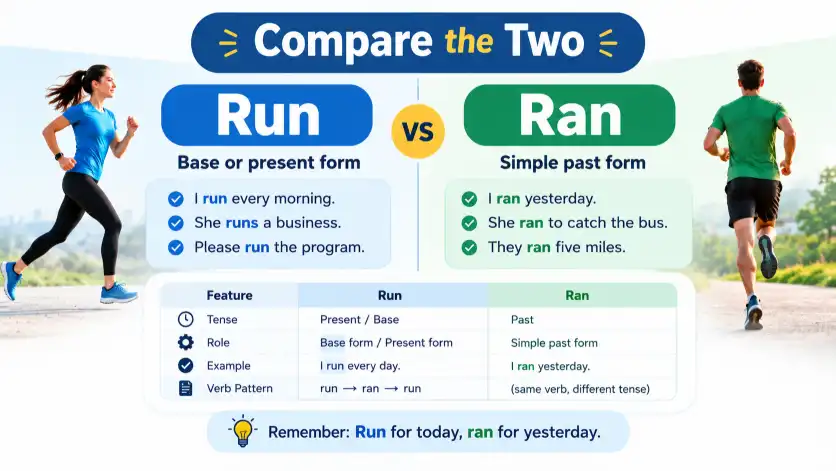
I run every morning.
This describes a regular or present activity.
I ran yesterday morning.
This describes a completed past activity.
A useful pattern to remember is:
run → ran → run
The first run is the base form, ran is the simple past, and the final run is the past participle.
What Does Run or Ran Mean?
Run and ran come from the same verb. Their basic meaning is to move quickly on foot, but run has many other meanings in modern English.
You can run a business, run a machine, run a test, run a program, run a meeting, or run out of time.
What does “run” mean?
Run can be used when talking about something that happens in the present or regularly.
For example:
I run every evening.
She runs a small company.
This computer runs quickly.
We run weekly meetings.
Notice that runs is used with he, she, and it in the simple present.
What does “ran” mean?
Ran is the simple past form of run. It tells the reader that the action happened in the past.
For example:
I ran home after school.
He ran five kilometers yesterday.
The engine ran for three hours.
She ran the business for ten years.
The word ran does not represent a completely different action. It simply shows that the action occurred in the past.
Run, ran, and running
Understanding all four common forms makes the difference clearer:
| Verb Form | Use | Example |
| run | Base form | I want to run. |
| run / runs | Present tense | I run every day. |
| ran | Simple past | I ran yesterday. |
| run | Past participle | I have run today. |
| running | ,ing form | I am running now. |
One of the most important rules is that ran is not the past participle.
Correct:
I ran yesterday.
Correct:
I have run today.
Incorrect:
I have ran today.
The Origin of Run
The verb run is an old English word with roots in early Germanic languages. Its history goes back to Old English forms related to rinnan and irnan, which were connected with movement and flowing.
Over many centuries, the word developed into the modern English run. Its meaning also expanded. It was no longer limited to physical movement.
Today, run can describe many different actions and situations:
- run a business
- run a machine
- run a program
- run a test
- run a campaign
- run a meeting
- run out of money
- run into someone
- run for office
The past form ran developed as part of the verb’s irregular past,tense pattern.
Unlike a regular verb such as:
walk → walked
the verb run follows an irregular pattern:
run → ran → run
This is why runned is not the standard past form.
The same basic pattern remains in modern English. Although the meanings of run have expanded greatly, its core verb forms have remained irregular.
Why is “ran” different from “run”?
English contains many irregular verbs whose past forms developed from older forms rather than from the regular ,ed pattern.
For example:
- go → went → gone
- see → saw → seen
- take → took → taken
- run → ran → run
So, there is no need to add ,ed to run. The correct simple past form is ran.
British English vs American English
There is no difference between British and American English in the basic forms of this verb. Both varieties use run as the base form and ran as the simple past.
| British English | American English | Example |
| run | run | I run every morning. |
| ran | ran | I ran yesterday. |
| run | run | I have run five miles. |
| running | running | She is running now. |
The same grammar applies in both varieties.
For example:
British English:
I ran to the station yesterday.
American English:
I ran to the station yesterday.
Both sentences are correct.
The important distinction is therefore not British versus American spelling. The important distinction is present/base form versus past form.
Does the pronunciation change?
Yes, run and ran also have different vowel sounds.
- run sounds like “rʌn”
- ran sounds like “ræn”
This difference in pronunciation can also help English learners remember that they are different forms of the same verb.
Which Version Should You Use?
When choosing between run and ran, you do not need to think about if your audience is American, British, Canadian, or Australian. The correct form depends on the tense and structure of the sentence.
United States
Use run for present actions, habits, or after auxiliary verbs.
I run every morning.
Use ran for a completed past action.
I ran five miles yesterday.
United Kingdom
The same rule applies in British English.
She runs a small shop.
She ran the shop last year.
Canada
Canadian English also follows the same verb pattern.
We run the program every summer.
We ran the program last summer.
Australia
Australian English uses the same forms.
They run every weekend.
They ran last weekend.
International Writing
For international readers, use the standard forms:
run → ran → run
Avoid trying to change the verb based on the country of your audience. The grammar stays the same.
Academic Writing
Academic writing may use either form depending on the time being discussed.
The researchers run the experiment every month.
The researchers ran the experiment last month.
When describing a completed research procedure, ran is usually appropriate if the action occurred in the past.
Business Writing
Business writing also follows normal tense rules.
Our company runs several training programs.
Our company ran a training program last year.
The word run can also mean manage or operate.
She runs the marketing department.
She ran the marketing department for five years.
Common Mistakes
The biggest problems with run or ran happen when writers confuse the simple past with the base form or past participle.
Mistake 1: Using “run” with a past,time expression
Incorrect:
I run five miles yesterday.
Correct:
I ran five miles yesterday.
Explanation:
The word yesterday clearly places the action in the past. Therefore, use the simple past form ran.
Mistake 2: Using “ran” after “have”
Incorrect:
I have ran five miles.
Correct:
I have run five miles.
Explanation:
After have, has, or had, use the past participle. The past participle of run is run.
Compare:
He ran to the bus stop yesterday.We have completed the race.She had finished her run before breakfast.
Mistake 3: Using “ran” after “did”
Incorrect:
Did you ran this morning?
Correct:
Did you run this morning?
Explanation:
When did is used to form a question, the main verb returns to its base form.
Compare:
You ran this morning.
Did you run this morning?
The same rule applies to negative sentences:
I did not run yesterday.
Not:
I did not ran yesterday.
Mistake 4: Writing “runned”
Incorrect:
She runned five miles.
Correct:
She ran five miles.
Explanation:
Runned is not the standard past form of run. The correct form is ran.
Mistake 5: Using “ran” after “will”
Incorrect:
I will ran tomorrow.
Correct:
I will run tomorrow.
Explanation:
After will, use the base form of the verb.
will run
not:
will ran
Easy Memory Tip
Use this three,part pattern:
Run = present/base
Ran = simple past
Run = past participle
Think of it this way:
Today: I run.
Yesterday: I ran.
Before now: I have run.
This simple pattern can help you avoid most run or ran mistakes.
Everyday Examples
The verb run appears in many kinds of English. It does not only describe physical movement.
Emails
In an email, run can describe an ongoing process or a repeated activity.
I run the report every Friday.
I ran the report this morning and attached the results.
Could you run the program again?
These examples show how the correct form changes according to the sentence.
Business Writing
Run is often used to mean manage or operate.
Maria runs the customer service department.
When describing the same activity in the past:
Maria ran the customer service department last year.
Another example:
The company runs several training sessions each month.
The company ran a special training session in June.
News Headlines
News headlines often describe completed events using the past tense.
Local Runners Ran for Charity
However, run can also appear when describing an ongoing program or event.
City Runs New Community Fitness Program
The exact form depends on what the headline is describing.
Blogs
Blog writers commonly use both forms.
I run three times a week.
Last weekend, I ran my first 10K race.
The first sentence describes a regular habit. The second describes a completed event.
Social Media
Social media posts are usually informal, but the same grammar rules apply.
I run every morning before work.
I ran my first race today!
Just ran five miles!
The last example is an informal shortened sentence. The implied subject is I.
Academic Writing
Academic writing often uses ran when describing completed experiments or procedures.
The researchers ran three separate tests.
For a general process, run may be appropriate.
The software runs automatically after installation.
The tense should match the meaning and time of the research.
Daily Conversation
The difference becomes very clear in ordinary conversation.
Present:
“Do you run every day?”
“Yes, I run before work.”
Past:
“Did you run yesterday?”
“Yes, I ran for thirty minutes.”
Notice that the question uses run after did, but the answer uses ran.
This is one of the most useful patterns to remember.
Other Meanings of “Run”
The verb can have several meanings beyond physical movement.
Operate:
The machine runs quietly.
Manage:
She runs a small business.
Continue:
The show runs for two hours.
Flow:
Water ran down the window.
Organize:
They run a weekly workshop.
Move quickly:
The children ran across the field.
Because run has so many meanings, you may see it frequently in both formal and informal English.
Google Trends & Modern Usage
The search phrase “run or ran” reflects a common grammar question. People often search for it when they are unsure which form to use in a sentence, especially when describing an action that happened in the past.
The confusion is understandable because run is an irregular verb. Its forms do not follow the regular pattern used by verbs such as walk or play.
For example:
walk → walked → walked
But:
run → ran → run
This means learners have to remember the individual forms rather than simply adding ,ed.
Another reason for confusion is that run serves more than one grammatical purpose. It can be the base form, present,tense form, or past participle.
For example:
I run every morning.
.. yesterday.
I have run five miles.
Exact search,volume or regional Google Trends statistics should not be claimed without current data. The general usage pattern, however, shows why this is a common English,learning question: the verb has an irregular past form and an identical base and past,participle form.
For practical writing, focus on the sentence structure rather than search popularity.
Quick Comparison Table
| Version | Meaning | Correct? | Region | Example |
| run | Base form | ✅ Yes | All major English varieties | I want to run. |
| run | Present form | ✅ Yes | All major English varieties | I run every day. |
| ran | Simple past | ✅ Yes | All major English varieties | I ran yesterday. |
| run | Past participle | ✅ Yes | All major English varieties | I have run today. |
| running | ,ing form | ✅ Yes | All major English varieties | I am running now. |
| runned | Intended past form | ❌ No | Not standard English | I runned yesterday. |
| ran after “did” | Incorrect verb structure | ❌ No | Not standard English | Did you ran? |
| ran after “have” | Incorrect participle | ❌ No | Not standard English | I have ran. |
Key Takeaways
- Run is the base form of the verb.
- Run is used for present habits and actions.
- Ran is the simple past form.
- Use ran for completed actions in the past.
- The past participle is run, not ran.
- Say I have run, not I have ran.
- After did, use run, not ran.
- Runned is not the standard past form.
- British and American English use the same basic forms.
- The easiest pattern to remember is run → ran → run.
FAQs
Q1: What is the difference between run and ran?
Run is the base or present form of the verb, while ran is the simple past form. Use run for present habits or actions, such as “I run every morning.” Use ran for completed past actions, such as “I ran yesterday.”
Q2: Is “I ran” or “I run” correct?
Both are correct, but they express different times. I run describes a present habit or activity. I ran describes something that happened in the past. For example, “I run every morning” and “I ran this morning” can both be correct depending on the intended meaning.
Q3: Is “I have ran” grammatically correct?
No. The correct form is “I have run.” After have, has, or had, use the past participle. The verb forms are run, ran, run. Therefore, “I ran yesterday” is correct, while “I have run today” is correct for the perfect tense.
Q4: Should I say “Did you run” or “Did you ran”?
The correct sentence is “Did you run?” After did, the main verb uses its base form. Although did refers to the past, you do not use ran after it. For example, “Did you run yesterday?” is correct, while “Did you ran yesterday?” is incorrect.
Q5: Is “runned” the past tense of run?
No. Runned is not the standard past form of run. The correct simple past form is ran. For example, say “She ran five miles yesterday,” not “She runned five miles yesterday.” Remember the irregular pattern: run → ran → run.
Q6: What is the past participle of run?
The past participle of run is run. This can be confusing because the simple past is ran. For example, “I ran yesterday” uses the simple past, while “I have run today” uses the past participle.
Q7: Is “I ran yesterday” correct?
Yes. “I ran yesterday” is grammatically correct because yesterday refers to a completed time in the past. The simple past form of run is ran. Other correct examples include “She ran home” and “They ran five kilometers last weekend.”
Q8: Do British and American English use run and ran differently?
No. British and American English use the same basic forms: run as the base form and ran as the simple past. The difference is determined by grammar and tense, not by if the writing follows British or American English.
Q9: Can “run” be used for things other than physical movement?
Yes. Run has many meanings. Someone can run a business, run a meeting, run a program, or run a test. It can also describe machines or systems that operate. For example, “She runs a company” and “The software runs automatically” are both correct.
Q10: How can I easily remember run or ran?
Use the pattern run → ran → run. Think of run for the present, ran for a completed past action, and run after have, has, or had. For example: “I run today,” “I ran yesterday,” and “I have run before.”
Conclusion
Understanding run or ran becomes much easier once you focus on the verb’s tense and sentence structure. Run is the base form and is commonly used for present actions, habits, commands, and after helping verbs. Ran is the simple past form and is used when an action happened in the past.
The most important point is that ran is not the past participle. The correct verb pattern is run → ran → run. This means you should write “I ran yesterday,” but “I have run today.” You should also say “Did you run?” because did is followed by the base form.
The same rules apply in British, American, Canadian, Australian, and international English. You do not need a different form based on your audience’s region.
If you are ever unsure, look for a time clue such as yesterday, last week, or this morning. Then check if another helping verb changes the required form.
Remember: Run today, ran yesterday, and have run before.
Read More About !

“I’m Charlotte Vans, and I enjoy making grammar and word usage easier to understand. Through my writing, I help readers understand confusing words, improve spelling, and write with greater confidence.”








1 thought on “Run or Ran: What’s the Difference?”