
Questioner means a person who asks questions, while questionnaire means a written or digital set of questions used to collect information. Although these words look similar, they have different meanings and are used in different situations.
People often search for “questioner or questionnaire” because both words begin with question and have similar spellings. This can cause confusion when writing emails, reports, surveys, academic papers, or everyday messages. The key difference is simple: a questioner is a person, but a questionnaire is a collection of questions.
For example, if someone asks a speaker several questions, that person can be called a questioner. If a researcher gives people a form containing questions, that form is a questionnaire. Using the wrong word can make a sentence unclear or change its intended meaning.
This guide explains the difference between questioner and questionnaire, including their meanings, origins, spelling, regional usage, common mistakes, and practical examples. Once you understand the basic distinction, choosing the right word becomes easy.
Questioner or Questionnaire : Quick Answer
The correct word depends on what you mean.
Questioner = a person who asks questions.
Questionnaire = a set or form of questions used to gather information.
Examples
- The questioner asked the speaker an important question.
- The students completed a questionnaire about their study habits.
Here, questioner refers to a person, while questionnaire refers to a document or collection of questions.
Quick Comparison
| Word | Meaning | Example |
| Questioner | A person who asks questions | The questioner asked for more details. |
| Questionnaire | A set of questions used to collect information | Please complete the questionnaire. |
Easy Memory Tip
Remember:
Questioner = person
Questionnaire = questions on a form
If you can complete it, it is usually a questionnaire.
If you can talk to or identify the person asking questions, that person is a questioner.
Definition and Meaning of Questioner or Questionnaire
What Does Questioner Mean?
Questioner is a noun that describes a person who asks questions.
The word comes from the verb question, which means to ask someone for information or to ask about something.
The ending ,er is often used to form nouns for people who perform an action.
For example:
- Teach → teacher
- Write → writer
- Speak → speaker
- Drive → driver
- Question → questioner
Therefore, a questioner is simply someone who questions or asks questions.
Simple Meaning of Questioner
In simple English:
A questioner is someone who asks questions.
The word can be used in many situations.
Example:
The questioner asked the manager why the project was delayed.
Here, questioner refers to the person asking the question.
Context and Usage of Questioner
You may see questioner in situations such as:
- Interviews
- Press conferences
- Classroom discussions
- Debates
- Public meetings
- Research interviews
- Question,and,answer sessions
- Conversations
For example:
The questioner asked several questions during the interview.
Each questioner was given two minutes to speak.
The word is correct, but in some situations, a more specific word may sound more natural. For example, interviewer can be used for a person conducting an interview.
What Does Questionnaire Mean?
Questionnaire is a noun that means a written or digital set of questions designed to collect information, opinions, facts, or responses.
A questionnaire may be printed on paper or provided online.
For example:
The researcher gave participants a questionnaire.
The questionnaire itself is not a person. It is a tool containing questions.
Simple Meaning of Questionnaire
In simple English:
A questionnaire is a form or list of questions that people answer.
Questionnaires are common in:
- Academic research
- Customer feedback
- Market research
- Surveys
- Education
- Employee feedback
- Product research
- Online forms
For example:
Please complete the questionnaire before the meeting.
The questionnaire contains ten questions.
Questioner and Questionnaire in Context
The easiest way to understand the difference is to place both words in similar situations.
Example 1:
The questioner asked the researcher about the results.
The questioner is the person asking.
Example 2:
The researcher distributed a questionnaire about the results.
The questionnaire is the form containing questions.
The words are related, but they cannot normally replace each other.
Different Meanings and Related Uses
Questioner has one main meaning: a person who asks questions.
Questionnaire also has one main core meaning: a collection of questions used to obtain information.
However, questionnaires can serve different purposes. A questionnaire may be used to collect:
- Personal information
- Opinions
- Preferences
- Feedback
- Research data
- Customer responses
- Educational information
So, while the basic meaning stays the same, the purpose of a questionnaire can change depending on the context.
The Origin of Questioner or Questionnaire
The words questioner and questionnaire share the word question, but they developed through different word,building patterns.
Origin of Questioner
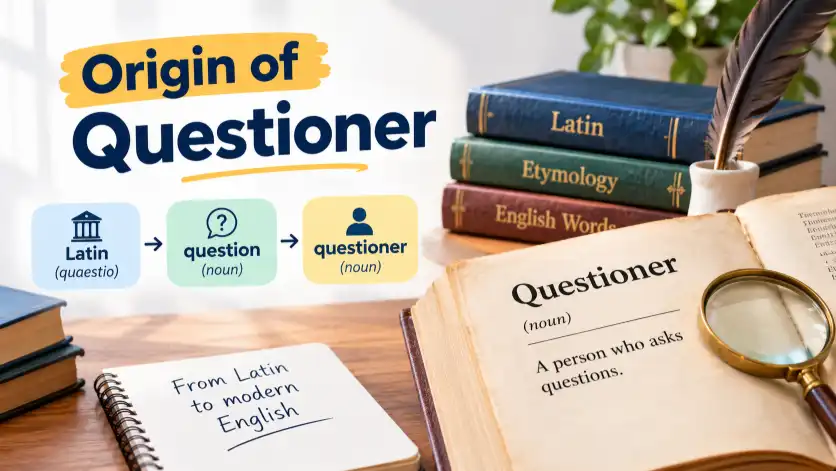
Questioner is formed from question + ,er.
The suffix ,er is commonly used in English to describe a person who performs an action.
For example:
- Run → runner
- Work → worker
- Teach → teacher
- Question → questioner
The word question itself has a long history in English and is connected to Latin and French forms related to asking or seeking information.
Over time, questioner became a natural English word for someone who asks questions.
Origin of Questionnaire
Questionnaire entered English from French.
The French word questionnaire refers to a set or series of questions used to obtain information. English adopted the word, especially in contexts involving surveys, research, and organized information gathering.
This explains why questionnaire has a spelling that looks different from the simpler English formation questioner.
Why Are the Spellings So Different?
The main reason is that the words were formed differently.
Questioner follows a common English pattern:
question + er
Questionnaire comes from a French,derived form.
Although both words are connected to question, their endings help create different meanings.
This is why questioner and questionnaire are not alternative spellings of the same word.
British English vs American English Spelling
Unlike some English words that have different British and American spellings, questioner and questionnaire are generally spelled the same in both varieties.
Questioner
American English:
The questioner asked about the results.
British English:
The questioner asked about the results.
The spelling remains questioner.
Questionnaire
American English:
The participants completed the questionnaire.
British English:
The participants completed the questionnaire.
The spelling remains questionnaire.
There is no standard British form such as questionaire, and questionaire is not the correct spelling in American English either.
British vs American Comparison Table
| Word | American English | British English | Meaning |
| Questioner | Questioner | Questioner | Person who asks questions |
| Questionnaire | Questionnaire | Questionnaire | Set of questions |
| Questioners | Questioners | Questioners | People who ask questions |
| Questionnaires | Questionnaires | Questionnaires | Multiple sets of questions |
Important Spelling Point
The biggest issue is not British versus American spelling. It is choosing the correct word.
If you mean a person, use questioner.
If you mean a form or set of questions, use questionnaire.
Correct:
The questioner asked a difficult question.
Correct:
The participants filled out the questionnaire.
Both spellings work in standard British and American English.
Questioner vs Questionnaire at a Glance
| Feature | Questioner | Questionnaire |
| Word type | Noun | Noun |
| Refers to | Person | Form or set of questions |
| Main action | Asks questions | Contains questions |
| Common use | Interviews and discussions | Surveys and research |
| Can a person be one? | Yes | No |
| Can it be completed? | No | Yes |
| American spelling | Questioner | Questionnaire |
| British spelling | Questioner | Questionnaire |
Remember: Questioner = the person asking. Questionnaire = the questions being answered.
Which Spelling Should You Use?
Choosing between questioner and questionnaire is not about choosing British or American English. Both words use the same spelling in major English varieties. The important thing is to understand what you want to describe.
Use “Questioner” for a Person
Use questioner when you mean someone who asks questions.
Examples:
- The questioner asked about the new policy.
- The questioner wanted more information.
- The questioner raised an important point.
Here, the word describes a person.
Use “Questionnaire” for a Form
Use questionnaire when you mean a group of questions that people answer.
Examples:
- Please complete the questionnaire.
- The researcher created a questionnaire.
- We sent the questionnaire to all participants.
Here, the word describes a form or set of questions.
Advice for US English Writers
American English writers should use:
- Questioner for a person
- Questionnaire for a set of questions
There is no need to change either spelling for American English.
Advice for UK and Commonwealth Writers
British and Commonwealth writers use the same standard spellings:
- Questioner
- Questionnaire
The meaning also stays the same.
Advice for Global English
For international readers, the simplest rule is:
Person → questioner
Form → questionnaire
This distinction is more important than regional spelling preferences.
Common Mistakes with Questioner or Questionnaire
Because the two words look alike, writers sometimes use one when they mean the other.
Mistake 1: “Questioner” Instead of “Questionnaire”
Incorrect:
Please complete the questioner.
Correct:
Please complete the questionnaire.
A person cannot normally be completed. A questionnaire can.
Mistake 2: “Questionnaire” Instead of “Questioner”
Incorrect:
The questionnaire asked the speaker about the issue.
Better:
The questioner asked the speaker about the issue.
The questioner is the person asking the question.
Mistake 3: Misspelling “Questionnaire”
A common spelling mistake is:
Questionaire ❌
The correct spelling is:
Questionnaire ✅
The word contains two n’s and ends with ,naire:
questionnaire
Mistake 4: Treating Them as Alternative Spellings
Some people think questioner and questionnaire are two spellings of the same word. They are not.
Compare:
The questioner asked five questions.
The questionnaire contained five questions.
The first refers to a person. The second refers to a set of questions.
Mistake 5: Using “Questioner” for Every Type of Person Who Asks Questions
Although questioner is correct, another word may be more specific depending on the situation.
For example:
- A person conducting an interview → interviewer
- A person asking questions in a survey → participant/respondent
- A journalist asking questions → journalist/reporter
- A person asking questions generally → questioner
The right choice depends on the exact context.
Questioner or Questionnaire in Everyday Examples
Understanding real,life examples makes the difference easier to remember.
In Emails
Questioner:
The questioner asked if the meeting would be recorded.
Questionnaire:
Please complete the customer questionnaire and return it by Friday.
The first sentence identifies the person asking. The second refers to a document.
In News Writing
Questioner:
The questioner asked the official to explain the decision.
Questionnaire:
Researchers used a questionnaire to collect responses from participants.
News and research writing may use both words, but their meanings remain different.
In Social Media
Questioner:
One questioner asked an interesting question during the live session.
Questionnaire:
We posted a questionnaire to learn what our followers think.
The first describes a user who asks a question. The second describes a survey tool.
In Academic Writing
Questioner:
The questioner requested further clarification from the researcher.
Questionnaire:
The participants completed a questionnaire before the experiment.
Questionnaire is especially common in academic and research contexts because researchers often use structured questions to collect data.
In Formal Writing
Questioner:
The questioner sought clarification about the report.
Questionnaire:
Each participant was asked to complete the questionnaire.
Both forms are grammatically correct when they match the intended meaning.
Questioner or Questionnaire : Google Trends & Usage Data
Search interest for questioner and questionnaire can differ because people use these words in different contexts.
Questionnaire is commonly connected with searches about surveys, research, feedback forms, customer studies, and data collection. These activities are used across education, business, research, and many other fields.
Questioner has a narrower meaning. Searches for this word are more likely to relate to the person asking questions, the meaning of the word, or a particular question,and,answer situation.
Usage by Context
| Context | More Relevant Word |
| Survey form | Questionnaire |
| Research study | Questionnaire |
| Customer feedback form | Questionnaire |
| Online survey | Questionnaire |
| Person asking questions | Questioner |
| Interviewer | Usually interviewer |
| Classroom discussion | Questioner |
| Public Q&A | Questioner |
Search popularity can change over time and may vary by country. Google Trends reflects search behavior, not if a word is grammatically correct.
For Wordslit readers, the practical lesson is more important than search volume: do not choose between these words based on popularity. Choose based on meaning.
Questioner vs Questionnaire : Comparison Table
| Feature | Questioner | Questionnaire |
| Basic meaning | A person who asks questions | A set of questions |
| Refers to | Person | Document, form, or tool |
| Used in surveys | Sometimes | Very common |
| Used in research | Yes, for the person asking | Very common |
| Can be completed? | No | Yes |
| Can contain questions? | No | Yes |
| Can ask questions? | Yes | It contains questions |
| Example | The questioner asked another question. | The questionnaire had 20 questions. |
| Plural | Questioners | Questionnaires |
| British spelling | Questioner | Questionnaire |
| American spelling | Questioner | Questionnaire |
Simple Rule to Remember
Think of the two words this way:
Questioner → Who asks?
Questionnaire → What do you answer?
For example:
Who asked the question? The questioner.
What did you complete? The questionnaire.
This simple distinction can help you avoid most mistakes.
FAQs About Questioner or Questionnaire
Q1: What is the difference between questioner and questionnaire?
A questioner is a person who asks questions, while a questionnaire is a set of questions used to collect information or responses.
Q2: Is “questioner” a correct English word?
Yes. Questioner is a correct English noun. It refers to someone who asks questions.
Example:
“The questioner asked the speaker for more details.”
Q3: Is “questionnaire” a correct English word?
Yes. Questionnaire is the standard word for a written or digital set of questions.
Example:
“Please complete the questionnaire before the interview.”
Q4: Should I say “complete the questioner” or “complete the questionnaire”?
You should say “complete the questionnaire.” A questionnaire is a form or set of questions that someone can complete.
Q5: What do you call a person who asks questions?
A person who asks questions can be called a questioner. Depending on the situation, a more specific word may also be suitable, such as interviewer for someone conducting an interview.
Q6: Is “questionaire” the correct spelling?
No. Questionaire is a common misspelling.
The correct spelling is:
Questionnaire ✅
Q7: Is questionnaire spelled differently in American and British English?
No. The standard spelling is questionnaire in both American and British English. Questioner is also spelled the same in both varieties.
Conclusion
Questioner and questionnaire are similar,looking words with different meanings. A questioner is a person who asks questions, while a questionnaire is a group or form of questions used to collect information. Understanding this difference will help you choose the right word in emails, reports, research papers, surveys, and everyday writing.
The easiest way to remember the difference is to connect questioner with a person and questionnaire with a form. For example, “The questioner asked a difficult question” refers to someone asking, while “The participant completed the questionnaire” refers to a set of questions.
Neither word has a major British,American spelling difference. The standard forms are questioner and questionnaire in both varieties of English. Also, remember that questionaire is incorrect; the correct spelling is questionnaire.
When unsure, ask yourself one simple question: Am I talking about the person asking, or the questions being answered? That will usually give you the correct choice.
Read More About !

“I’m Charlotte Vans, and I enjoy making grammar and word usage easier to understand. Through my writing, I help readers understand confusing words, improve spelling, and write with greater confidence.”








2 thoughts on “Questioner or Questionnaire: Meaning, Usage, and Examples”